
How to Measure Referral Retention Rate
Calculate and track referral retention rate using a clear formula, cohort analysis, and analytics tools to evaluate and improve your referral program.

Justin Britten

Referral retention rate shows how many referred customers stick with your product over time. It's a critical metric for understanding the quality of users your referral program attracts. Referred customers often stay longer, engage more, and generate higher revenue compared to those acquired through paid channels.
Key Formula:
To calculate referral retention rate, use this formula:
CRR = ((C₁ − ΔC) / C₀) × 100, where:
- C₀: Referred customers at the start of the period
- C₁: Total referred customers at the end of the period
- ΔC: New referred customers gained during the period
Example:
If you start with 500 referred customers (C₀), end with 520 (C₁), and gain 80 new referrals (ΔC), the retention rate is:
CRR = ((520 − 80) / 500) × 100 = 88%
Why It Matters:
Tracking this metric helps you evaluate the effectiveness of your referral program and refine strategies to attract loyal, high-value users. Pair it with other metrics like referral conversion rate, customer lifetime value, and referral revenue contribution for a complete picture.
Pro Tip: Use referral analytics tools like Prefinery to automate tracking and gain deeper insights into your referral program's performance.
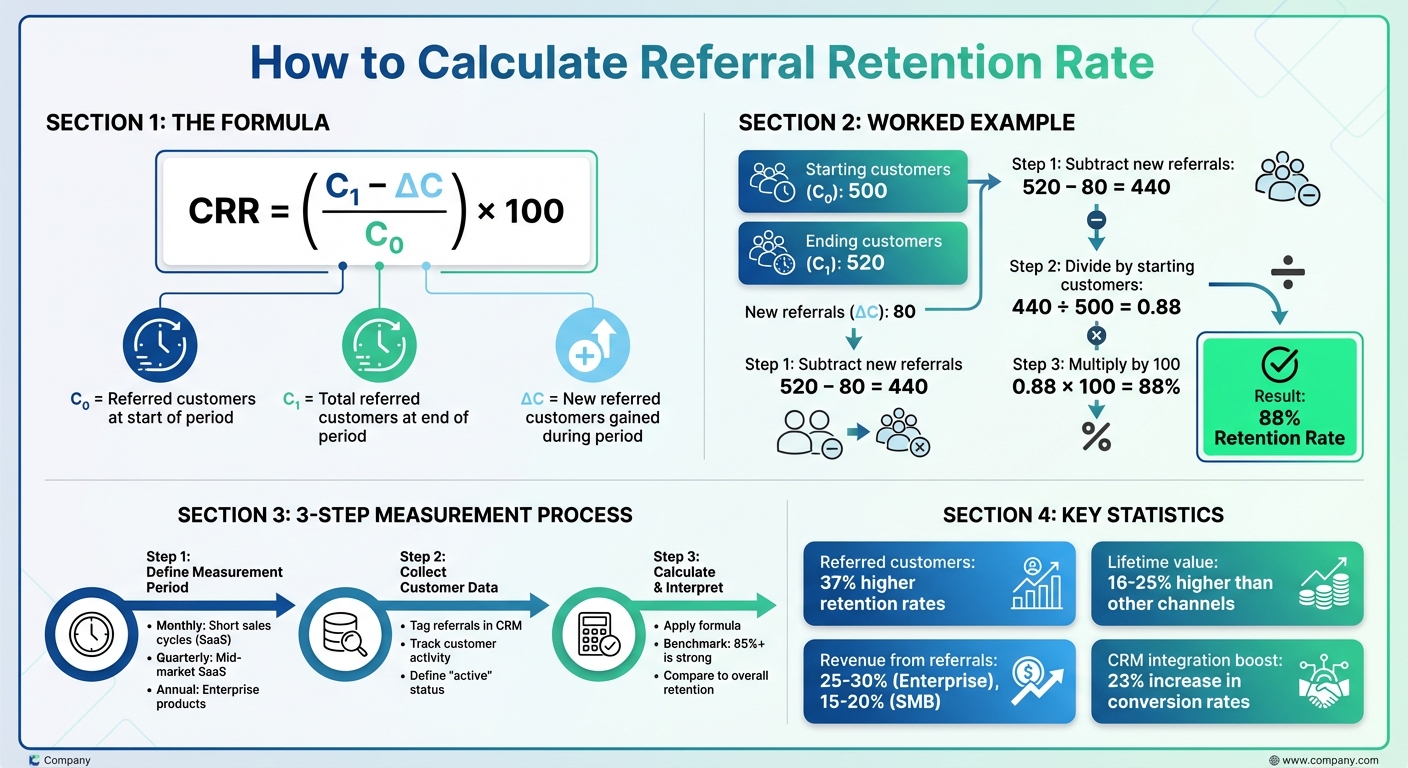
How to Calculate Referral Retention Rate: Formula and Step-by-Step Guide
The Referral Retention Rate Formula
The referral retention rate formula mirrors the structure of the standard customer retention rate (CRR), but it hones in exclusively on customers gained through referrals. Here's the equation: CRR = ((C₁ − ΔC) / C₀) × 100. Each part of the formula helps you zero in on how well you're retaining customers who came from referrals. This is a key metric when looking to scale SaaS referral programs effectively.
Formula Breakdown
Here’s what each component represents:
- C₀: The number of referred customers active at the start of the measurement period. This establishes your starting point.
- C₁: The total number of referred customers at the end of the period. This gives you the final tally before adjustments.
- ΔC: The number of new referred customers acquired during the period. Subtracting this value ensures that new referrals don’t skew your retention numbers.
The critical step here is subtracting ΔC from C₁. Without this adjustment, the formula would include new referrals, giving you an inflated retention rate. By isolating the original cohort, you get a more accurate view of how many of your initial referred customers stayed with you.
| Component | Definition | Purpose |
|---|---|---|
| C₀ | Referred customers at the start | Defines the initial group to track |
| C₁ | Total referred customers at the end | Captures the final count before adjustments |
| ΔC | New referred customers during the period | Removes the influence of new growth |
Example Calculation for SaaS
Let’s break it down with an example. Imagine your SaaS company starts the quarter on January 1 with 500 active referred customers (C₀). By March 31, you have 520 referred customers in total (C₁). Over the same period, you gained 80 new referred customers (ΔC).
Using the formula: CRR = ((520 − 80) / 500) × 100 = (440 / 500) × 100 = 88%.
This means your referral retention rate for Q1 is 88%. In other words, 12% of the customers you started with on January 1 churned during the quarter. The 88% retention rate reflects only the loyalty of your original referred customers - the 80 new referrals don’t affect this calculation.
How to Measure Referral Retention: Step-by-Step
To measure referral retention effectively, you need a structured approach that ensures your data is accurate, your time frames are consistent, and your results reflect the true performance of your referral program. Let’s break it down.
Step 1: Define the Measurement Period
The first step is to select a time frame that fits your business model and how your customers interact with your product. For example:
- Monthly tracking works well for SaaS products with short sales cycles, where catching retention issues early is crucial.
- Quarterly tracking is often a good fit for mid-market SaaS companies, offering enough data to identify trends without being overwhelmed by short-term fluctuations.
- Annual tracking aligns better with enterprise products that have longer sales cycles or annual contracts.
Consistency is critical. If you start with monthly tracking, stick with it to ensure your results are comparable over time. Also, match your measurement period to your billing cycle. For instance, if customers are billed annually, quarterly tracking might miss mid-cycle churn. Once you’ve defined your period, you can move on to gathering the data you need.
Step 2: Collect and Organize Customer Data
For each measurement period, you’ll need three key data points: C₀ (referred customers at the start), C₁ (total referred customers at the end), and ΔC (new referrals acquired during that time).
To make this process easier:
- Tag new sign-ups as "referred" in your CRM immediately and ensure this data is synced with your analytics tools.
- Track customer activity closely. If a referred customer cancels their subscription, downgrades to a free plan, or stops using the product altogether, count them as churned.
- Clearly define what "active" means for your business. It could be based on login frequency, feature usage, or ongoing payments.
Being consistent with these definitions ensures your calculations are reliable. With your data in hand, you’re ready to calculate retention rates.
Step 3: Calculate and Interpret the Results
Use the retention rate formula to compute your results: CRR = ((C₁ − ΔC) / C₀) × 100. A retention rate above 85% generally indicates a strong referral program, though this benchmark can vary depending on your industry and product.
But don’t stop at the number - compare your referral retention rate to your overall customer retention rate. If referred customers stick around longer than others, it’s a sign your viral referral program is attracting high-quality users. As Monetizely explains, "Referred customers generally convert at higher rates, improving CAC efficiency."
On the other hand, if your referral retention is lower, it could mean your incentives are attracting users who aren’t genuinely interested in your product. This insight can help you refine your referral criteria, adjust rewards, or enhance the onboarding process for referred customers. For new products, using a viral waitlist can help manage this influx while maintaining high engagement.
Additional Metrics to Track Alongside Retention Rate
While referral retention rate shows how well you're keeping referred customers, it doesn't tell the whole story. To get a clearer picture of your referral program's performance, you need to look at other important metrics. Let’s dive into three key ones that can help you better understand the program’s impact.
Referral Conversion Rate
This metric tells you what percentage of referred visitors actually become paying customers. It’s a way to measure how effective your referral program is at bringing in qualified leads.
To calculate it, divide the number of referred visitors who convert into paying customers by the total number of referred visitors, then multiply by 100. For instance, if 500 people were referred to your business and 75 of them made a purchase, your referral conversion rate would be 15%.
Keep in mind, conversion rates can vary depending on your business and audience. If your conversion rate is low but your retention rate is strong, it might mean your referral messaging or targeting needs tweaking to attract more relevant prospects. Optimizing your referral landing pages can also significantly boost these conversion rates.
Customer Lifetime Value of Referrals
Customer lifetime value (CLV) measures how much revenue a customer generates during their time with your business. When applied to referral customers, it can reveal whether your program is bringing in high-value users.
To find CLV, multiply your average revenue per customer by the average customer lifespan. Comparing the CLV of referred customers to non-referred ones can be eye-opening. For example, if referred customers have a CLV of $8,000 compared to $5,000 for non-referred customers, it’s clear your referral program is attracting more valuable users. This insight can help justify increasing your investment in referral rewards or marketing efforts.
Referral Revenue Contribution
This metric looks at the big picture - how much of your total revenue comes from referred customers. It’s closely tied to retention because referred customers often stick around longer, contributing more to your revenue over time.
For example, enterprise SaaS companies typically generate 25–30% of their revenue from referrals, while SMB SaaS companies see 15–20%. To calculate referral revenue contribution, add up all the revenue from referred customers over a specific period and divide it by your total revenue. If this percentage is growing consistently while your retention rate stays strong, it’s a clear sign that your referral program is making a meaningful impact on your bottom line.
Tools for Tracking Referral Retention
Referral Analytics Platforms Overview
Tracking referral retention manually through spreadsheets is a tedious and inefficient process. Referral analytics platforms take over the hard work, automating data collection and analysis so you can focus on actionable insights. These tools integrate with your existing tech stack, pulling customer data to segment referred users by signup date and measure how their retention compares to other acquisition channels.
One key feature of these platforms is cohort analysis, which groups referred users based on when they signed up. This allows you to directly compare their retention rates to non-referred users over time. Most platforms use a first-touch attribution model with a 30–90 day cookie window to ensure the original referrer gets credit. Companies that integrate referral data with their CRM often see a 23% boost in conversion rates, underscoring the importance of seamless integration.
Another valuable feature is the ability to A/B test different referral incentive models, such as comparing dual-sided rewards (where both referrer and referee benefit) to one-sided rewards. This helps refine strategies for improving retention, not just driving signups. Among the available platforms, Prefinery stands out for its ease of use and comprehensive features.
Why Prefinery Is the Better Choice

Prefinery sets itself apart by offering no-code integration, making setup quick and hassle-free. In just minutes, you can start tracking referral retention and other critical metrics. The platform provides detailed analytics that let you segment users by cohort, monitor churn rates, and pinpoint which referral sources bring in the most loyal customers.
One of Prefinery's standout features is its viral waitlist system, which not only tracks retention but also creates engaged prelaunch communities. By encouraging users to climb the waitlist through referrals, the system fosters early investment in your product. This enthusiasm often leads to better retention once users convert.
Prefinery also excels in handling attribution, automating reward delivery for verified conversions, and allowing you to test various incentive structures - all without requiring any coding. With plans starting at $69 per month and a 14-day free trial, Prefinery delivers powerful analytics tailored for SaaS startups. It’s a cost-effective solution that eliminates complexity while supporting your growth strategy.
Conclusion
The referral retention rate is a powerful indicator of how well your referral program performs over time. Referred customers tend to have 37% higher retention rates and a 16-25% higher lifetime value compared to customers acquired through other channels. These figures highlight that referrals don’t just bring in more users - they attract the right users who stay loyal and contribute more revenue in the long run. By consistently monitoring this metric, you can pinpoint what's working and identify areas for improvement. Looking at SaaS referral program examples can provide inspiration for these optimizations.
To recap, retention rate is calculated by dividing the number of active referred customers at the end of a period (excluding new sign-ups) by the size of the initial cohort, then multiplying by 100. The key lies in tracking this consistently, comparing different cohorts, and analyzing patterns to uncover actionable insights.
However, relying on manual tracking methods can slow down progress. Using referral analytics platforms to automate and optimize your program simplifies the process by automating data collection, offering detailed cohort analysis, and integrating smoothly with your existing tools - making it easier to act on the insights that drive growth.
FAQs
What counts as an “active” referred customer?
An “active” referred customer is a person who has been referred to a product or service, started using it, and continues to engage with it during a defined period. This status is typically measured by factors such as completing onboarding, consistent usage, or maintaining a subscription over time (e.g., 30 days, 6 months, or even a year). It highlights their continued interaction and alignment with the product's value.
How do I choose the right retention time period?
The best retention time frame depends on what you’re aiming to achieve and the type of product you offer. Typical choices include monthly, quarterly, or yearly, and the right one often ties directly to how often customers engage with your product.
For products with frequent usage, a monthly retention period tends to offer the most relevant insights. On the other hand, if your product has a longer usage cycle, such as seasonal services or annual subscriptions, quarterly or yearly retention data might be more meaningful.
The key is to pick a time frame that matches your customer lifecycle and aligns with your business goals. This way, you’ll gather retention data that’s not only relevant but also actionable.
How can I track referral retention automatically?
To keep an eye on referral retention without the hassle, a referral tracking system is your best bet. Tools like Prefinery can do the heavy lifting by generating unique referral links, syncing with CRMs and payment systems, and tracking essential metrics like engagement and renewal rates.
You can also automate workflows at critical points - like when a referral signs up or reaches a certain milestone. Pair that with cohort analysis to spot trends or pinpoint early signs of churn. Together, these strategies simplify tracking and give you insights to fine-tune your referral program for long-term success.