
Product Launch Strategy: Waitlist First, Ship Second
A waitlist-first product launch strategy builds your audience before you ship — here's how to structure one that generates real signal and demand.

Justin Britten
- Why Most Product Launch Strategies Fail Before Launch Day
- What "Waitlist First" Actually Means
- Waitlist as Validation, Not Just Accumulation
- How Long Should a Waitlist Stay Live?
- Structuring a Waitlist That Generates Real Signal
- When to Keep Building Versus Open Access
- The Infrastructure Question
- After the Waitlist: Converting Signups Into Customers
- Frequently Asked Questions
- Ship to an Audience, Not Into a Void
Most founders treat a product launch as the moment everything begins. Build the product, announce it, hope people show up. That approach has a well-documented failure rate. Searchlab's 2026 research puts it plainly: 90% of new products fail within two years. The same report found that 72% of companies have no formal go-to-market strategy at all.
Those two numbers are not unrelated.
This article is about a different approach: building your audience before you ship, using a waitlist as a deliberate mechanism rather than a holding page. It covers why the waitlist-first model works, how to structure one that generates real signal, and what to do with the list once you are ready to open access.
Why Most Product Launch Strategies Fail Before Launch Day
The standard narrative blames poor execution on launch day itself. Wrong channel, wrong message, bad timing. But most launches are lost weeks or months earlier, when teams spend every sprint on product and zero time on audience.
Toolradar Research's B2B SaaS GTM 2026 report, which analyzed 9,024 tools, found that 92% of B2B SaaS launches had no tracked discovery channel coverage. The vast majority of products shipped into a vacuum — no press, no community, no warm audience, no referral loop. Just a landing page and a hope.
The result is predictable. NIQ's 2026 analysis of more than 3,500 new brands and sub-brands launched across five European countries in 2025 found that only one third of those launches reached 1% of households. Distribution, not product quality, was the differentiator.
A waitlist-first product launch strategy addresses this directly. Instead of scrambling to build an audience after you ship, you build it while you build.
What "Waitlist First" Actually Means
A waitlist-first strategy is not about delaying your launch indefinitely. It is about separating audience building from product delivery and treating both as real work.
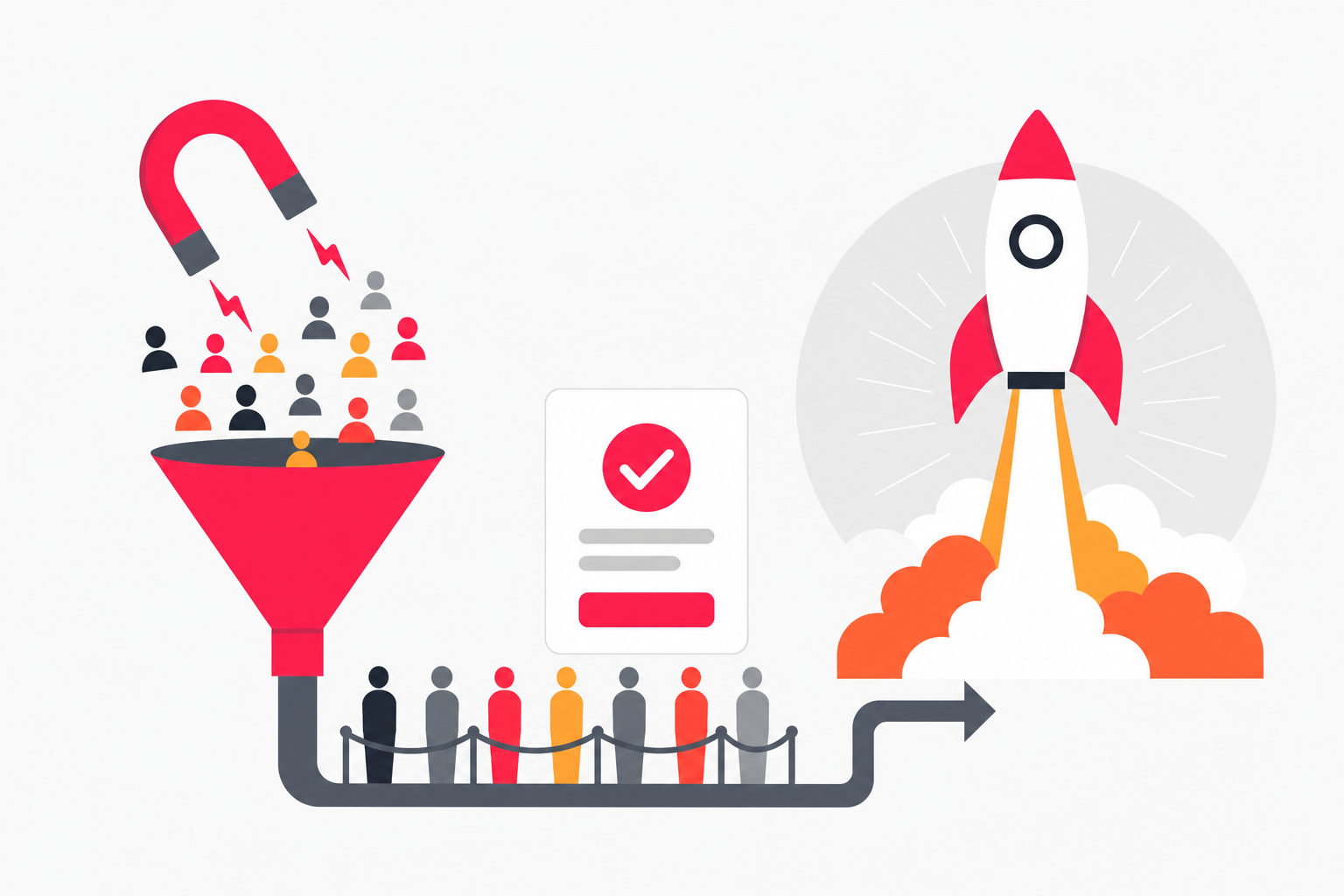
The mechanics are straightforward. You put up a signup form before the product is ready. Every person who signs up gets a unique referral link. They share that link to earn rewards or move up the queue. Their friends sign up, get their own links, and the loop continues. By the time you ship, you have a warm, self-selected audience with social proof already baked in.
This is the model Robinhood and Superhuman used to generate massive pre-launch demand. Queue scarcity gave people a reason to share. The referral link made sharing easy and trackable.
The key distinction from a basic email capture page: a waitlist with referral mechanics is an active growth channel, not a passive list. Every signup has the potential to generate more signups — without paid ads or a single engineering sprint.
Waitlist as Validation, Not Just Accumulation
Here is where most founders miss the point. They treat waitlist size as the goal. It is not. Waitlist size is a vanity metric unless you understand what it is telling you.
A well-structured waitlist teaches you things a survey never will:
Who actually wants this. People who sign up and then share the link are not just curious — they are motivated enough to take action. That behavioral signal is more reliable than any stated preference.
Which use case resonates. If you run campaigns for different segments, you can see which framing drives more signups and more referrals. That is pricing and positioning research disguised as audience building.
What your top-of-funnel copy needs to say. The words people use when sharing your referral link, or the questions they ask in reply emails, reveal how they describe the problem to their peers. Those are the words your launch messaging should use.
How engaged your list actually is. Open rates on triggered emails, referral activity per signup, and queue position competition all tell you whether you have built genuine anticipation or just collected addresses.
The difference between 5,000 engaged advocates and 5,000 cold signups is enormous. Measure referral activity and email engagement, not just total signups.
How Long Should a Waitlist Stay Live?
There is no universal answer, but there is a useful framework. Keep the waitlist live until you have three things: enough signups to form a meaningful first cohort, enough referral activity to confirm the loop is working, and enough behavioral signal to inform your onboarding and messaging.
For most early-stage SaaS or fintech products, that window is somewhere between four and twelve weeks. Shorter than four weeks and the referral loop has not had time to compound. Longer than twelve weeks without a clear ship date and conversion interest starts to decay — people forget why they signed up.
Triggered emails help manage that decay risk. A well-timed sequence that reminds people why they signed up, shows them their queue position, and updates them on progress keeps the list warm. But even the best email sequence cannot hold attention indefinitely. Set a target date, even an approximate one, and communicate it.
If your list engagement starts dropping before you are ready to ship, take that seriously. Either accelerate your timeline, open an early access tier, or be honest with your list about the delay.
Structuring a Waitlist That Generates Real Signal
The mechanics of a strong waitlist campaign are simpler than most founders expect. Here is what matters:
Referral incentives tied to behavior, not just signup
A reward for signing up is a lead magnet. A reward for referring three friends is a growth mechanic. The distinction changes who participates. People who share to earn something are demonstrating intent. Design your reward rules around referral actions, not passive registration.
Queue position as a motivator
Telling someone they are number 847 in the queue — and that referring two friends will move them into the top 100 — creates urgency without paid ads. It also gives people a personal reason to share, not just an altruistic one. They share because it helps them.
A branded form that matches your product's look and feel
Your waitlist is the first product experience many people will have. A generic form with someone else's branding undermines the impression you are trying to create. Full control over HTML and CSS, and white-label options that remove third-party branding, matter here.
Triggered emails at the right moments
Confirmation on signup, a nudge when their position changes, an update when you hit a milestone. These are not newsletters. They are contextual touchpoints that keep the waitlist feeling alive.
Analytics that show you who your advocates are
Not all signups are equal. The person who referred twelve friends in the first week is a different kind of early adopter than someone who signed up and never opened an email. Knowing who your top advocates are before launch lets you give them early access, ask for feedback, or build a beta cohort from the people most likely to stick around.
When to Keep Building Versus Open Access
This is the decision most waitlist guides skip. You have a list. When do you ship?
A few decision rules that hold up in practice:
Open access when your referral loop is still active. If people are still sharing and moving up the queue, you have momentum. Opening access while that momentum exists means your first cohort arrives with social context already established.
Keep building if your core use case is still unclear. If your top referrers are sharing for completely different reasons, you do not yet know what your product means to the market. That is worth resolving before you onboard a thousand people who expect different things.
Consider a staged rollout if your infrastructure is not ready for full scale. Invite your top advocates first. They are the most forgiving early users and the most likely to give you useful feedback. Use the waitlist analytics to identify them.
Do not wait for perfection. OpenHunts' 2025 report found that only about 40% of tech products hit their launch goals, with SaaS products reaching a 45% success rate. The ones that succeed tend to ship earlier than they feel ready, not later.
The Infrastructure Question
Most early-stage teams cannot afford to spend engineering time on waitlist tooling. Building a custom referral system with unique links, queue logic, reward tracking, and email triggers is weeks of work — weeks not spent on the product itself.
This is exactly why purpose-built tools exist for this moment. Prefinery is designed specifically for pre-launch viral waitlists: every signup gets a unique referral link automatically, queue position advances through referrals, and the whole thing runs without any engineering work from your team. You configure the reward rules, embed the form, and the referral loop runs on its own.
Teams like Woodpecker, GitKraken, and Geckoboard have used it to build pre-launch audiences across SaaS and fintech verticals. The platform connects to Zapier, Make, HubSpot, Mailchimp, Stripe, and more than 30 other tools, so it fits into whatever stack you are already running.
API and webhook access are available on the Essentials plan and above. White-label — which removes Prefinery branding from your forms and emails — is also available from Essentials upward.
After the Waitlist: Converting Signups Into Customers
Building the list is the first half of the job. Converting it is the second.
Your launch day email to the full list is not a marketing message. It is the fulfillment of a promise. People signed up because they wanted access. Give it to them clearly, quickly, and with context about what comes next.
Segment your onboarding based on what the waitlist data showed you. Your top referrers deserve a different welcome than someone who signed up the day before launch. Your most engaged email openers are candidates for a feedback loop. Your least engaged signups need a stronger hook in the first product experience.
The data you collected is not just a list of names. It is a segmentation tool, a positioning test, and an early indicator of which users are most likely to become long-term customers. Use it that way.
Frequently Asked Questions
What is a waitlist-first product launch strategy?
A waitlist-first strategy means building your audience before your product ships, using a signup form with referral mechanics to grow a warm, self-selected list. Instead of launching into a vacuum, you arrive on launch day with an engaged audience that already has social proof built in.
How is a viral waitlist different from a simple email capture page?
A basic email capture page collects addresses passively. A viral waitlist gives every signup a unique referral link and ties rewards or queue position to sharing that link. This turns each signup into a potential growth channel rather than a static entry in a spreadsheet.
How do you measure whether a waitlist is generating real buying intent?
Look at referral activity per signup, email open and click rates on triggered messages, and whether people are actively competing for queue position. Passive signups with no referral activity are weaker signal than signups who share immediately and track their position.
How long should a pre-launch waitlist stay live before you ship?
Most early-stage products benefit from four to twelve weeks of active waitlist time. Shorter than four weeks and the referral loop has not had time to compound. Beyond twelve weeks without a clear ship date, engagement tends to decay even with good email sequences.
When should you open early access instead of waiting for a full launch?
Open early access when your referral loop is still active and you have enough signups to form a meaningful first cohort. Prioritize your top advocates — identified through referral and engagement analytics — as your first users.
Do you need engineering resources to run a viral waitlist?
Not if you use a purpose-built tool. Platforms like Prefinery handle referral link generation, queue logic, reward tracking, and triggered emails without any custom development. Your dev team stays focused on the product.
What should you do with waitlist data after you launch?
Use it to segment your onboarding. Top referrers, highly engaged email openers, and early signups each represent different levels of intent and different onboarding needs. The behavioral data from your waitlist is more useful than most post-launch surveys.
Ship to an Audience, Not Into a Void
A product launch strategy that starts on launch day starts too late. The teams that consistently hit their launch goals treat audience building as product work, not a marketing afterthought.
A waitlist with real referral mechanics, clear incentives, and triggered communication is not a delay tactic. It is a validation mechanism, a distribution channel, and an early signal about what your market actually wants. By the time you ship, you should already know who your best early users are, what language resonates with them, and which use case is driving the most organic sharing.
That is a stronger position to launch from than any paid campaign can buy you.
If you are preparing to launch within the next 30 to 90 days and want to build that kind of audience, learn more at prefinery.com.