
Founder-Led Marketing: Build Your Waitlist Before Funding
Founder-led marketing lets you build a waitlist before you have a product or funding. Here's the exact sequence that turns visibility into signups.

Justin Britten
- What Founder-Led Marketing Actually Means
- Why It Works Before You Have a Product
- The Channels That Work for Pre-Launch Founders
- What to Post When You Have No Product Yet
- Turning Founder Attention Into an Owned Asset
- The Sequence That Works
- What This Looks Like for Investors
- Avoiding the Bottleneck Problem
- Measuring What Actually Matters
- Frequently Asked Questions
- Start Before You're Ready
Most founders wait until they have a product, a pitch deck, and a term sheet before they start talking publicly. That's backwards. The founders who raise faster, launch stronger, and convert better are the ones who started building an audience months before any of that existed. Founder-led marketing is how they did it, and a pre-launch waitlist is the asset it produces.
This article covers the specific sequence: how to show up as a founder before you have a product, how to turn that visibility into real email signups, and how to use a waitlist to validate demand in a way that actually moves investors.
What Founder-Led Marketing Actually Means
Founder-led marketing isn't about personal branding for its own sake. It means the founder, not a marketing team or a brand account, is the primary voice building trust and attention in the market.
That distinction matters because people trust people. A post from a named founder explaining a real problem they've lived through reads differently than a company account announcing a feature. The emotional signal is different. The credibility is different.
According to MHI Growth Engine's 2026 analysis of $50 million in ad spend across more than 200 direct-to-consumer brands, founder-led content outperformed brand content by 31% in return on ad spend, 42% in click-through rate, and 68% in trust metrics. Those aren't marginal differences. They reflect a structural advantage that founders at the pre-product stage can use without spending anything.
Why It Works Before You Have a Product
When there's no product to show, founders often go quiet. That's the wrong instinct.
The pre-product stage is actually when founder-led marketing is most powerful. You're not selling anything yet, so the content doesn't read as promotional. You're sharing what you're learning, what problem you're obsessing over, and why existing solutions fall short. That kind of content builds genuine credibility with exactly the people who will eventually want what you're building.
It also builds a relationship before the ask. By the time you launch a waitlist or open a beta, the people who've been following your thinking already feel like they know you. Converting a follower into a signup is dramatically easier when that trust already exists.
The Channels That Work for Pre-Launch Founders
You don't need to be everywhere. You need to be consistent in one or two places where your target audience actually spends time.
LinkedIn is the default for B2B founders. Thought leadership posts, problem framing, and "here's what I'm building and why" content performs well there. The professional context also makes it easier to attract a relevant audience rather than a general one.
X (formerly Twitter) works well for founders building in public, especially in tech. The format rewards short, sharp observations and lets you engage directly with potential users, investors, and journalists in the same thread.
Reddit and niche communities are underused. If your target audience congregates in a specific subreddit or Slack group, showing up as a knowledgeable participant, not a promoter, can generate early signups that no paid channel can match.
The key principle: pick the channel where your future users already are, not the one where you feel most comfortable.
What to Post When You Have No Product Yet
The content categories that work before launch are more specific than most founders expect.
Problem documentation. Write about the problem you're solving in granular detail. Share what you're hearing in research conversations. Quote the frustrations real people have expressed. This content attracts exactly the people who have the same problem.
Contrarian takes. If the conventional wisdom in your space is wrong, say so and explain why. This generates engagement and signals that you understand the market at a level most people don't.
Behind-the-scenes process. Sharing what you're testing, what failed, and what surprised you builds trust faster than polished announcements. People root for founders they've watched work through something real.
Audience questions. Ask your followers what they currently use to solve the problem you're working on. Ask what they hate about it. This is free customer research that also signals you're building something worth waiting for.
Turning Founder Attention Into an Owned Asset
Social reach is borrowed. Email is owned. The goal of every piece of founder content is to move people off the platform and onto a list you control.
This is where a waitlist becomes the strategic asset. Instead of pointing followers to a generic "coming soon" page, you give them a reason to sign up: early access, a better queue position, or a reward for bringing friends. The waitlist converts passive followers into active, identified prospects.
With Prefinery, every person who joins your waitlist gets a unique referral link automatically. When they share it, their friends join the list and the original signup moves up in the queue. The referral loop runs without any manual effort on your part. You're not just collecting emails — you're building a self-amplifying audience.
This matters for founder-led marketing specifically because your early content audience is warm. They already trust you. When you give them a referral mechanism, they share it with people who trust them. The quality of signups compounds.
The Sequence That Works
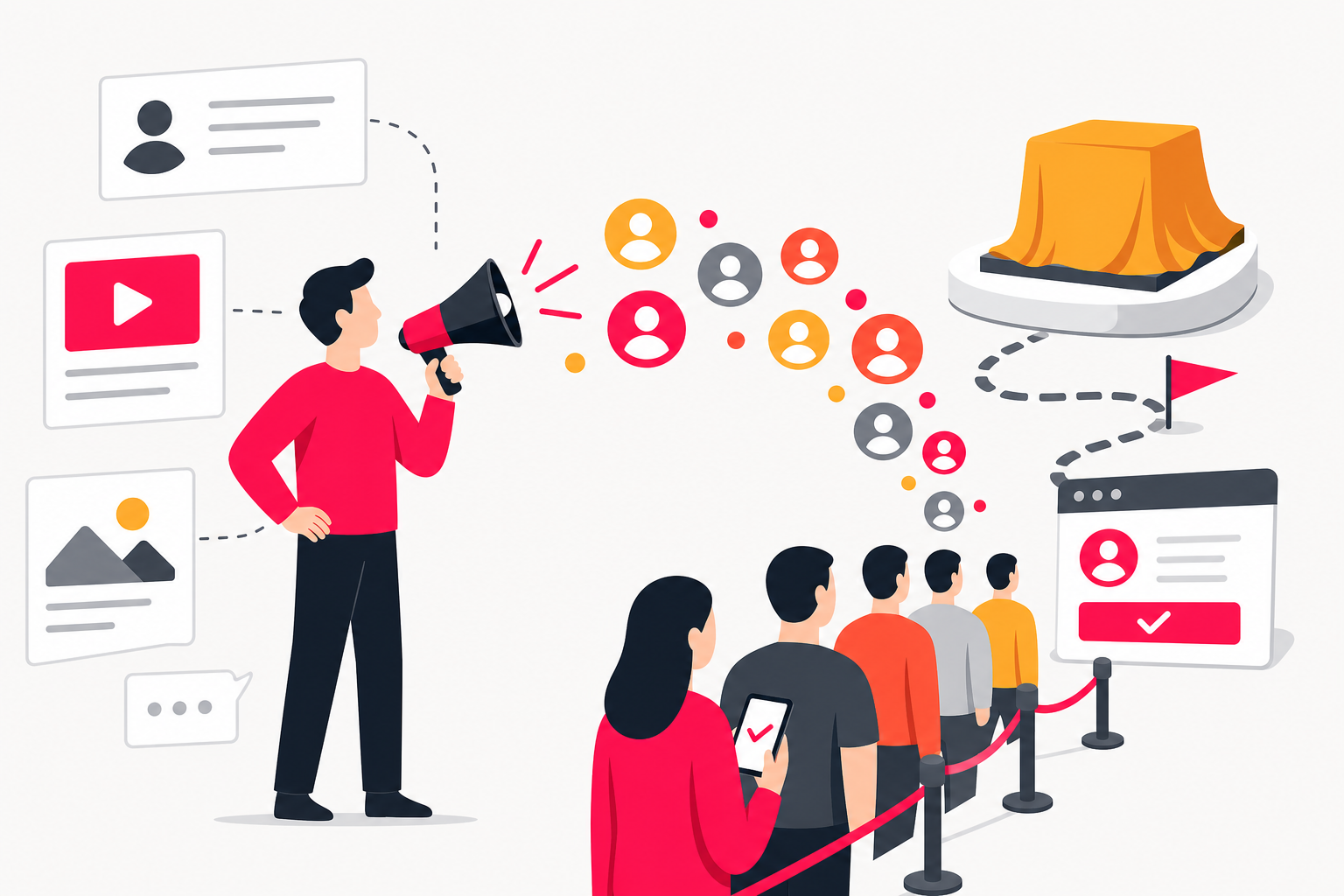
Most founders treat content and waitlist as separate activities. The founders who build the strongest pre-launch audiences treat them as one system.
Here's the sequence:
- Start with problem content. Spend four to six weeks publishing about the problem, not the solution. Build an audience around the pain point, not your product.
- Introduce the waitlist. Once you have an engaged following, launch the waitlist with a clear value proposition. What do early signups get? Why does it matter to join now?
- Create a referral loop. Use a tool that automatically assigns referral links and rewards signups for bringing others. The waitlist grows while you keep publishing.
- Use signups as social proof. "We've had 2,000 people join the waitlist" is a fundraising signal — and it's also content. Post about it. It reinforces momentum and attracts more signups.
- Qualify the list. Ask waitlist members questions. Survey them. Find out who has the sharpest pain, who has budget, who would pay on day one. This turns a list of emails into a validated demand signal.
What This Looks Like for Investors
Founders who walk into a seed or pre-seed meeting with several thousand engaged waitlist signups have a fundamentally different conversation than those who don't.
A waitlist is evidence of demand. Not hypothetical, not a survey — it's people who gave you their email address and, in many cases, referred their friends. That's a behavioral signal, and investors read it clearly.
It also shows that the founder can build distribution, not just a product. Many early-stage investors bet as much on a founder's ability to acquire customers as on the product itself. A functioning referral waitlist is proof of that ability.
The fundraising narrative writes itself: "We haven't launched yet, and we already have X people waiting to use this."
Avoiding the Bottleneck Problem
One real risk in founder-led marketing is that everything runs through one person. If the founder stops posting, the engine stops.
The answer isn't to hand it off — founder-led marketing only works because it's genuinely founder-led. But you can build systems around it. Batch content creation into one or two sessions per week. Repurpose long-form posts into shorter ones. Keep a simple editorial calendar so you're never starting from a blank page.
The waitlist solves part of this problem too. Once the referral loop is running, the list grows even when you're not actively posting. Content drives the initial signups; the referral mechanism drives the rest.
Measuring What Actually Matters
Follower count is a vanity metric at the pre-launch stage. The numbers worth tracking are:
- Waitlist signups per week, and the trend over time
- Referral rate: what percentage of signups are coming from referrals versus direct
- Email open rates on any waitlist updates you send
- Survey response quality: are the people on your list the ones with the sharpest pain?
These metrics tell you whether your founder-led content is reaching the right people and whether those people care enough to act. Post engagement is a leading indicator. Signups are the conversion that counts.
Frequently Asked Questions
What is founder-led marketing?
Founder-led marketing means the founder, rather than a brand account or marketing team, is the primary voice building trust and audience in the market. It relies on the founder's personal credibility, direct experience with the problem, and authentic communication to attract potential customers and investors.
Why does founder-led marketing work better than brand marketing at the pre-launch stage?
Before a product exists, there's nothing for a brand account to credibly promote. A founder talking about the problem they're solving, the research they're doing, and the thinking behind their decisions builds genuine trust. People connect with people, not logos — especially when no product has been proven yet.
Which platforms should a pre-launch founder focus on?
It depends on where your target audience spends time. LinkedIn works well for B2B founders. X works for founders building in public within tech communities. Niche forums, subreddits, and Slack groups can be highly effective when your audience is concentrated there. Pick one or two and be consistent rather than spreading thin across many.
How do I turn my founder audience into waitlist signups?
Every piece of content should have a clear next step that moves people off the platform and onto your list. A waitlist with a referral mechanism — like the one Prefinery provides — gives followers a reason to sign up and share. The combination of founder trust and a referral reward turns passive followers into active, identified prospects.
What should I post before I have a product to show?
Focus on the problem, not the solution. Document what you're learning through customer research. Share contrarian takes on why existing solutions fail. Post behind-the-scenes updates on what you're building and why. Ask your audience about their current frustrations. This content attracts the right people and builds credibility before you have anything to demo.
How does a waitlist help with fundraising?
A waitlist is behavioral evidence of demand. People who gave you their email address and referred friends are showing genuine interest, not just answering a survey. Walking into a seed meeting with thousands of engaged waitlist signups demonstrates that you can build distribution and that real people want what you're building.
How do I avoid becoming a bottleneck in my own founder-led marketing?
Batch your content creation so it doesn't require daily effort. Repurpose posts across formats. Use an editorial calendar to stay consistent without starting from scratch each time. A referral-based waitlist also helps — once the loop is running, the list grows even when you're not actively posting.
Start Before You're Ready
The founders who build the strongest pre-launch momentum aren't the ones with the most polished brand. They're the ones who started talking about the problem before they had a solution, built an audience around that problem, and then gave that audience a way to signal their interest through a waitlist.
Founder-led marketing isn't a tactic you add after the product is built. It's the strategy you run before it exists. The waitlist is the proof of concept that makes everything else — the launch, the fundraise, the first customers — easier.
If you're at the pre-launch stage and want a referral waitlist that runs itself, Prefinery is built for exactly this.