
ROI Calculation Checklist for Referral Campaigns
Measure true profitability of your referral program by tracking referral revenue, all costs, CAC, and CLV for actionable ROI.

Justin Britten
Want to know if your referral program is profitable? Calculating ROI is the only way to find out. Here's the formula:
ROI = (Referral Revenue – Total Costs) ÷ Total Costs × 100
To get it right, you need to:
- Track revenue from referred customers (including upsells and recurring payments).
- Account for all program costs - rewards, software, marketing, and admin expenses.
- Measure key metrics like conversion rates, participation, and referral CAC.
- Compare referred customer lifetime value (CLV) to costs for long-term insights, following referral program best practices to maximize retention.
Example: If your program generates $80,000 in revenue and costs $10,000, your ROI is 700%.
The article breaks down every step - including common mistakes, tools to automate and optimize your program, and how to benchmark against other marketing strategies.
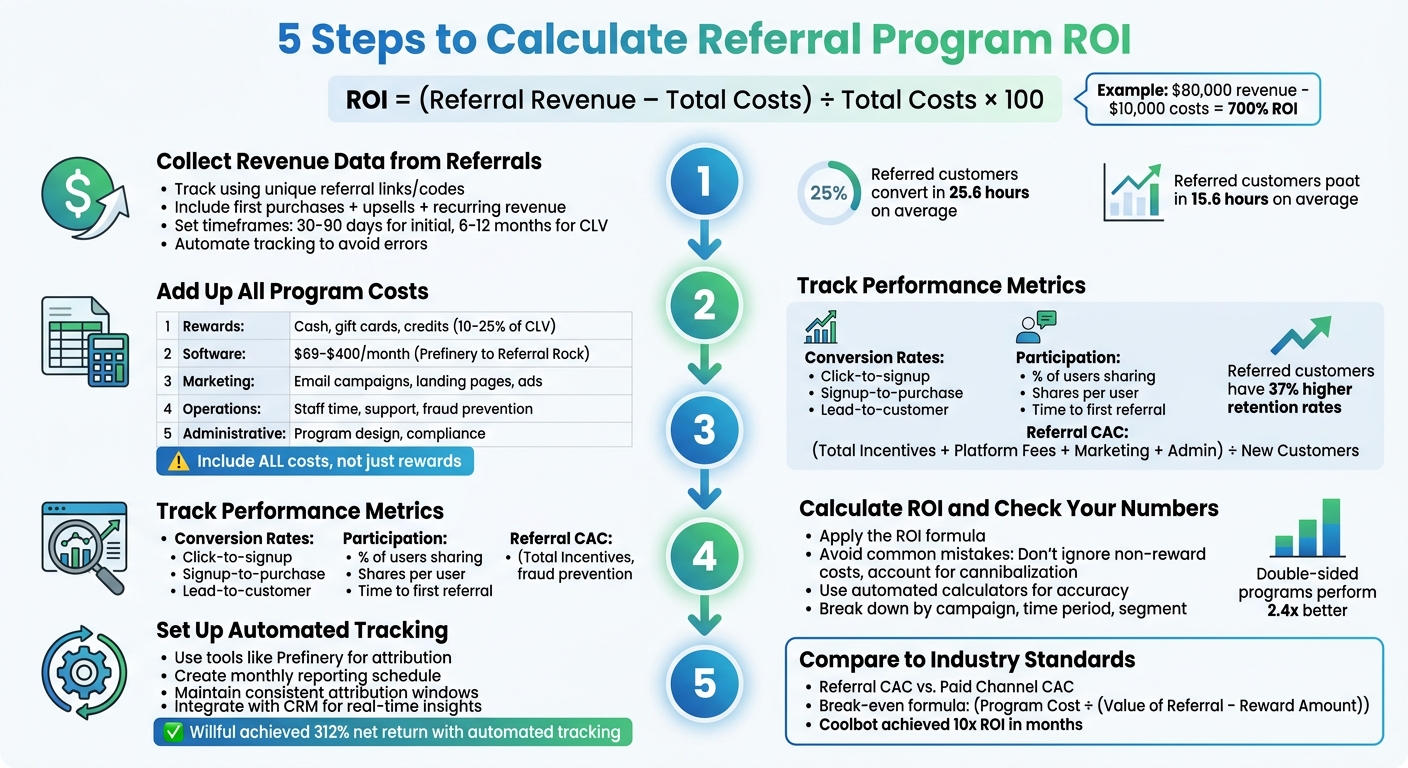
5-Step ROI Calculation Process for Referral Programs
Step 1: Collect Revenue Data from Referrals
To understand how much revenue your referral program generates, track referred customers using unique referral links or codes. These tools automatically tag every referred customer in your system, making it easier to capture the revenue they bring in.
Be thorough - track everything from their first purchase to upsells, cross-sells, and recurring subscription revenue. As Jessica Paluzzi, CMO at Referral Factory, explains:
"Referral-Generated Revenue... should account for not just their first purchase, but any upsells, cross-sells, or recurring revenue".
Referred customers often stick around longer and are more likely to upgrade their plans, which adds to their value.
To streamline this process, automate your tracking. Avoid relying on manual spreadsheets, which can be time-consuming and prone to errors. Instead, use specialized software to monitor every step of the referral journey - from the initial share to long-term retention. This will also help you identify where drop-offs occur.
Set specific timeframes for measuring conversions. For example, track initial purchases within a 30–90 day window, but extend your analysis to 6–12 months to capture ongoing value. Make sure your referral platform integrates with your CRM so you can link referrals directly to accounts and pipelines. And don’t forget to flag fraudulent activity - automated tools can help detect issues like self-referrals, duplicate accounts, or suspicious behavior.
By following these steps, you’ll ensure accurate revenue attribution, which is essential for evaluating your program’s ROI.
Add Customer Lifetime Value (CLV) to Your Calculations
For a more complete picture of your referral program’s ROI, factor in Customer Lifetime Value (CLV). CLV represents the total revenue a customer generates over their entire relationship with your business. This is especially important for SaaS and fintech companies with recurring revenue models. For instance, a customer paying $50 per month for three years contributes about $1,800.
Incorporating CLV into your calculations not only helps you estimate future earnings but also determines how much you can spend on referral rewards. If referred customers have a higher CLV than those acquired through other channels, it makes sense to invest more in your referral program. This way, you can grow your program without sacrificing profitability.
Step 2: Add Up All Program Costs
To figure out the true ROI of your referral program, you need to account for every dollar spent - not just the rewards. Many companies focus solely on the incentives but forget about software fees, marketing efforts, and administrative overhead. Tracking these costs is just as important as measuring revenue.
As Jessica Paluzzi, CMO at Referral Factory, explains:
"If you aren't measuring referral ROI, you can't accurately judge profitability, efficiency, or customer value".
Create a detailed expense list that includes both one-time setup costs and ongoing monthly charges. This should cover everything - rewards for referrers and referees, software subscriptions, promotional efforts, and team hours spent managing the program. Missing even one category could skew your ROI analysis. Break down these expenses into key areas like reward payouts, platform fees, and marketing and administrative costs.
Calculate Referrer and Referee Reward Costs
Reward payouts are often the largest expense in a referral program. If you offer double-sided rewards - where both the referrer and the referee get something - make sure to calculate both sides. For example, if you give $10 to each party and generate 100 conversions, your total reward cost would be $2,000.
For fixed rewards, multiply the reward amount by the number of conversions. For percentage-based discounts, convert them into dollar amounts based on the purchase price. If you’re running a subscription-based business, calculate the discount over its applicable duration. For instance, offering $5 off per month for 12 months to both parties would cost $120 per referral.
A practical guideline is to keep total reward costs between 10% and 25% of Customer Lifetime Value. This ensures incentives remain impactful while maintaining profitability. Also, consider your redemption rate - not everyone who receives a reward will redeem it. Calculate costs based on actual redemptions rather than just issued rewards for a clearer picture.
Include Platform and Software Fees
Don’t forget to include subscription costs for your referral program platform. These fees can add up quickly, especially as your program grows. For instance, Prefinery starts at $69/month, while Referral Rock can cost around $400/month. Some platforms also charge setup fees, API access costs, or integration expenses.
When evaluating platforms, consider more than just the subscription price. Features like automated attribution (using unique referral links), CRM integration, and fraud prevention tools can significantly reduce manual work. Prefinery, for example, automates these tasks, saving time and lowering operational costs. Choosing a platform that handles these functions can streamline your program and free up your team’s resources.
Add Marketing and Administrative Expenses
Beyond rewards and software, you’ll also incur marketing and operational costs. These might include email campaigns to promote the program, landing page designs, social media ads, and any creative assets you develop. Keep these expenses separate so you can assess which promotional efforts deliver the best results.
Administrative tasks can also be a hidden but significant cost. This includes the time your team spends coordinating the program, approving rewards, resolving support tickets, and managing fraud prevention. If someone on your team dedicates 30% of their time to the referral program, include that portion of their salary in your calculations.
Here’s a snapshot of typical cost categories:
| Cost Category | Examples of Specific Expenses | Type |
|---|---|---|
| Rewards | Cash, gift cards, account credits, free months of service | Recurring |
| Software | Subscription fees, API access, setup fees, integration costs | One-time & Recurring |
| Marketing | Email marketing, landing page design, social media ads | Recurring |
| Operations | Staff time (30% of FTE), support, fraud prevention tools | Recurring |
| Administrative | Program design, rule-setting, legal/compliance review | One-time |
Make sure your attribution window aligns with your cost tracking period. For instance, if you’re measuring conversions within 30–90 days, apply the same timeframe to your expense tracking. Once you’ve accounted for all costs, you’ll be ready to move on to tracking performance metrics to complete your ROI analysis.
Step 3: Track Performance Metrics
After calculating your program costs, it’s time to evaluate how well your referral campaign is performing. Metrics are the key to understanding if your program is generating revenue effectively. Without them, it’s impossible to gauge whether your spending is paying off.
Jessica Paluzzi, CMO at Referral Factory, emphasizes the importance of clarity in referral programs:
"Referrals are a behavior, not a banner ad. Even the best incentive structure won't work if the program feels buried, confusing, or not worth the effort".
To get a full picture of success, focus on three main metric categories: conversion rates at every stage of the funnel, participation and engagement levels, and referral-specific customer acquisition cost (CAC). These numbers reveal where prospects drop off, how engaged your users are, and whether your program is financially efficient. Together, they connect your cost tracking efforts to the final ROI calculation in the next steps.
Measure Conversion Rates at Each Stage
Understanding how prospects move through your referral funnel is crucial. Track key stages like click-to-signup, signup-to-purchase, and lead-to-customer conversion rates. If users click referral links but don’t sign up, your landing page or signup process might need improvement. If they sign up but don’t make a purchase, you may need to address pricing concerns or improve onboarding or optimize referral funnel conversion rates.
By analyzing where users drop off, you can make targeted improvements. For example, a high drop-off rate at the signup stage might mean your form is too long or asks for too much information. If the issue occurs at the purchase stage, unclear pricing or a lack of trust-building during onboarding might be to blame. Conversion metrics help you focus on actions that drive revenue instead of chasing vanity metrics.
Interestingly, referred customers tend to convert faster than those from other acquisition channels. On average, they go from their first website visit to making a purchase in just 25.6 hours. This speed reflects higher trust and stronger intent to buy.
Track Participation and Share Rates
Participation metrics reveal how actively users engage with your referral program. Start by calculating your Participation Rate - the percentage of eligible users who share referral links. Then, track the average number of shares per participant and how quickly users make their first referral after signing up.
Low participation rates usually point to visibility issues. If users aren’t aware of the program, you may need to improve its placement in your app or send more email reminders. If users see the program but don’t share, either the incentives aren’t appealing enough, or the sharing process might be too complex.
These metrics also help identify your most active advocates. While some users may share once and stop, others will promote your product to multiple people. Knowing this distribution allows you to design campaigns that re-engage inactive participants or reward your top referrers.
Once you’ve gathered this engagement data, you can assess the cost efficiency of your referral acquisitions.
Calculate Referral Customer Acquisition Cost (CAC)
Now, let’s measure how cost-effective your referral program is. Your Referral CAC shows how efficiently you’re acquiring new customers through referrals compared to other marketing channels. The formula is simple: (Total Incentives + Platform/Software Fees + Marketing/Administrative Expenses) ÷ Number of New Referred Customers.
Make sure to include all costs - this isn’t just about reward payouts. Factor in software subscription fees, marketing expenses, and the staff time spent managing the program. For instance, if you’ve spent $4,000 to acquire 50 new customers, your Referral CAC would be $80.
Compare this Referral CAC to what you’re spending on paid advertising, content marketing, or other acquisition strategies. If your Referral CAC is lower and referred customers have better retention rates, it’s a strong case for scaling the program. Referred customers are especially valuable, with 37% higher retention rates than those acquired through paid ads.
| Metric Category | Key Data Points to Track | Why It Matters for ROI |
|---|---|---|
| Participation | % of users sharing, shares per user | Indicates if the program is visible and motivating |
| Cost (CAC) | (Incentives + Software + Admin) / New Customers | Measures the financial efficiency of acquisition |
| Value (CLV) | Total revenue over customer lifespan | Proves the long-term profitability of referred leads |
| Engagement | Active engagement rate, referral visits | Measures brand awareness and ongoing program health |
To track these metrics accurately, use automated attribution tools like unique referral links or codes. Manual tracking, such as spreadsheets, can lead to errors, miss fraud, and fail to capture cross-device activity. Platforms like Prefinery can automate this process, providing real-time insights into your funnel performance. With these metrics in hand, you’ll be ready to calculate ROI and determine whether your program is hitting its goals.
Step 4: Calculate ROI and Check Your Numbers
Once you've gathered your revenue, costs, and performance metrics, it's time to calculate your ROI. The formula is straightforward: (Referral Revenue – Total Cost) ÷ Total Cost × 100. For example, if your referral program generates $80,000 in revenue with $10,000 in costs, your ROI would be an impressive 700%. After crunching the numbers, double-check your calculations to avoid potential errors.
Avoid Common Calculation Mistakes
When verifying your numbers, watch out for common oversights. One frequent mistake is focusing solely on reward payouts while ignoring other expenses like platform fees, marketing costs, or staff time. Another pitfall is failing to account for "cannibalization", where some referred customers might have purchased even without the referral program. To measure true incremental gains, use techniques like holdout testing or compare referred customers to similar non-referred groups. This helps you understand the actual lift generated by your program.
Also, ensure your attribution windows are consistent. If you're tracking performance over varying time frames, comparisons can become unreliable.
Use ROI Calculators for Accuracy
Relying on manual spreadsheets can leave room for errors. Automated ROI calculators can save you time and improve accuracy by catching issues like duplicate referrals. Many of these tools also include fraud detection features, such as identifying duplicates or flagging suspicious activity through velocity limits.
Platforms like Prefinery go beyond basic calculations. They offer real-time ROI tracking and attribution analytics, helping you pinpoint which referral sources are driving revenue. This kind of automation not only reduces errors but also integrates seamlessly with your earlier performance metrics, making ROI analysis much more efficient.
Break Down ROI for Deeper Insights
A single ROI figure may not tell the full story. Breaking it down by campaign, time period, or customer segment can uncover valuable insights. For instance, cohort analysis allows you to group referred customers by the month they joined and compare their lifetime value to non-referred customers. This approach helps you track long-term retention and incremental value.
Additionally, consider the structure of your referral program. Research shows that double-sided referral programs - where both the referrer and the referee receive rewards - perform 2.4 times better than single-sided programs. Use these insights to refine your program and focus your budget on the most effective referral marketing strategies, as outlined in earlier steps.
Step 5: Set Up Automated Tracking and Reports
Relying on manual tracking might work at the start, but it quickly becomes inefficient as your referral program grows. Automation is key to protecting your ROI by catching hidden costs before they spiral out of control. Automated tools handle tasks like generating unique referral links, monitoring every step of the funnel, and flagging suspicious activity in real time. This streamlined approach ensures your data feeds directly into performance reviews without extra hassle.
Use Prefinery for Attribution and Analytics

Prefinery is a powerful tool for tracking and attribution. It assigns unique IDs to each referrer, giving you precise insights into performance across devices and channels. Its real-time analytics pinpoint which referral sources are driving revenue, while built-in fraud detection catches duplicate accounts and unusual behavior automatically. Unlike tools that rely on rigid templates and frequent updates, Prefinery integrates effortlessly with your CRM and lifecycle tools. This allows you to trigger referral prompts at the perfect moments - like after a survey or during renewals - ensuring you maximize engagement.
Create a Regular Reporting Schedule
Once your data collection is automated, regular reporting turns those insights into actionable strategies. Set up monthly reporting to analyze your key metrics, spot bottlenecks, and experiment with improvements. Use consistent attribution windows - such as 30–90 days for first conversions and 6–12 months for tracking customer lifetime value - to maintain accurate comparisons over time.
Your reporting process should follow a straightforward loop: review metrics, identify performance dips (e.g., low participation or conversion rates), test solutions, and scale up what works. Visual reports make it easier for leadership to quickly assess how the program contributes to revenue. For instance, Willful, a Canadian online estate planning service, saw a 312% net return on their referral program by combining automated tracking with ongoing optimization.
Compare Your ROI to Industry Benchmarks
Once you've calculated your ROI, the next step is to compare it with industry standards and other marketing channels. This comparison adds depth to your ROI analysis and helps identify areas for improvement in your referral program. To make these comparisons meaningful, ensure your data is accurate and your metrics are consistent.
Compare Referral ROI to Traditional Marketing CAC
Referral programs often outperform traditional paid channels by delivering higher ROI and lower customer acquisition costs (CAC). While paid channels demand continuous investment to maintain results, referrals create a snowball effect, generating ongoing growth through viral marketing without the need for constant funding.
When comparing referral ROI to paid channels, make sure to use the same attribution windows for consistency. Additionally, evaluate the incremental impact by comparing referred customers to similar non-referred groups. This approach provides a clearer picture of how your referral program stacks up against other strategies.
Learn from High-Performing Programs
Looking at successful referral programs can offer valuable insights. Take Coolbot, for example - its referral program achieved a 10x ROI within just a few months of launching. This kind of success can serve as a benchmark for your own efforts, highlighting what’s possible and helping you pinpoint areas to refine in your strategy.
Conclusion
A clear and structured approach to calculating ROI is the backbone of any successful referral program. It helps separate a program that drives profit from one that drains resources. The process requires gathering precise revenue figures, accounting for all associated costs, and comparing outcomes with industry standards.
But calculating ROI is just the beginning. Long-term success comes from constant refinement. Regularly test your incentive strategies and implement automated fraud detection to ensure your data remains reliable.
Understanding your break-even point is crucial. Use the formula (Program Cost ÷ (Value of Referral – Reward Amount)) to identify the referral volume necessary to recover your investment. Additionally, monitor key metrics like referral CAC (Customer Acquisition Cost) for efficiency and referred customer lifetime value to assess quality. By consistently measuring performance and making informed adjustments, you can ensure your referral program remains a driver of sustainable growth.
FAQs
How do I track referral revenue correctly?
To keep tabs on referral revenue effectively, start by measuring the revenue generated from customers brought in through referrals. Then, compare this income to the costs of running your referral program. Key metrics to monitor include referral conversion rate, customer lifetime value (CLV), and program expenses.
Automated tools can help you accurately attribute revenue to specific referral sources, ensuring precise tracking. Regularly evaluate referral revenue against the total program costs - such as incentives and administrative expenses - to get a clear picture of your program's true return on investment (ROI).
What costs should I include in referral ROI?
When figuring out referral ROI, make sure to factor in one-time expenses, ongoing costs, and the value of rewards given to referrers. Including these elements helps you get a clear picture of your program's overall profitability.
How can I prove referrals are incremental?
To show that referrals genuinely add value, you need to prove that the customers or revenue generated wouldn’t exist without the referral program. One way to do this is by comparing the customer lifetime value (CLV) and revenue of referred customers to a control group or baseline data.
Keep an eye on metrics such as participation rate, conversion rate, and customer acquisition cost (CAC). Use tools like incremental analysis or A/B testing to clearly demonstrate that the growth you’re seeing is directly tied to the referral program itself, not influenced by unrelated factors.