
Virality Explained: How to Get Users to Invite Others
Learn how virality works, how to calculate the viral coefficient, and which four loop types get users to invite others before your product launch.

Justin Britten
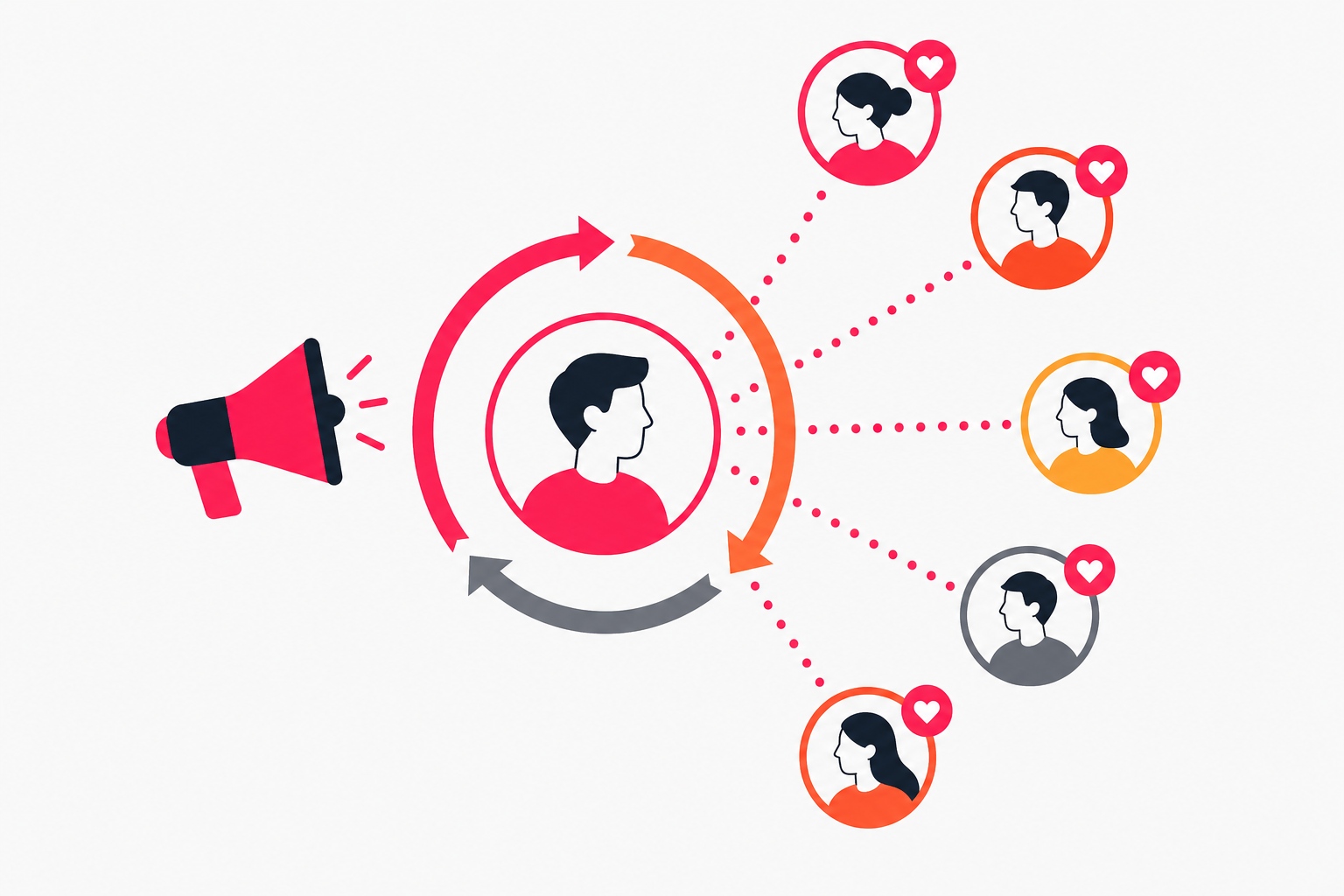
Virality is when existing users bring in new users on their own, so each user generates more than one more user over time. You get there by finding the moment your product reaches a non-user, picking a loop type, rewarding or exposing sharing, and measuring the viral coefficient (invites sent times conversion rate).
Here's what you need to know:
- Virality is a measurable mechanism, not luck.
- Most products fall well short of a viral coefficient of 1, so plan for a boost to paid and organic channels, not a replacement.
- The math is simple: invites per user times the share of invites that convert.
- Four loop types cover almost every example you've seen, and the right one depends on your product's core interaction.
- You can build the smallest version of a loop before launch, using a waitlist.
If you're 30 to 90 days from launch with a validated idea and no audience, this guide gives you the sequence to follow.
What is virality, and is it luck?
Virality is the process where your users, through normal use of your product, bring in other users without you paying for each one. Each new user triggers further signups, which is why growth can compound instead of staying linear.
It helps to separate three ideas that get mixed up:
- Virality: users invite or expose other people to your product, and some of them sign up.
- Network effects: the product gets more valuable as more people use it. Slack is a good example, since a chat tool with one person in it is useless.
- Word of mouth: people mention you in conversation. It's real and valuable, but you can't track or design it the way you can a loop.
A product can have one without the others. A network effect keeps users around, while virality brings them in. The strongest products have both.
Is it luck? Not entirely. Some products land a perfect moment and grow without trying, but the mechanics behind it are repeatable: a trigger, an invite, a conversion. You can design for each part and measure it.
It matters more now because paid acquisition keeps getting pricier. Growth expert Martin Ebongue reports that customer acquisition costs have increased by 40 to 60 percent since 2023. His data also puts the median B2B SaaS company at $702 to acquire a single customer in 2026. Both figures are vendor-reported, so treat them as directional. Even so, they explain why founders with small budgets want users who recruit other users.
The next section turns the idea into a number you can track.
How do you calculate the viral coefficient?
The viral coefficient (also called the K-factor) is the average number of new users each existing user brings in. The formula is K = i × c, where i is the number of invites each user sends and c is the share of those invites that convert into new users.
As an illustration, say each user sends a handful of invites and a fraction of recipients sign up. If K comes out below 1, every 100 users bring in fewer than 100 more, those bring in fewer still, and the loop fades out instead of sustaining itself.
If K reaches 1, each user replaces themselves, and growth sustains without extra spend. Above 1, growth compounds.
Cycle time is the second number to watch. It's how long it takes for a new user to go from signing up to inviting someone who signs up. K-factor tells you how big the loop is; cycle time tells you how fast it turns. A product with a lower K and a cycle time of one day can still add more users than a product with a higher K and a cycle time of three months, because the loop runs many more times. You'll need to measure your own cycle time, since no standard benchmark exists.
Realistic benchmarks matter here, because headlines mislead. EasyVC reports Slack reached a K-factor of 8.5 through its team collaboration features in 2025. That's an outlier. According to AdSights, the median viral coefficient for a typical B2B SaaS product is 0.2. Flowjam data puts Notion at roughly 0.62, which is strong for a product that doesn't force invites.
A coefficient below 1 isn't failure. Any K above zero means some paid users bring in free ones, which cuts your effective acquisition cost. Next, you'll see the loop types that produce those invites.
Which viral loop types exist, with real examples?
Most viral loops fall into four types: inherent, incentivized, exposure, and shared output. The right choice depends on what your users already do inside the product.
- Inherent: the product only works when others join, so inviting is part of using it.
- Incentivized: you reward users for inviting, such as storage, credits, or queue position.
- Exposure: using the product shows your brand to non-users.
- Shared output: users create something and share it, and the output carries your brand.
| Loop type | How it spreads | Example |
|---|---|---|
| Inherent | Teammates are invited so the product works for them | Slack |
| Incentivized | Both sides get a reward for each invite | Dropbox |
| Exposure | Non-users see the brand during a core action | Calendly |
| Shared output | Users share what they made with their network | Canva |
| Exposure / template sharing | Public pages and templates reach new people | Notion |
| Inherent / collaboration | Stakeholders are invited to view and comment | Figma |
Dropbox is the classic incentivized case. Founderpath cites data showing its dual-sided referral incentive permanently raised signup rate by 60% [F3 is not this one; see F4]. That figure is undated, so read it as a historical result, not a current benchmark.
Calendly shows how exposure works. Sharing is the core action, and every recipient lands on a branded page without needing an account. Figma works similarly: designers invite others to view and comment as part of their normal workflow.
So which is an example of viral marketing? Any of these. What matters is that sharing sits inside the product's main job, not bolted on afterward. Next, you'll start building: find the moment where your product already reaches a non-user, then pick the loop that fits.
Step 1 and 2: Find the sharing moment and pick a loop
Start by finding the one moment where your product already reaches someone who isn't a user, then match it to a loop type. Everything else in the build depends on getting this pairing right.
Step 1: Find the sharing moment. Walk through your product's core job and mark every point where a non-user could see, receive, or touch something. Check each of these:
- A link, file, or invite your user sends to get work done
- A page, report, or output your user shows to a client or teammate
- A moment when the product works better with a second person in it
Calendly's moment is obvious: the person booking a meeting lands on a branded page without an account. Figma's is a designer asking a stakeholder or developer to comment. If you can't point to a moment like that, your product has no natural loop yet. It's better to learn that before you build.
Step 2: Pick the loop type. Match the moment to the types in the table above:
- Users already send things to others: use exposure.
- The product needs other people to function: use inherent.
- Users create outputs they want to show off: use shared output.
- No natural moment exists: use incentivized, and give people a reason to invite.
Pre-launch products usually land on the last one. You have no product for anyone to share yet, so a reward for inviting is the mechanism you have.
Once you've picked, you need to make sure the invited person has a reason to stay.
Step 3 and 4: Protect the value and build the smallest loop
A loop that sends people to a weak first experience leaks every user it creates, so protect the value before you ship anything. Then build only what the loop needs.
Step 3: Protect the value. Think about the switchover point, the moment an invited person decides whether to stay. If they arrive and hit a blank screen, a long form, or a feature wall, they bounce, and your conversion rate (the c in K = i × c) drops to near zero. Decide what the invitee should get in their first minute, and send them straight to it.
Dropbox is the model here. Both sides of its referral earned storage, which gave the invitee something concrete on arrival. Founderpath cites data showing that dual-sided incentive permanently raised signup rate by 60%. The figure is undated and secondhand, so use it as a pointer to the design, not a promise of your own result.
Ask yourself three questions:
- What does the invited person see first?
- Can they get value without setting anything up?
- Is the reward for the inviter and invitee clear before they click?
Step 4: Build the smallest loop. Cut the scope to the fewest features that let one user invite one person who then converts. For most teams that means:
- A unique link per user
- A signup page that explains the offer
- A way to count who came from whom
- One reward rule
Skip leaderboards, tiers, and custom dashboards until the basic loop moves. With limited dev time, a loop you ship this month and measure beats a perfect one you ship after launch.
Next comes getting people into the loop.
Step 5 and 6: Seed the loop and test it, starting with a waitlist
A loop with no one in it produces nothing, so you need seed traffic first. Then you improve the loop by testing one change at a time.
Step 5: Seed the loop. Send your first users from channels you already have: your personal network, founder communities, an email list, and a few targeted posts. A small, interested group is enough. Ten engaged users who each invite two people beat a hundred who never click.
A pre-launch waitlist is the practical way to start, since it gives people a reason to sign up before the product exists. Prefinery is a referral and waitlist platform that helps founders collect early signups and grow them through invites. It assigns each new signup a unique referral link and rewards invites with perks or a better spot in the queue. You set up a branded signup form, configure the reward rules, and track growth through analytics. That covers the smallest loop from Step 4 without custom development, and it lets you validate demand before you ship. If you want the full pre-launch picture, the product launch guide covers the sequence around the loop, including how a viral waitlist works.
Step 6: Test and improve. Run A/B tests on the page elements that sit between an invite and a signup. Change one thing at a time:
- The headline on the signup page
- The reward offered to the inviter or invitee
- The wording of the share message
- The placement of the share button after signup
Track invites per user and conversion rate separately. If invites are low, work on the prompt and the reward. If conversion is low, work on the landing page and what the invitee sees first. Changing both at once hides which one moved K.
Repeat the cycle every week or two until the numbers stop improving.
When does virality fall short, and what should you use instead?
Virality falls short when your coefficient stays low, your loop wears out, or your product has no natural sharing moment. Even strong performers like Notion reach only about 0.62. Treat referral as one growth engine among several.
Loops also fatigue. As a market matures, the same invite prompt gets ignored, so keep testing rewards and messages. Physical products rarely spread as cleanly as software, since sharing takes more effort than sending a link.
If building in-house eats dev time you don't have, a dedicated tool is the faster route. Compare referral program tools that work as alternatives to Viral Loops to see which fits your launch. Pricing for Prefinery runs $49 per month for Lite, $249 for Essentials, and $499 for Pro.
Prices and plan limits verified as of November 2026.
FAQs
Is virality luck or can it be engineered?
You can engineer most of it. Some products hit a lucky moment, but the parts of a loop are repeatable: a trigger, an invite, and a conversion. You can design each part, measure it with K = i × c, and improve it through testing. Luck affects how big the result gets, not whether you can build the mechanism.
Which is an example of viral marketing in software?
Dropbox is a clear example. It rewarded both the person who invited and the person who joined with extra storage. Calendly is another: every meeting invite shows its branded booking page to someone who isn't yet a user. Both place sharing inside the product's main job.
Does a viral coefficient below 1 mean the loop has failed?
No. A coefficient below 1 still brings in users at no extra cost, which lowers your effective acquisition cost. Treat a sub-1 loop as a booster for paid and organic channels, not a replacement for them.
How is virality different from word of mouth?
Virality is built into the product and can be tracked: a link is sent, someone clicks, someone signs up. Word of mouth is a conversation you can't see or count. Word of mouth helps, but you can only design, measure, and improve a viral loop.
Does virality work for physical products the same way it does for software?
Not as cleanly. Software spreads through a link in seconds, with almost no friction. Physical products need shipping, cost, and effort before anyone can try them, so the cycle runs slower and conversion usually drops. Referral rewards can still work, but expect longer cycle times and lower invite volume.
Can a viral loop wear out in a mature market?
Yes. When a market matures, people see the same invite prompts everywhere and respond less. Your coefficient can drift down over time even if you change nothing. Refresh your rewards, test new share messages, and watch invites per user and conversion rate separately so you catch the drop early.
Are there ethical limits to viral mechanics in sensitive verticals like health news?
Yes. In areas like health news, a loop that rewards sharing can push people to spread unverified or alarming content, and that does real harm. Reward invites to accurate, useful content only, avoid pressuring users with fear, and be clear about what a shared item contains.
Conclusion
Virality is a mechanism you can measure, and for most products it lifts growth rather than carrying it alone. Expect a coefficient well below 1, and judge success by how much it lowers your cost per new user.
Start by finding the one moment where your product already reaches a non-user. Then build the smallest loop around it, seed it with a waitlist, and track invites per user and conversion rate separately.