
How Behavioral Data Boosts Referral Programs
Use behavioral signals—milestones, activity, and conversion timing—to target superfans, personalize prompts, and lift referral ROI.

Justin Britten

Behavioral data can transform referral programs by identifying your most engaged users and tailoring strategies to maximize their impact. Instead of generic outreach, use user actions - like milestones or frequent logins - to trigger referral prompts at the right moments. This approach ensures you're asking the right people at the right time, leading to higher-quality referrals and stronger results.
Key takeaways:
- Track user behavior: Focus on actions like referral frequency, conversion rates, and time-to-referral.
- Segment users: Identify "superfans" (highly engaged users) and tailor messaging and rewards to their preferences.
- Use personalized prompts: Trigger referral requests after users achieve milestones or provide positive feedback.
- Design effective referral incentives: Dual-sided rewards and tiered systems work well, especially when aligned with user motivations.
- Leverage tools: Platforms like Prefinery and Google Analytics 4 simplify tracking, messaging, and automated referral marketing.
How to Track and Analyze Behavioral Data
You don’t need to overhaul your entire system to start tracking behavioral data. The trick lies in focusing on the right metrics and knowing how to capture them effectively.
Key Metrics to Track
Begin by measuring three core metrics that give you a clear picture of your referral program’s performance:
- Referral frequency: Tracks how often users share your product. Are they occasional sharers, or do they consistently refer others?
- Conversion rates: Measures the percentage of referred users who sign up and become active customers.
- Time-to-referral: Identifies the time gap between when a user joins and when they make their first referral. This helps pinpoint the best moment to encourage sharing.
In addition to these, keep an eye on referral velocity, which highlights trends among top referrers who bring in high-quality users over short periods. Other valuable metrics include the average deal size and retention rates of referred customers. For context, referred customers tend to stay 37% longer and close deals that are 25% larger than those acquired through other channels.
Once you’ve established these metrics, the next step is to dig into the behaviors that set top-performing referrers apart.
Behavioral Patterns of Top Referrers
After tracking your core metrics, dive deeper to uncover patterns that distinguish high-performing referrers. Start with cohort analysis, grouping referred customers by their referrers to identify which advocates drive high-value leads versus those who bring in high volumes of lower-quality users.
Use UTM parameters (like utm_source=referral) in referral links to see which channels - email, social media, or direct links - your top referrers prefer. This can help you identify your "superfans", the users who consistently deliver the best results.
Tools for Collecting Behavioral Data
To act on your findings, you’ll need tools that provide precise insights into user behavior. Referral platforms like Prefinery make this easy by generating unique tracking IDs and monitoring shares, clicks, and conversions all in one place. Unlike generic templates, dedicated platforms designed for behavioral tracking can boost revenue tracking accuracy by as much as 84%.
Complement your referral software with Google Analytics 4 to analyze long-term user journeys and traffic sources. Automation tools like Zapier or HubSpot Workflows can seamlessly sync referral data with your CRM. For even greater accuracy, consider server-side attribution methods to bypass ad-blockers.
When choosing how to implement your system, you have two main options: build an in-house solution or use a specialized platform. While in-house development gives you complete control, it requires substantial engineering time and ongoing upkeep. On the other hand, dedicated platforms can be up and running within days and often include advanced features like fraud detection for duplicate IPs or disposable email addresses. These tools also make it easier to customize referral messages and rewards, which ties into the next section.
Using Data to Improve Referral Messaging and Rewards
To make referral programs more effective, focus on identifying top referrers and leveraging behavioral insights. This helps craft personalized messages and rewards that go beyond generic prompts like "Share with a friend!"
Creating Personalized Referral Messages
The timing of your referral prompts can make or break their success. Trigger these prompts right after users experience their "Aha moment" - the point where they first see real value in your product. Another strategy is sentiment-based targeting, where you ask users who rate you 9 or 10 on NPS surveys to refer others. To take it a step further, personalize landing pages by including the referrer's name. For example, new users might see, "Sarah invited you!" This adds a personal touch, validating the recommendation and building trust instantly.
Using advanced platforms, you can experiment with SaaS referral program best practices and messaging approaches quickly. This allows you to test and refine what resonates most with your audience.
Once your messaging is dialed in, the next step is to design rewards that motivate users to take action.
Designing Rewards That Drive Action
After perfecting your referral messaging, align rewards with user behavior to maximize engagement. Behavioral data can reveal what types of rewards different user segments prefer, enabling you to create more effective incentives.
The reward structure itself plays a huge role in driving referrals. Dual-sided rewards - where both the referrer and the new user benefit - are particularly effective. For instance, Dropbox offered 500 MB of free storage to both parties, which led to 35% of their daily signups and an impressive 3,900% growth over 15 months.
Tiered reward structures are another powerful tool. They recognize top referrers and encourage ongoing participation. Harry's, for example, used this approach to collect 100,000 emails in just one week. Their system rewarded users with shaving cream for 5 referrals, a razor for 10, a full kit for 25, and a year of free blades for 50. This strategy accounted for 77% of their total email signups through referrals. Data shows tiered systems deliver 1.8x higher ROI compared to flat rewards.
It’s also important to match rewards to your product type. For utilitarian products like SaaS tools, cash or account credits work well. On the other hand, hedonic products like entertainment or lifestyle brands see better results with experiential rewards. Tesla, for example, offered factory tours and event invitations, achieving a 40x ROI. One advocate alone generated $16 million in revenue through 188 referrals.
Finally, consider consumer expectations when setting monetary rewards. Most people expect at least $21, while percentage discounts generally need to be 11% or higher to motivate action - 20% is often the sweet spot. Use behavioral data to test models like "Give $20, Get $20" against one-sided rewards to see what resonates most with your audience.
Segmenting and Targeting Users Based on Behavior
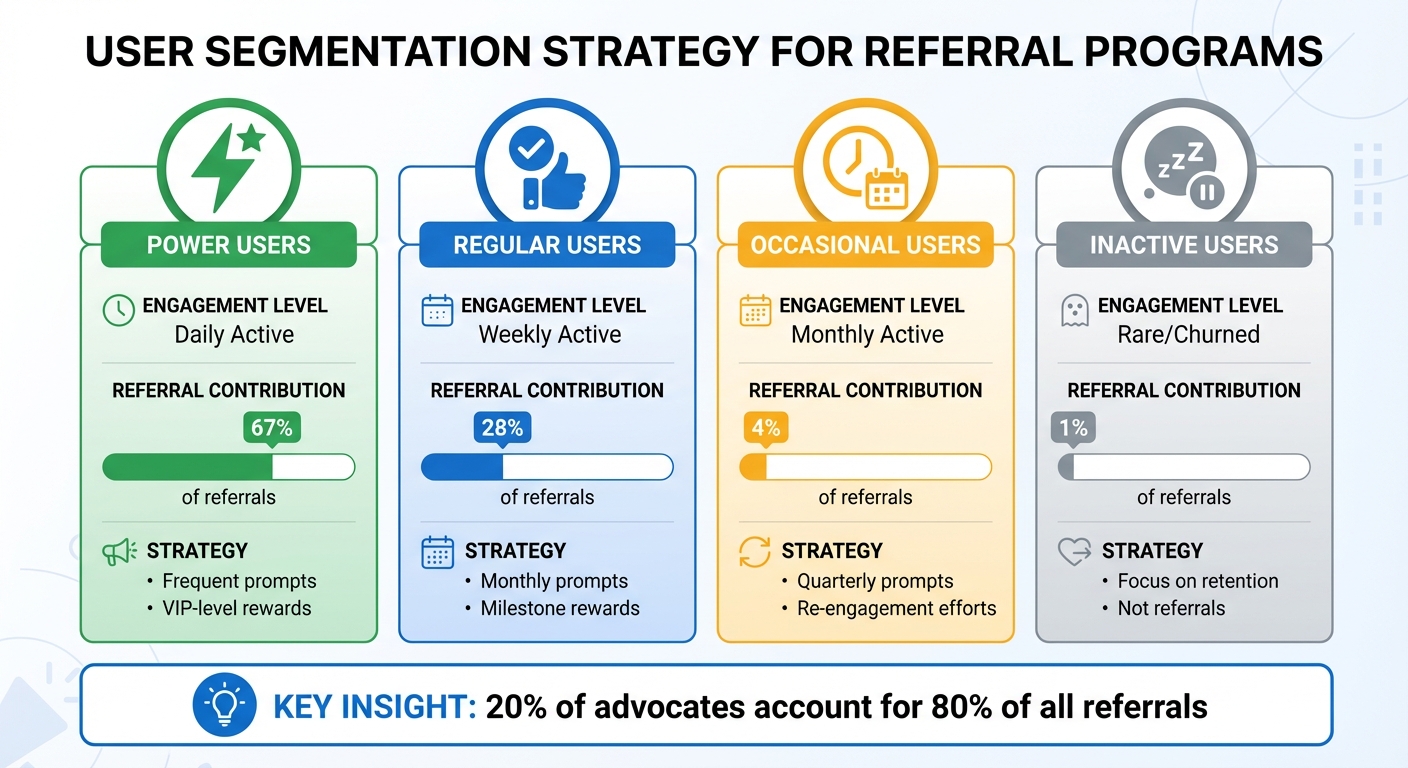
User Segmentation Strategy for Referral Programs by Engagement Level
Once you optimize your SaaS referral program messaging and rewards, the next step is targeting users based on their behavior. Not all users are equally likely to refer others, and understanding behavioral data can help you pinpoint those who will deliver the best results.
Building Referral Personas
A smart way to start is by segmenting users based on how they interact with your product. For example, users who engage 3–4 times per week are four times more likely to make a successful referral. These frequent users deeply understand your product's value, making them natural advocates.
Another important factor is referral velocity - how quickly users begin sharing after joining. The most effective advocates often make three or more referrals within their first week. Early activity like this signals enthusiasm, which you can nurture for even greater results. On the flip side, inactive users who rarely log in are unlikely to refer and might even be turned off by repeated prompts.
Lifecycle stage also plays a role. New users bring enthusiasm, while long-term loyalists lend credibility. For B2B SaaS companies, plan-based targeting is worth considering - enterprise clients often refer different types of prospects compared to small business users.
Here’s a quick breakdown of user segments and strategies:
| User Segment | Engagement Level | Referral Contribution | Strategy |
|---|---|---|---|
| Power Users | Daily Active | ~67% of referrals | Frequent prompts; VIP-level rewards |
| Regular Users | Weekly Active | ~28% of referrals | Monthly prompts; milestone rewards |
| Occasional Users | Monthly Active | ~4% of referrals | Quarterly prompts; re-engagement efforts |
| Inactive | Rare/Churned | ~1% of referrals | Focus on retention, not referrals |
By defining these personas, you can zero in on your most valuable referrers and craft strategies to maximize their impact.
Identifying and Rewarding Top Referrers
Once you’ve segmented your users, it’s time to focus on the ones driving the majority of referrals. Interestingly, about 20% of advocates account for 80% of all referrals. Recognizing and rewarding these high-performers is essential.
Beyond the number of referrals, look for other behavioral indicators like email engagement, frequent visits to the referral dashboard, or mentions on social media. These actions reveal who’s genuinely invested in promoting your product.
One effective way to keep top referrers motivated is by using tiered rewards. For instance, set milestones at 3, 10, and 25 referrals, with increasingly appealing rewards at each level. Research shows that 62% of consumers feel leaderboards inspire them to refer more. For your best performers, consider creating an exclusive VIP tier with perks like direct access to your founding team, private Slack communities, or higher commission rates.
Fraud prevention is equally important to protect your referral program. Only issue rewards after meaningful actions, such as completing onboarding or creating a project. Watch for suspicious patterns like duplicate IP addresses or unusually high referral activity (e.g., 20 signups in an hour). This ensures your rewards go to genuine advocates, not opportunistic users exploiting the system.
Platforms like Prefinery can help you manage this process. With its advanced analytics, fraud detection, and no-code integration, Prefinery enables precise segmentation and tailored rewards, giving you the tools to scale your referral program effectively.
Improving Performance Through Data Feedback Loops
Behavioral data is the backbone of refining your referral program. A data feedback loop involves continuously testing, measuring, and improving based on actual user behavior - not guesses.
Refining Messaging and Timing
The success of a referral prompt often hinges on when and how you ask. Identifying key engagement moments - those times when users are most satisfied with your product - can make all the difference. For example, these moments might occur after completing a milestone, finishing onboarding, or achieving a specific outcome.
Take Kommunicate as an example. By using behavioral triggers, they increased milestone signups from 28% to 41%, with an 86% milestone achievement rate driving both usage and revenue.
Timing is equally critical and varies by user type. For transactional referrers, prompt them immediately after they hit a milestone. For social referrers, emphasize mutual benefits.
Another proven tactic is targeting users right after they provide positive feedback. Andrew Chen, Partner at Andreessen Horowitz, explains:
"The headline best practice is that your referral program should target new users to refer their friends - this means prompting users during their initial onboarding flows".
For instance, prompting referrals immediately after users give high Net Promoter Scores (NPS) can yield great results.
Set clear expectations in your messaging by highlighting the maximum reward available. Limited-time offers, like a 30% discount for six months, can also drive higher sharing and signup rates.
Once you’ve optimized these prompts, the next step is to apply these strategies across your entire user base.
Scaling What Works
After identifying successful tactics, automation and personalization become key to scaling your referral program. Using behavioral data not only sharpens your messaging but also helps you scale systematically. Companies that integrate referral data with their CRM systems see 23% higher conversion rates by automating personalized follow-ups.
Begin by analyzing which customer segments generate the best leads. Consider factors like how long they’ve been using your product, their usage patterns, and their industry. For example, users who engage with your product 3–4 times a week are four times more likely to make successful referrals. Focus your efforts on similar high-engagement segments.
Run quarterly A/B tests to fine-tune reward structures - compare cash versus credits, or one-sided versus two-sided rewards - and test different timing strategies to maximize your ROI. Document the results in a knowledge base to ensure you’re building on past successes.
Accurate attribution is also crucial. Use a first-touch attribution model with a 30–90 day window to correctly credit referrers and allocate resources to the most effective channels.
For B2B businesses, tying rewards to a percentage of Monthly Recurring Revenue (MRR) can encourage sustained advocacy. Automate compliance processes, such as managing legal requirements for U.S.-based users who earn over $600.
Platforms like Prefinery streamline this entire process by offering built-in analytics, automated triggers, and CRM integrations, allowing you to focus on strategy instead of manual tracking.
Conclusion
Key Takeaways
Behavioral data can transform your referral program into a reliable engine for growth. By analyzing how users engage with your product, you can pinpoint your superfans - those loyal, highly active customers who are most likely to make successful referrals. This approach allows you to target the right individuals at the perfect moments, such as just after they achieve a meaningful milestone.
But the advantages don’t stop there. Companies that integrate referral data with their CRM systems report 23% higher conversion rates. You can also refine your strategies by A/B testing vs. traditional methods for reward structures, personalizing landing pages with referrer details, and utilizing first-touch attribution to ensure advocates receive proper recognition for bringing in new customers.
These insights provide a roadmap for taking immediate, data-informed steps to improve your referral program.
Next Steps for SaaS Companies
Ready to put these ideas into action? Here’s how to get started.
- Create unique referral links: Use UTM parameters to track performance across email, social media, and in-app sharing.
- Integrate your tools: Connect your referral program with your CRM and billing platforms, like Stripe, to follow the entire customer journey - from the initial click to lifetime value.
- Monitor key metrics: Build a dashboard to track participation (5–15%), share rates (10–15%), and conversion rates (5–12%).
- Leverage behavioral triggers: Identify moments when users are most satisfied and automate referral prompts to appear at those times.
Platforms such as Prefinery simplify this entire process, offering built-in analytics, automated triggers, and easy integrations. This lets your team focus more on refining strategy rather than managing logistics. Start small, experiment consistently, and scale up based on real feedback from your users - not on guesses or assumptions. By doing so, you’ll create a referral program that’s both effective and sustainable.
FAQs
What’s the best moment to ask a user to refer?
The best moment to request a referral is right after a user has had a positive experience with your product and feels confident in it. Timing makes all the difference - reach out when they’re actively engaged and happy to increase both the likelihood of participation and the quality of the referral.
What behavioral metrics should I track first?
To get the most out of your referral program, begin by keeping tabs on three critical metrics: user activity rate, referral share rate, and conversion rate.
- User activity rate shows how engaged users are with your program. Are they actively participating, or is interest waning?
- Referral share rate tracks how often users are sharing your program with others. A high share rate usually signals enthusiasm.
- Conversion rate measures how well those referrals are turning into actual customers.
By staying on top of these numbers, you can identify what’s working, spot areas that need improvement, and fine-tune your program for stronger results.
How do I prevent referral fraud without hurting conversions?
Preventing referral fraud while keeping conversions steady requires a balance of vigilance and strategy. Start by using tools like email and IP validation, device fingerprinting, and CAPTCHA challenges to confirm user identities. These steps help filter out fake or malicious sign-ups.
Another effective approach is to delay rewards until specific milestones are reached - like when a referred user makes a purchase. This ensures that only legitimate referrals are rewarded.
Finally, keep an eye out for unusual activity patterns and enforce clear eligibility rules for your referral program. This not only safeguards its integrity but also promotes genuine and meaningful participation.