
Checklist for Optimizing Time-to-Referral Metrics
Shorten time-to-referral by tracking key metrics, timing prompts at engagement milestones, simplifying sharing, and automating workflows for faster referrals.

Justin Britten

Want faster growth? Focus on reducing your time-to-referral. This metric measures how quickly users go from signing up to making their first referral. Why does it matter? Shorter referral times mean happier customers, quicker advocacy, and lower acquisition costs. For example, cutting referral times from 30 to 10 days can triple your viral growth cycles and boost referrals to account for 30% of new leads.
Here’s the game plan to optimize your time-to-referral:
- Track Key Metrics: Measure "time to first referral", "activation-to-referral", and "time between referrals." Use tools like Mixpanel or Prefinery for accurate tracking.
- Trigger Referrals at the Right Time: Prompt users to refer immediately after they hit milestones like completing onboarding or making a purchase.
- Simplify the Referral Process: Use one-click sharing options and pre-written messages to remove friction.
- Make Referrals Visible: Add referral CTAs in-app, via email, or after transactions to keep them top of mind.
- Automate Workflows: Platforms like Prefinery streamline referral campaigns with no-code integrations and detailed analytics.
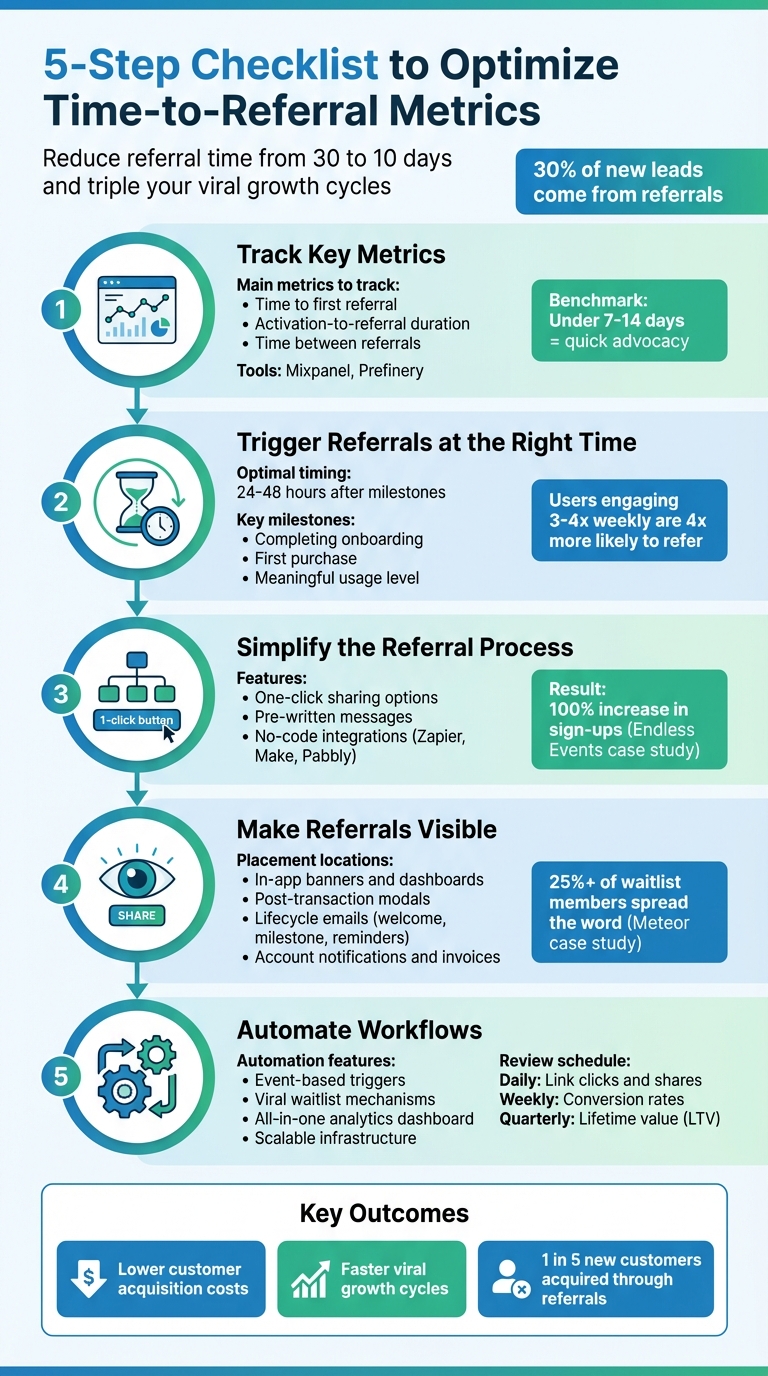
5-Step Checklist to Optimize Time-to-Referral Metrics
How to Define and Track Time-to-Referral Metrics
Core Metrics to Track
To effectively measure time-to-referral, focus on three key metrics: time to first referral, time from activation to first referral, and time between first and second referral. Here's what each involves:
- Time to first referral tracks how long it takes - from minutes to days - for a user to send their first referral invite or for a referred user to complete signup. This gives insight into the initial engagement timeline.
- Time from activation to first referral measures the duration between a user reaching an "aha moment" (like finishing onboarding or hitting a specific usage threshold) and making their first referral.
- Time between first and second share highlights how quickly users share again, offering a glimpse into the likelihood of repeat advocacy.
How to Standardize Event Definitions
Consistency is key when defining events. Develop a shared event taxonomy document that aligns your product, growth, data, and engineering teams. For example:
- Define Signup as the moment a user creates an account and verifies their email or phone. Map this to a single analytics event, such as
User Signed Up, with consistent properties like plan type, source, and UTM tags. - For Activation, identify a clear milestone that signifies an "aha moment." This could be completing onboarding or performing a core action a set number of times within a specific timeframe. Ensure that the activation criteria are measurable and straightforward.
Setting Up Analytics Tools
To track these metrics effectively, set up tools like Segment to send events to platforms such as Mixpanel, your data warehouse, and your referral system. Use Mixpanel or similar tools to create funnels that map the journey from User Signed Up to Referral Invite Sent to Referred Signup. These funnels allow you to calculate the time between each step.
It's essential to manually test these flows to verify that timestamps and durations are being recorded accurately.
Alternatively, tools like Prefinery simplify the process by offering built-in analytics that automatically track referral activity and user growth. As Shawn Whiting, Designer at Pluto VR, shared:
"The automatic messaging systems, ability to refer friends to move up in line, and the all-in-one dashboard and analytics tools have been a lifesaver for us."
– Shawn Whiting, Designer, Pluto VR
To establish a baseline, track the median time from signup to first referral over a 60–90 day period. Use consistent timeframes, such as measuring referrals within the first 30 days of signup, to avoid late outliers skewing your data. These insights can help you fine-tune and improve your referral funnel.
Checklist for Analyzing Current Time-to-Referral Performance
Breaking Down the Referral Journey
To evaluate your referral journey, break it into four key stages: signup (when users register), activation (when they complete onboarding or their first important action), referral request (when they’re prompted to share or initiate sharing), and referred signup (when their referred friend completes registration). Use analytics to measure the time intervals between these stages. If the average time from customer acquisition to the first referral is under 7–14 days, it’s a great sign of quick advocacy, often reflecting high product satisfaction. Additionally, track the time between the first and second shares to understand repeat behavior patterns.
Once you’ve mapped this journey, dig deeper by segmenting your data to identify specific friction points.
How to Segment Performance Data
Segmenting your time-to-referral data can uncover valuable insights. Focus on categories like lifecycle stage, plan tier, and acquisition channel to identify trends and slow-moving segments. For example, breaking down conversion rates by referrer type can help you spot your top advocates while also revealing bottlenecks in the customer journey. Pay close attention to segments where the activation-to-referral time lags - this often points to onboarding challenges or engagement drop-offs that require attention.
These segmented insights will help you pinpoint areas that need improvement to boost overall referral performance.
Key Metrics for Diagnosis
Timing is just one piece of the puzzle. Link your referral data to broader metrics like referral rate, number of referrals per customer, and lifetime value (LTV). A key indicator of success is the percentage of customers generating multiple referrals, as this reflects strong repeat advocacy and network effects. Remember, referrals can drive significant growth - 30% of new leads often come from referrals, and 1 in 5 new customers is typically acquired through them.
For optimal tracking, review metrics weekly at first, then shift to bi-weekly or monthly as patterns stabilize. Monitor link clicks daily and assess LTV on a quarterly basis to catch trends early. To ensure accuracy, use tools with robust attribution tracking so you don’t underestimate the true impact of your referral program.
Checklist for Improving Referral Timing and Workflows
Trigger Referrals at the Right Time
When you ask for a referral can make all the difference. Timing plays a key role in determining whether users are ready and willing to recommend your product. Metrics like time-to-referral - measuring the period from customer acquisition to the first successful referral - can indicate how well your product resonates with users and how satisfied they are. The ideal moment? Within 24–48 hours of hitting key milestones, such as completing onboarding, making a first purchase, or reaching a meaningful usage level.
For SaaS products, aligning referral prompts with active usage windows is especially effective. According to Mixpanel, users who engage with a product 3–4 times weekly are four times more likely to refer others. Instead of sending generic monthly emails, trigger prompts immediately after actions like completing a task or achieving a milestone. Tools like NPS scores (9 or higher) or 5-star ratings can help you identify promoters who are most likely to share your product.
Once your timing is on point, focus on making the referral process as smooth as possible.
Simplify the Referral Process
The easier it is for users to refer someone, the more likely they are to do it. Remove barriers by offering one-click sharing options and pre-written messages. This eliminates the need for users to come up with their own wording, speeding up the process. No-code platforms like Zapier, Make, or Pabbly Connect can help you launch referral campaigns quickly, without placing extra demands on your development team.
"Prefinery is the best tool to build a viral sign-up process for your company. We saw a 100% increase in sign-ups because of the waitlist and refer system."
– Will Curran, Founder, Endless Events
Streamlining the experience for referred friends is just as important. Complicated sign-up forms or lengthy checkout processes can discourage them from completing the process. Keep it simple by cutting unnecessary steps, and use automated reminders to nudge referred friends who haven’t converted yet.
Make Referral Prompts More Visible
Even a flawless referral program won’t work if users don’t notice it. Visibility is critical. Add persistent banners or menu items (like "Earn rewards - Invite a friend") in prominent areas of your app, such as dashboards, profiles, or billing pages. Use post-transaction or post-support modals to display a success message with a one-click sharing option after a purchase or resolved support ticket.
Lifecycle emails can also be a powerful tool. Send welcome emails after onboarding, milestone emails when users achieve goals, and targeted reminders for active users who haven’t referred anyone yet. Don’t forget to include referral calls-to-action (CTAs) in account notifications, invoices, and monthly summaries. Combine these efforts with in-app prompts, SMS, and social sharing options to expand your reach.
"Prefinery enabled us to build a live waitlist for our service, complete with social sharing and referral rewards. As a result, we saw over 25% of our waitlist members spread the word on their networks."
– Dan Ahmadi, Digital Marketing, Meteor
To refine your approach, continuously A/B test different referral triggers - such as immediate prompts versus those sent 24 hours after a milestone. Experiment with various channels (in-app vs. email) and creative elements like headlines or incentive framing. These tweaks can significantly improve your referral funnel by reducing time-to-referral and driving faster, more consistent growth.
Tools and Automation for Reducing Time-to-Referral
Features to Look for in Referral Platforms
Choosing the right referral platform is crucial for driving rapid referral growth. Start by seeking out platforms with event-based triggers. These triggers activate referrals at key moments, such as when users complete onboarding or reach their first milestone - times when they're most eager to share. A viral waitlist feature can also add urgency, motivating users to refer friends quickly to move up the list or unlock rewards.
Another essential feature is a customizable reward system with tiered incentives, which encourages users to share repeatedly. Simplify the process with one-click social sharing tools, which make it easier and faster for users to spread the word. Additionally, robust analytics are a must-have. Look for platforms that provide detailed breakdowns by channel (email, social media, direct links) so you can fine-tune your referral strategy. Finally, prioritize platforms with no-code setup and seamless integrations with tools like Zapier, Make, or Pabbly Connect. This ensures you can automate workflows without needing extensive development resources.
How Prefinery Supports This Checklist
Top platforms like Prefinery check all these boxes. Prefinery’s no-code integration allows for quick deployment, saving valuable development time. Its viral loop mechanism creates a self-sustaining referral system, generating 30% of new leads directly from referrals.
"I set everything up yesterday afternoon. This morning I'm over 10k signups. I've never seen anything like it."
– Doug Broughton, CEO, Vendible
The platform’s all-in-one dashboard makes tracking referral activity, user growth, and campaign momentum a breeze. This helps you identify what’s working and adjust your strategies as needed. Prefinery also boasts a scalable infrastructure that handles traffic surges effortlessly, and with a 4.9/5 star rating on Capterra, it has powered over 23,000 campaigns in its 17 years of operation.
"Prefinery saved us hundreds of hours we would have to spend on web development. We could focus on more effective beta testers' onboarding instead."
– Matt Tarczyński, CEO, Woodpecker.co
Automation Best Practices
Once you’ve chosen a capable platform, using it effectively is key. To reduce the time-to-referral, trigger referral prompts immediately after users hit important milestones instead of limiting them to the signup moment. For users who don’t engage with the first prompt, follow up after 3–7 days with adjusted messaging or an added incentive.
Keep referral requests to a once-a-week schedule to prevent user fatigue. Alternate the channels you use - such as sending an in-app notification one week and an email the next. Use behavior-based suppression to avoid targeting users with negative signals, like those who failed onboarding or have unresolved support tickets. Integrate no-code alerts to notify your team if key metrics, like referral thresholds, are breached. Finally, monitor your dashboard weekly for quick insights like link clicks and shares, and dive deeper into conversion rates by channel and trigger on a monthly basis to refine your timing and approach.
How to Monitor and Improve Over Time
Set Up a Review Schedule
Once you've fine-tuned your referral triggers and workflows, keeping an eye on performance is essential for steady growth. Monitoring metrics like time-to-referral should be an ongoing process. For day-to-day tracking, focus on referral clicks and shares. When launching new triggers, review these metrics weekly. For more in-depth insights - such as lifetime value (LTV) and return on investment (ROI) - switch to bi-weekly or monthly reviews. Additionally, re-segment customer cohorts every quarter to assess whether onboarding changes are driving better results.
Define Benchmarks and Targets
After setting up your review schedule, establish clear goals to reduce the time it takes for users to make their first referral. Start by defining a specific target for how quickly new users should generate their first referral. Track the average time from sign-up to first successful referral, and work to shorten it by improving your onboarding process and optimizing referral prompts. To connect this metric to your bottom line, measure your payback period - the time it takes to recover customer acquisition costs (CAC) through revenue generated by referrals. Align these time-to-referral goals with key engagement milestones that encourage users to take action.
Ensure Data Accuracy
Accurate data is the backbone of any successful optimization effort. Use regular audits to ensure referrals are correctly attributed to the right advocates and campaigns. Double-check that event tracking systems are properly recording sign-ups, referral clicks, and conversions. Tools with built-in analytics dashboards, like Prefinery, simplify this process by making it easier to spot errors and monitor referral activity - no manual spreadsheets required. Reliable data ensures you’re making decisions based on a solid foundation.
Conclusion: Key Takeaways for Time-to-Referral Optimization
Quick Reference Checklist
Improving time-to-referral requires a thoughtful, step-by-step approach. Start by tracking key metrics and breaking down data by user cohorts, acquisition channels, and engagement levels. For instance, users who engage with your product 3–4 times per week are four times more likely to make successful referrals. Prompt users to refer at moments of high engagement and streamline the process by minimizing friction and making sharing options easy to find. Use automated workflows with no-code tools to save your development team’s time. Regularly review your performance metrics - monitor clicks and shares daily, assess conversion rates weekly, and analyze lifetime value quarterly.
Specialized platforms can simplify the process further. For example, Prefinery offers a viral waitlist system with features like customizable rewards, automated email campaigns, and seamless integrations with tools like Zapier. These tools let you launch referral campaigns quickly, allowing your team to stay focused on enhancing your core product.
By implementing these strategies, you can make referrals smoother and set the stage for consistent, scalable growth.
Why Time-to-Referral Optimization Matters Long-Term
The benefits of reducing time-to-referral go beyond immediate results - it creates a growth engine that sustains itself over time. Referral-driven growth not only slashes customer acquisition costs but also validates your product’s fit in the market by turning satisfied users into advocates . This creates a viral loop where active users generate new leads with minimal additional spending, significantly lowering acquisition costs.
Another key advantage is better resource allocation. Automating referral workflows saves your team time, enabling faster product launches, quicker updates, and stronger positioning in a competitive market. Over time, this approach helps you build a more efficient and resilient growth strategy.
FAQs
What’s the best way to track and improve time-to-referral metrics?
To keep a close eye on and improve your time-to-referral metrics, start by utilizing a referral platform or analytics tool. These tools can log crucial timestamps, such as when a referral is made and when the referred user takes key actions like signing up or completing a purchase. This information is invaluable for identifying delays and figuring out where adjustments are needed.
Make it a habit to review this data regularly to uncover trends or potential bottlenecks. For instance, if you notice a significant delay between the referral and the desired action, you might need to simplify your referral process or make your incentives more appealing. Platforms like Prefinery can help by offering detailed analytics and customizable workflows, giving you the insights and flexibility needed to refine your referral strategy and achieve quicker results.
What are the best ways to streamline the referral process?
To make the referral process smoother, aim for a system that's straightforward, engaging, and user-friendly. Here are some important tips to get started:
- Leverage no-code tools for an easy and quick setup, minimizing technical hurdles.
- Provide clear and flexible incentives to encourage users to refer others.
- Include social sharing options to make spreading the word simple and hassle-free.
- Create a seamless viral loop that keeps participants actively involved.
Prefinery offers a standout solution by delivering a referral platform that's both scalable and developer-friendly. With its customizable features and dependable infrastructure, businesses can save time while driving organic growth and increasing user engagement.
How does automating workflows speed up referral processes?
Automating workflows can simplify referral processes by cutting out unnecessary delays and ensuring tasks are handled promptly. By removing manual steps and avoiding bottlenecks, it keeps operations running seamlessly. Automated notifications and updates also ensure everyone stays informed and on track.
When workflows are fine-tuned like this, businesses can connect with potential customers faster, respond more quickly, and close deals sooner. This doesn’t just improve how long it takes to complete a referral - it also makes the entire experience smoother and more enjoyable for both users and referrers.