
How Long Should Referral Programs Run?
Match referral program length to your goals, audience, and budget. Use 2–8 week bursts for urgency or 3–6 month programs for steady growth; monitor ROI weekly.

Justin Britten

Starting a referral program without a clear timeline can backfire. Here's the bottom line: the duration of your referral program depends on your goals, audience behavior, and budget. Short-term referral program examples (2–8 weeks) create urgency and quick results, while longer programs (3–6 months or more) focus on steady growth and trust. However, running a program too long can lead to "reward fatigue", where interest drops off, and costs outweigh benefits.
Key takeaways:
- Short-Term (2–8 weeks): Great for launches or seasonal pushes but may miss late adopters.
- Long-Term (3–6 months): Ideal for sustainable growth but risks becoming stale.
- Event-Triggered: Tied to milestones or key moments for maximum engagement.
- Track ROI Weekly: If results stay negative for 3 weeks, adjust or end the program.
For best results, align your program's length with your audience's behavior and monitor performance regularly to make data-driven adjustments.
Problems with Unclear Referral Program Duration
When referral programs lack a clear timeline, they tend to fade into the background. Users see the same offer repeatedly, and without any sense of urgency or a fear of missing out, the motivation to act disappears entirely.
This absence of urgency leads to what’s often called reward fatigue. Stagnant incentives and no visible end date sap any initial excitement, reduce participation, and could even tarnish your brand by making it seem like you’re endlessly pushing promotions.
"A well-timed referral program creates excitement and urgency rather than becoming part of the furniture that users learn to ignore." – Expert Guide Series, ThisIsGlance
But urgency isn’t just about keeping users engaged - it also protects your finances.
Programs that run indefinitely can drain resources by continuing to pay for referrals long after the cost per acquisition (CPA) outweighs the customer lifetime value (LTV). Without proper monitoring and ROI tracking, you risk turning the program into a loss-making effort. On top of that, referral fraud - responsible for 21% of e-commerce attacks - can spiral out of control when programs operate without clear oversight.
Another major issue is market saturation. When a program runs too long, it inevitably reaches most of its target audience. Without strategic adjustments, this leads to plummeting conversion rates as interest wanes. Poor visibility or unclear placement can make matters worse, with participation rates dropping by as much as 80%. An undefined timeline only amplifies these problems, pushing the program well past its peak effectiveness. These challenges highlight why setting a defined duration is crucial for achieving maximum impact.
Factors That Determine Referral Program Duration
How long should your referral program run? That depends on several key factors, including your business stage, customer lifecycle, and budget constraints. For example, pre-launch startups often need more time to build momentum compared to established businesses. Take Robinhood as an example: they spent over a year building a pre-launch referral waitlist, ultimately attracting 1,000,000 users before their official debut. On the flip side, some pre-launch campaigns gain traction in just a matter of days. Timing matters, and understanding how customer engagement and financial resources play into this can help you plan effectively.
Your customer lifecycle is another critical piece of the puzzle. The best time to ask for referrals is right after users experience that "aha moment" - the point where they truly see your product's value. For new mobile apps, a referral program lasting 3 to 6 months often works well. This timeframe gives users enough time to get comfortable with your product and feel confident recommending it to others. On the other hand, shortening referral cycles - say, from 4 weeks to 2 weeks - can sometimes supercharge growth, depending on how quickly users engage with your product. Matching your program's duration to your users' behavior can significantly improve referral quality and conversion rates.
Budget sustainability is equally important. To protect your margins, make sure rewards only activate after a qualifying action, like a paid subscription or purchase. A simple way to align your referral program with your customer acquisition cost is to divide your marketing budget by the number of converted leads. Keep in mind that while the average referral rate for software and digital products hovers around 3.35%, top-tier programs can achieve rates between 22% and 25%. To ensure you're getting a positive return on investment, track your program's ROI weekly. If results remain negative for three straight weeks, it might be time to adjust your rewards or end the campaign.
Lastly, the type of product you're offering plays a big role in determining the ideal program length. For B2B or productivity apps, longer campaigns - typically 6 to 9 months - are often necessary because decision-making cycles can take around 8 months. Fitness apps, on the other hand, benefit from ongoing programs that align with regular user habits. Gaming and fintech apps might do better with short-term campaigns tied to new feature launches. It's also worth noting that referred customers tend to stick around 37% longer and are four times more likely to refer others, proving the long-term value of a well-designed referral program.
Recommended Referral Program Durations
When planning a referral program, it's essential to consider factors like your customer lifecycle, program objectives, and budget. Here's a breakdown of suggested durations for different types of campaigns.
Short-Term Campaigns (2–8 Weeks)
Short-term campaigns are great for creating quick buzz or leveraging specific events. These typically run for 2–8 weeks. Viral giveaways, for example, perform best within a 2–4 week window. Running such campaigns around every two months (roughly six times a year) keeps your audience engaged without overwhelming them. Flash campaigns, lasting just 1–2 weeks, can drive sudden spikes in user acquisition, making them perfect for product launches or testing new rewards. However, referral activity often drops sharply once the campaign ends, so it's important to plan follow-ups to sustain the momentum.
Longer campaigns, on the other hand, offer a more sustainable growth strategy.
Long-Term Programs (3–6 Months or More)
For businesses seeking steady customer acquisition, long-term programs (lasting 3–6 months or more) provide the opportunity to gather meaningful data and fine-tune your strategy. Many mobile apps find that programs in this range help maintain consistent growth. Ambassador programs, where loyal customers act as ongoing brand advocates, often run indefinitely and serve as a dependable marketing channel for established brands.
One challenge with extended programs is avoiding "reward fatigue", where users become desensitized to ongoing incentives. Brands like Uber and Amazon tackle this by running short, high-energy referral bursts every 2–3 months instead of relying on a single, continuous offer. This approach keeps the campaigns feeling fresh and engaging. For ongoing programs, regularly updating your creative assets can also help prevent user disengagement.
Event-Triggered or Milestone-Based Campaigns
Event-triggered campaigns focus on specific customer moments, such as completing onboarding, hitting a usage milestone, or renewing a subscription. These campaigns are effective because they engage users at peak excitement about your product. Milestone-based campaigns, like those pioneered by Harry's, reward users at different levels based on how many friends they refer. As users hit benchmarks, they unlock increasingly valuable rewards.
For pre-launch campaigns, durations can range from 2 months to over a year, depending on your goals. At a minimum, a 2-month timeline allows you to gather feedback and build a solid user base. Longer pre-launch campaigns are effective for building anticipation and letting word-of-mouth grow naturally. Instead of just collecting email addresses, you're creating excitement and a sense of community around your product.
How Duration Affects Engagement and Results
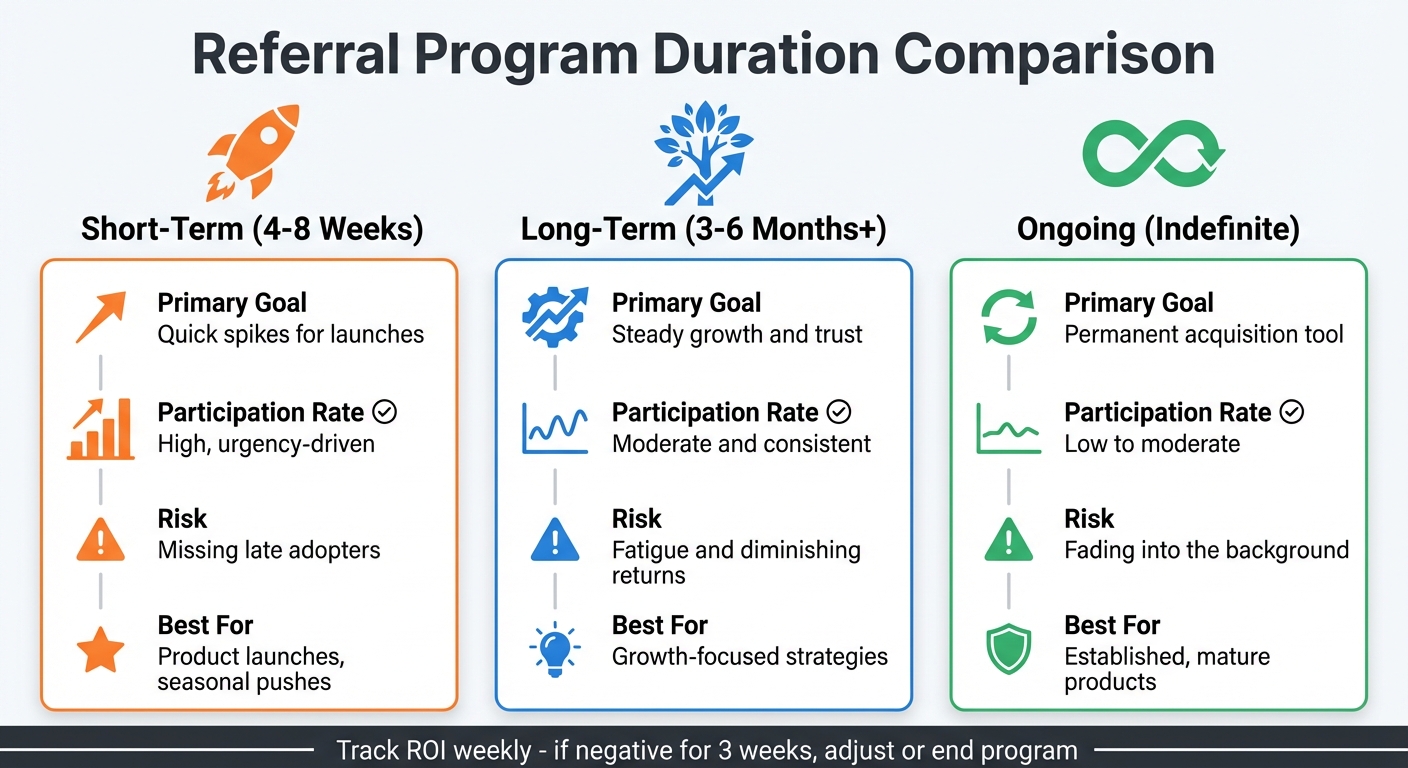
Referral Program Duration Comparison: Short-Term vs Long-Term vs Ongoing Campaigns
When it comes to referral programs, the length of the campaign plays a huge role in shaping both engagement and results. The challenge lies in finding the sweet spot between creating urgency and giving participants enough time to act. Short-term campaigns often generate quick bursts of activity, while long-term ones focus on consistent, steady growth. Striking the right balance depends on your specific goals.
Shorter campaigns can drive immediate action but might miss out on users who need more time to explore and appreciate your product. For instance, many successful apps take about 3–6 months to gain real traction. On the other hand, longer campaigns provide that extra time but run the risk of becoming stale or overlooked. Let’s break down how different durations impact performance.
"The most successful referral programs aren't just about length - they're about finding the right balance between creating urgency and giving users enough time to actually refer their friends."
- Expert Guide Series, thisisglance.com
Short-Term vs. Long-Term Duration Comparison
| Feature | Short-Term (4–8 Weeks) | Long-Term (3–6 Months+) | Ongoing (Indefinite) |
|---|---|---|---|
| Primary Goal | Quick spikes for launches | Steady growth and trust | Permanent acquisition tool |
| Participation Rate | High, urgency-driven | Moderate and consistent | Low to moderate |
| Risk | Missing late adopters | Fatigue and diminishing returns | Fading into the background |
| Best For | Product launches, seasonal pushes | Growth-focused strategies | Established, mature products |
Short-term campaigns are ideal for creating buzz around a product launch or seasonal promotion, but they may leave out "late bloomers" who need more time to engage. Long-term campaigns, while better for building trust and sustained growth, can suffer from reward fatigue if participants lose interest. Ongoing programs, meanwhile, work well for mature products as a permanent channel, but they risk becoming white noise if not actively promoted.
Tracking ROI for Smarter Adjustments
To make sure your program is working, keep an eye on ROI. Regular tracking - ideally weekly - helps you spot trends and make adjustments. For instance, if ROI stays negative for three weeks straight, it might be time to tweak or even end the campaign. Consumer apps often perform better with shorter bursts (2–3 months), while business-focused SaaS platforms benefit from longer durations (6–9 months) to match their slower decision-making cycles.
Using Prefinery to Optimize Referral Program Duration
Prefinery equips you with the tools to fine-tune your referral program's timeline, ensuring it aligns with customer engagement patterns. With its no-code setup, your marketing team can easily experiment with different durations - launch a campaign, analyze the data, and adjust based on real-time insights. This adaptability makes it easier to match program length with audience behavior, keeping engagement levels high.
Prefinery's Tools for Testing and Iteration
Prefinery's analytics provide a deep dive into key metrics, including referral conversion rates (a baseline of 10% is a good starting point, with 15% or more being ideal), average referrals per customer, and customer lifetime value - referred users typically have a lifetime value about 25% higher than non-referred ones. By segmenting data by timeframes, you can identify when engagement peaks and when it starts to drop off.
The platform also offers a customizable incentive system, making it simple to test various approaches. For example, you can compare shorter, high-intensity campaigns with fixed rewards to longer, tiered-incentive programs. Prefinery's dashboard helps you see which strategy resonates most with your audience, so you can avoid running programs that lose steam over time.
Benefits of Prefinery for Referral Campaigns
Prefinery goes beyond analytics to deliver practical advantages for managing referral campaigns. Unlike generic template-based solutions, its viral waitlist system is specifically designed for product launches where timing is critical. The platform is built to handle high traffic volumes, ensuring smooth performance whether you're running a short-term prelaunch blitz or a longer growth-focused campaign.
Additionally, Prefinery's integration capabilities and expert support ensure you're making data-driven decisions about your program's duration. For example, the team can help you determine if a 5–9% share rate is healthy for your industry or if it's time to adjust your campaign timeline based on usage rates. With referral programs driving 69% faster sales close times and boosting customer lifetime value by 10%, getting the timing right directly impacts your bottom line. Prefinery gives you the insights and infrastructure to make informed decisions - not just educated guesses - about your referral strategy.
Conclusion
Choosing the right program duration is all about aligning it with your business goals, customer behavior, and available budget. There's no universal formula here - it's about tailoring your timeline to what you aim to achieve. Short-term campaigns, lasting 2–4 weeks, are great for creating urgency and driving quick signups with a refer a friend campaign, especially during product launches or seasonal events. However, they might not capture those potential referrers who need a bit more time. On the flip side, longer programs (3–6 months or even ongoing) promote steady growth and are ideal once you've nailed product–market fit. Just keep in mind, these require periodic tweaks to stay relevant and avoid fading into the background. For many businesses, a 3–6 month window strikes a balance, giving enough time to build momentum without overwhelming participants.
The key is to let your program's performance guide your decisions. Keep a close eye on ROI - if it stays negative for three weeks straight, it’s a clear signal to either pivot or end the campaign. Also, track how referred customers interact with your product. Are they sticking around or just claiming rewards? Referred customers tend to have a 37% higher retention rate and generate 16% more lifetime value, so getting the duration right can significantly boost engagement and ROI.
To take this a step further, advanced tools can make optimization much easier. Prefinery is one such platform that simplifies the process with robust analytics, testing capabilities, and the infrastructure to make data-driven decisions about your referral program. Whether you’re debating between a quick 4-week campaign or a longer 6-month strategy, Prefinery lets you test both, measure results, and refine your approach. Its no-code setup means you can launch quickly, while its tracking tools highlight when engagement peaks and when it’s time to refresh your strategy.
FAQs
What’s the best referral program length for my business?
The ideal timeframe varies based on your business objectives and the type of campaign you're running. Long-term initiatives, like those employed by Dropbox, can span several years, focusing on sustained growth and customer retention. On the other hand, short-term campaigns, such as seasonal promotions or product launches, usually run for 2–4 weeks. The key is to align the duration with your overall strategy, keep a close eye on performance metrics, and make adjustments as necessary to boost engagement and achieve the best outcomes.
How do I know when to end or refresh my referral program?
When your referral program has achieved its goal or starts losing momentum, it might be time to end or revamp it. Short-term campaigns, like those tied to sales events, usually last anywhere from 2–4 weeks to a few months. On the other hand, long-term programs, such as ambassador initiatives, can run indefinitely - provided they continue to deliver results.
If you notice a dip in engagement or shifts in market trends, consider updating your rewards or tweaking your messaging to keep the program relevant and appealing. Regularly track key metrics and make adjustments to align with your performance targets and overall strategy.
How can I prevent reward fatigue and referral fraud?
To keep reward programs effective and minimize issues like reward fatigue and referral fraud, it's important to set clear boundaries. For example, you can limit how many referrals each participant can make or restrict when rewards are available. Delaying incentives until users show meaningful engagement ensures rewards go to participants who are genuinely invested. Verification methods can also confirm that advocates are legitimate, ensuring rewards are distributed fairly and only once.
Additionally, keeping an eye on how quickly rewards are being claimed (reward velocity) can help spot unusual activity. Aligning rewards with actual customer behavior not only keeps participants motivated but also reduces the chances of fraud.