
How to Analyze Referral Sources for Better ROI
Track UTM parameters, compare attribution models, and test incentives to identify high-value referral channels and boost ROI.

Justin Britten
When it comes to understanding which referral sources drive the most revenue, tracking and refining your efforts is key. Without proper analysis, businesses risk losing thousands annually on ineffective channels. Here's how you can maximize ROI by focusing on the right strategies:
- Track referral sources: Use UTM parameters to identify where your traffic originates. Tools like Google Analytics 4 (GA4) can help you analyze performance more accurately.
- Calculate ROI: Measure the value of each channel with a simple formula:
((CLV × Referred Customers) – Costs) / Costs × 100 - Segment and analyze: Break down referral data by source to identify high-performing channels and improve underperformers.
- Test and optimize: Experiment with incentives, messaging, and touchpoints to improve conversion rates.
- Scale what works: Focus resources on top-performing sources and use predictive analytics to guide future decisions.
Step 1: Set Up Referral Source Tracking
To optimize referral sources effectively, you first need to pinpoint where your traffic originates. Without proper tracking, it’s nearly impossible to identify which channels are driving conversions. In fact, research shows that 73% of marketers struggle to analyze referral source performance, leading to an average annual loss of $42,000 on low-performing traffic.
The key to accurate tracking lies in UTM parameters - tags added to URLs that provide Google Analytics 4 (GA4) with detailed information about a visitor’s origin. Focus on these five UTM parameters: utm_source (platform), utm_medium (channel type), utm_campaign (initiative), utm_content (creative variation), and utm_term (search keywords). Analyzing UTM-tagged data can boost attribution accuracy by 47% and cut wasted marketing spend by 35%.
"Having a good GA setup (with proper UTM parameters) is the cornerstone of a successful marketing program." - Juuso Lyytikkä, VP of Growth at Funnel
Consistency is crucial. Use underscores or hyphens instead of spaces, and maintain a master spreadsheet to standardize naming conventions across your team. Also, avoid using UTM parameters on internal links within your website. Doing so can overwrite the original referral source, skewing your attribution data.
Use UTM Parameters for Source Attribution
Creating UTM-tagged links is simple. Start with your destination URL and append the parameters using a question mark and ampersands. For instance: https://yoursite.com/signup?utm_source=linkedin&utm_medium=social&utm_campaign=q2_launch&utm_content=video_ad. This setup tells GA4 that the visitor came from LinkedIn, through a social post, as part of your Q2 launch campaign, specifically from a video ad.
Once your UTM-tagged links are live, review the data in GA4's Traffic Acquisition Report. Add the "Session source/medium" dimension to identify which combinations yield the highest conversions. Extend GA4's retention period to 14 months to track long-term trends. Additionally, include platforms like PayPal in your Referral Exclusion List to prevent them from being incorrectly counted as traffic sources, which can distort your data.
However, keep in mind that third-party cookies are blocked by browsers like Safari and Firefox, leading to a 30–50% drop in attribution accuracy. To address this, implement server-side tracking, which shifts attribution processes from the browser to your server. This method bypasses cookie restrictions and ad blockers. With 60–70% of conversions spanning multiple devices, combining client-side cookies with server-side webhooks from payment platforms like Stripe or PayPal ensures a more complete attribution picture. Tackling these challenges upfront strengthens your foundation for maximizing referral ROI.
Use Prefinery for Automated Tracking

When scaling referral programs, manual tracking methods quickly become impractical. Automated solutions like Prefinery simplify the process with advanced tracking and analytics. While UTM parameters are great for general campaigns, referral programs demand a more tailored approach. Managing referrals through spreadsheets becomes unmanageable when dealing with hundreds or thousands of participants - it’s nearly impossible to monitor who referred whom, prevent fraud, or automate reward distribution accurately.
Prefinery offers a streamlined solution by generating unique referral links and codes for each user, tracking signups and conversions in real time. Unlike manual tracking, which is prone to errors and inefficiencies, Prefinery provides a dashboard with real-time analytics, fraud detection, and key performance metrics like conversion rates and lifetime value. It integrates seamlessly with CRMs and payment processors, automating reward distribution only after specific conditions - like a completed purchase - are met. This ensures ROI before payouts are triggered.
For SaaS and fintech startups, Prefinery’s automation is a game-changer. It allows your development team to focus on building core products instead of maintaining custom referral systems. With 30% of new leads often coming from referrals via the platform, the insights from Prefinery can help you identify and reward top advocates, transforming customer referrals into a scalable growth strategy.
Step 2: Measure Key Metrics for Referral ROI
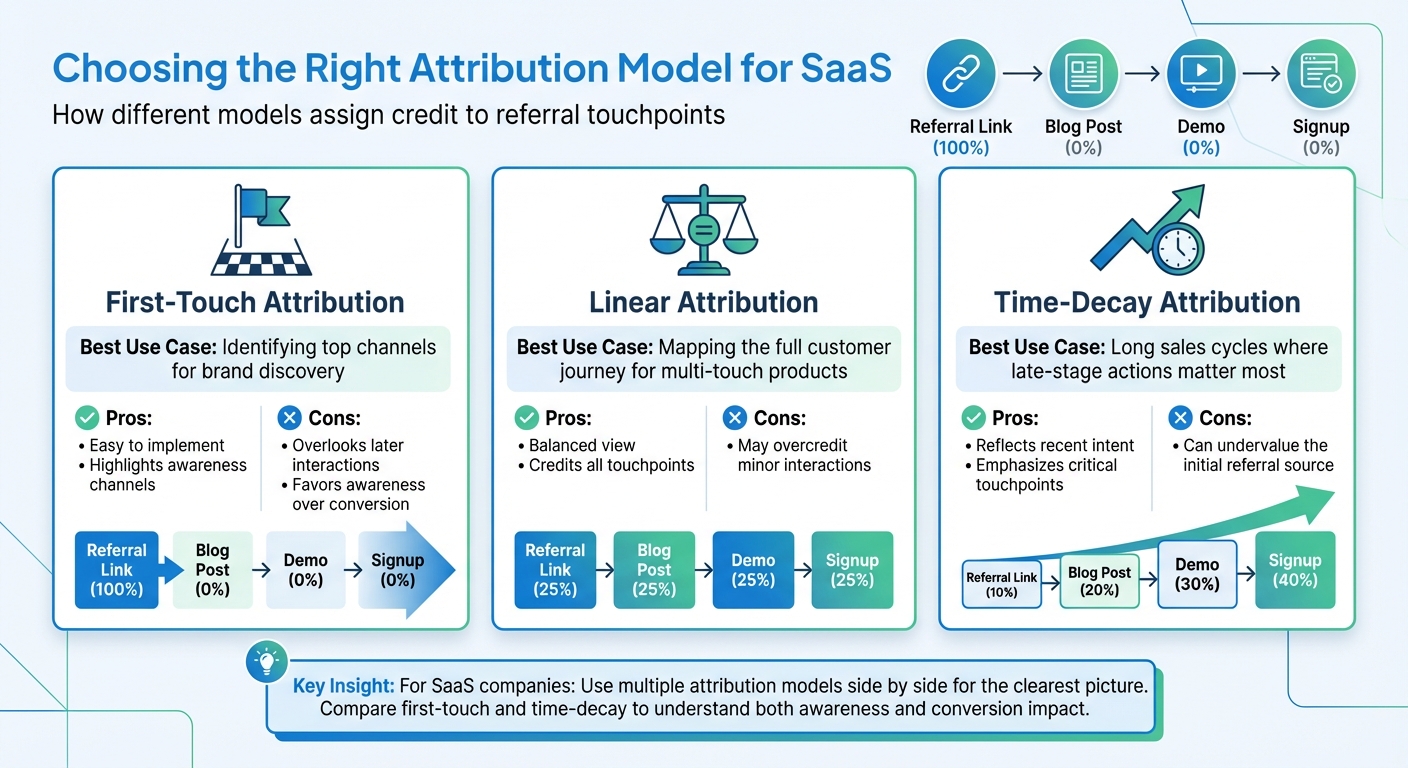
SaaS Attribution Models Comparison: First-Touch vs Linear vs Time-Decay
Once tracking is in place, the next step is to figure out how much value each referral source adds to your business. Without clear metrics, you're essentially guessing which sources are worth your investment and which ones are costing you more than they're bringing in. The goal here is to create a system that consistently shows which referral channels are driving results and which ones need adjustments.
Calculate Referral ROI
To measure referral ROI, use this formula:
((CLV × Referred Customers) – Costs) / Costs × 100
Here’s a quick breakdown:
- Customer Lifetime Value (CLV) is the total revenue a customer generates over their lifetime.
- Multiply CLV by the number of referred customers.
- Subtract the total program costs (like incentives, platform fees, and staff time).
- Divide the result by the costs and multiply by 100 to get your ROI as a percentage.
For example, let’s say your average CLV is $1,200, and you gained 150 customers through referrals last quarter. That’s $180,000 in revenue. If your program costs were $30,000, your ROI would be:
(($180,000 – $30,000) / $30,000 × 100) = 500%
This tells you that for every dollar spent, your program returned five dollars. A positive ROI means your referral program is working, while a negative ROI suggests it’s time to rethink your approach.
Make it a habit to track this metric monthly. If you notice a drop, dig into possible causes - like whether your incentives are less appealing, your product isn’t resonating as well, or your referrers have become less active. Staying on top of these trends lets you adjust before problems escalate. Also, optimizing your referral program with attribution models can provide even deeper insights into performance.
Compare Attribution Models
Not all referral sources contribute to conversions in the same way. Some introduce potential customers to your brand, while others play a bigger role in closing the deal. Attribution models help you assign credit to different touchpoints in the customer journey, and choosing the right one is key to understanding which sources truly drive ROI.
Here’s a quick overview of common attribution models:
- First-touch attribution gives all the credit to the first interaction a customer had with your brand. It’s great for figuring out which channels are best at creating awareness but ignores everything that happens afterward. For example, if a customer found you through a referral but converted after attending a webinar, the referral gets 100% of the credit - even though other factors influenced their decision.
- Linear attribution splits credit equally across all touchpoints. If a customer clicked a referral link, read a blog post, and then signed up after a demo, each step gets an equal share of the credit. This approach highlights the entire journey but may overemphasize smaller interactions that didn’t have a big impact.
- Time-decay attribution gives more weight to interactions closer to the conversion. For instance, in a long sales cycle, a final demo or free trial often carries more influence than the initial referral. While this model reflects recent intent, it can undervalue the original source that introduced the customer to your brand - especially in B2B sales where early awareness is critical.
Here’s how these models stack up for SaaS businesses:
| Attribution Model | Best SaaS Use Case | Pros | Cons |
|---|---|---|---|
| First-Touch | Identifying top channels for brand discovery | Easy to implement; highlights awareness channels | Overlooks later interactions; favors awareness over conversion |
| Linear | Mapping the full customer journey for multi-touch products | Balanced view; credits all touchpoints | May overcredit minor interactions |
| Time-Decay | Long sales cycles where late-stage actions matter most | Reflects recent intent; emphasizes critical touchpoints | Can undervalue the initial referral source |
For SaaS companies, using multiple attribution models often provides the clearest picture. Compare first-touch and time-decay models side by side. If referrals perform well in first-touch but poorly in time-decay, it means they’re great at driving awareness but need better follow-up to convert leads. On the flip side, if referrals excel in time-decay, they’re helping close deals - making them a smart investment for your budget.
Step 3: Analyze and Segment Referral Sources
Once you’ve assessed your referral ROI and attribution models, the next move is to break down your referral sources into useful segments. Not all referral channels are created equal - some bring in high-value, engaged customers, while others focus on volume but deliver lower long-term value. By segmenting, you can pinpoint where to invest more resources and which areas may need adjustments or even elimination. The goal here is to evaluate which channels truly drive value.
Evaluate Source Performance
Start by taking a close look at each referral source. Your UTM data is a goldmine for this, as it helps distinguish high-performing channels from those underperforming. Focus on metrics like lifetime value (LTV), retention rates, and secondary referrals to get a clearer picture of long-term ROI.
Here’s an example of how referral source performance might stack up:
| Referral Source | Conversion Rate | Revenue per Click | Customer LTV |
|---|---|---|---|
| Partner Referrals | 23.4% | $8.67 | $580 |
| Email Campaigns | 18.9% | $6.23 | $420 |
| LinkedIn Organic | 14.7% | $4.89 | $340 |
| Paid Social | 7.2% | $2.34 | $180 |
Partner referrals tend to outperform other channels because they often come from trusted professional networks, making them more reliable. Email campaigns also deliver solid results, especially when personalized and targeted. Paid social, while good for generating large volumes of leads, typically results in lower-quality customers with shorter lifespans.
To dig deeper, segment your referral sources by customer attributes. This could include subscription tier, customer tenure, or acquisition channel. For instance, customers who are highly engaged are four times more likely to refer others. Behavioral segmentation like this allows you to identify your most valuable referrers and fine-tune your incentives to match their preferences. This approach ensures your investments are directed toward the sources with the highest returns.
Use Cohort Analysis for Trends
Cohort analysis is an excellent tool for uncovering long-term trends and behaviors. It works by grouping referred customers based on when they were acquired - whether monthly, quarterly, or by campaign - and tracking their actions over time. This method can reveal patterns that aggregate data often hides, such as whether customers referred during Q1 have better retention rates than those referred in Q4 or if certain campaigns attract users who churn faster.
It’s also helpful to compare referred and non-referred cohorts to measure the program’s long-term impact. If referred customers consistently show higher LTV and lower churn rates, it’s a clear sign your viral marketing program is bringing in strong leads. Seasonal trends, like referral spikes during product launches or holiday promotions, which can be amplified by a viral pre-launch waiting list, can also be identified through cohort analysis, allowing you to adjust your timing and budget to make the most of these opportunities. Additionally, this analysis can serve as an early warning system. If you spot a recent cohort with unusually high churn, you can investigate and address the issue before it escalates.
Step 4: Optimize Referral Sources Through Testing
Once you've segmented your audience, the next step is to continuously improve your referral sources through testing. Even if a referral channel is performing well, there's always room for improvement. The most successful referral programs rely on data-driven experimentation to fine-tune incentives, messaging, and funnel design. In fact, businesses that combine both quantitative data and qualitative insights are 2.3 times more likely to achieve long-term success with their referral programs. Testing helps uncover actionable insights that can elevate your program to the next level.
### Run A/B Tests on Incentives
Experimenting with different rewards and messaging strategies can reveal what motivates your audience to take action. For example, you could test reward timing by comparing immediate incentives (like rewards given on signup) with delayed options (such as rewards after a purchase or milestone). Some users may prefer instant gratification, while others might be more enticed by the promise of a larger reward down the road.
You can also test different value propositions in your messaging. For instance, try emphasizing how the program helps friends discover something beneficial versus focusing on personal rewards. B2B audiences often respond better to messaging that highlights professional benefits, while consumer-focused users tend to engage more with clear, personal incentives.
Another key area to test is the placement of your call-to-action. Experiment with in-product prompts, email campaigns, or post-purchase messages to see which generates the most participation.
Prefinery's Customization Features
Prefinery stands out from traditional template-based referral tools by offering unparalleled flexibility and analytics capabilities. While many platforms lock users into rigid structures, Prefinery enables developer-friendly customization, making it easier to implement advanced testing strategies. Plus, its no-code integration ensures you can launch experiments quickly without pulling significant resources from your engineering team.
Here's how Prefinery compares to template-based tools:
| Feature | Prefinery | Template-Based Tools |
|---|---|---|
| Custom Reward Logic | Fully customizable timing, tiers, and conditions | Limited to preset reward structures |
| Testing Flexibility | Test multiple incentive models simultaneously | Basic or no testing capabilities |
| Analytics Depth | Track cohort behavior, lifetime value (LTV), and secondary referrals | Surface-level conversion metrics |
| Integration Options | Seamless API and webhook support | Rigid, pre-built integrations |
| Scalability | Enterprise-grade infrastructure for traffic spikes | Prone to performance issues at scale |
Prefinery's advanced customization and real-time analytics allow you to iterate quickly based on user behavior. Not only does the platform track first-order referrals, but it also monitors secondary referrals and long-term engagement trends. This comprehensive data helps refine your program over time. With 30% of new leads typically coming from referrals on the platform, Prefinery provides a reliable system that grows as your testing uncovers what resonates most with your audience.
Step 5: Scale and Prioritize High-Performing Sources
Now that you've tested and segmented your referral sources, it's time to focus on scaling the ones that work best.
Instead of spreading your budget thin across all channels, concentrate on the sources that consistently deliver high-quality customers at the lowest cost. By scaling these top performers, you ensure that every dollar you spend directly boosts your ROI. The ultimate aim? Create a sustainable system that grows alongside your business.
Use Predictive Analytics to Guide Decisions
Predictive analytics takes the guesswork out of scaling. By analyzing historical data, you can forecast which channels are likely to maintain strong performance. Metrics like customer lifetime value (LTV), conversion rates, and retention trends are key here. For example, if one referral source consistently brings in customers with a higher LTV, it makes sense to allocate more resources to that channel. Keep an eye on performance trends over time and prioritize quality over sheer volume.
This data-driven approach ensures you're not just scaling blindly but reinforcing the channels that deliver long-term results.
Invest in Scalable Platforms
Once you've identified your winning referral sources, make sure your infrastructure can handle the growth. Many referral tools falter under heavy traffic or when faced with complex reward structures. Prefinery stands out as a platform built for businesses ready to scale.
Prefinery handles traffic surges without downtime, thanks to its enterprise-grade scalability. Its developer-friendly API and webhooks make integration a breeze, while its analytics provide detailed insights into both primary and secondary referral activity. This allows you to track engagement trends and optimize referral funnel conversion rates as you grow. With 30% of new leads typically coming from referrals on Prefinery, reinvesting in a scalable solution like this ensures your referral program evolves alongside your business needs.
Conclusion
Using these strategies, structured referral analysis transforms raw data into practical steps that can improve ROI. By implementing proper tracking with UTM parameters, focusing on the right metrics, breaking down your sources, experimenting with different tactics, and expanding on what works, you can create a referral system that gets better with time.
"Unless you can measure the impact of your marketing, you can neither improve it nor use it as proof of your work." - Peter Drucker
UTM analysis has been shown to increase attribution accuracy by 47% and reduce wasted marketing spend by 35%. Considering that annual marketing waste averages $42,000 and customer acquisition costs have climbed nearly 60% over the last five years, refining your approach isn’t just helpful - it’s necessary for steady growth.
For SaaS and fintech startups, Prefinery simplifies this process with automated referral tracking, detailed analytics, and scalable tools designed to support growth. Its no-code setup and flexible referral rewards allow you to concentrate on your core product while your referral system runs smoothly behind the scenes.
Review your UTM practices, monitor trends, and reinvest in the channels that deliver results. Focus on your top-performing referral sources. You can also draw inspiration from successful SaaS referral examples to see how others optimize their channels. This methodical approach ensures your referral program not only brings in high-quality customers but also drives sustainable growth over the long term.
FAQs
How do I standardize UTM naming?
To keep your UTM naming consistent across your team, it’s essential to document your conventions in a centralized system. This ensures everyone is on the same page and reduces confusion. Stick to lowercase letters and use hyphens instead of spaces or underscores. This simple step helps avoid duplicates and keeps things accurate.
Automating tagging is another smart move. It cuts down on human errors and ensures uniformity. When deciding on a naming structure, go for something clear and straightforward, like key-value pairs, and make sure everyone applies it the same way.
Don’t forget to regularly review and clean up your UTM parameters. This keeps your data reliable and ensures you can trust your attribution metrics.
How do I choose an attribution model?
To pick the right attribution model, start by thinking about your referral goals, the customer journey, and the length of your sales cycle. Here are some common models:
- First-touch attribution: Gives all the credit to the channel where the customer first discovered your brand.
- Last-touch attribution: Assigns all credit to the final interaction before the conversion.
- Linear or time decay attribution: Spreads credit across multiple touchpoints, with time decay giving more weight to interactions closer to the conversion.
Each model works better for different strategies. Take a close look at which one matches your marketing priorities to get the most out of your referral data and improve your ROI.
How can I track referrals without cookies?
To keep tabs on referrals without relying on cookies, you can use UTM tags or server-side tracking.
- UTM tags: These are parameters added to your URLs that help identify the source of traffic. Analytics platforms, like Google Analytics, can then track these tags and provide insights into where your visitors are coming from.
- Server-side tracking: This method collects referral data directly on your server. It ensures you still get accurate attribution, even if cookies are blocked or cleared by users.
Both techniques are effective for identifying referral sources in environments where cookies aren't an option.