
Case Study: Boosting Referral Funnel ROI in SaaS
How one SaaS raised referral participation from 3.5% to 12%, cut CAC, and turned referrals into a 2.5× ROI channel.

Justin Britten
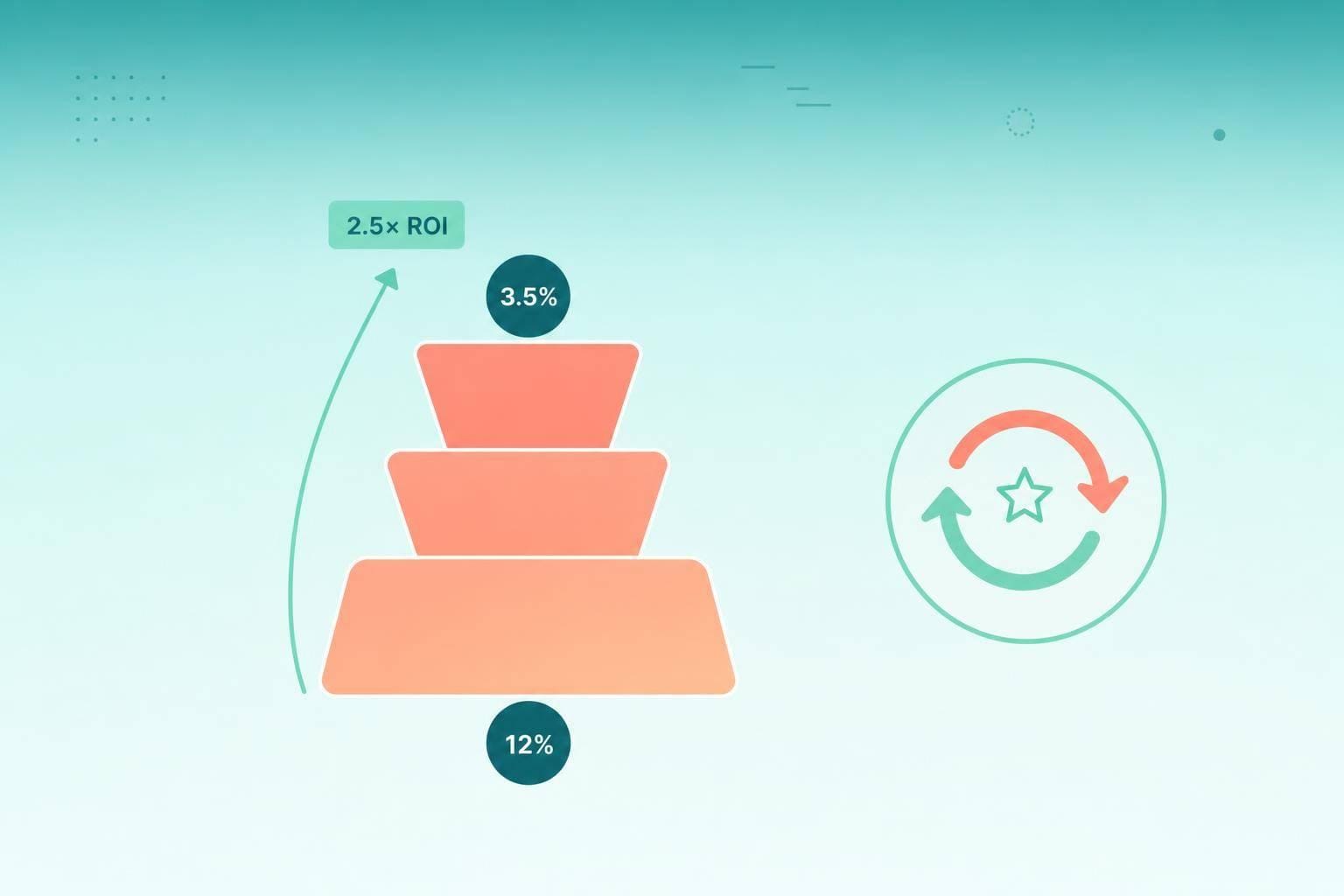
A SaaS referral program can go from side channel to profit driver when you fix participation, cut friction, and track ROI the right way.
In this case, I’d sum it up like this: the company moved referral participation from 3.5% to 12%, cut referred CAC from $160 to $110, and improved referral ROI from about 40% to about 180%. The big lesson is simple: the funnel was not weak at the bottom. It was too thin at the top.
If you want the short version, here’s what drove the change:
- Measure profit, not just shares or clicks
- Get more users into the referral flow
- Use two-sided and tiered rewards with cost controls
- Remove signup and sharing friction by following SaaS referral program examples that prioritize user experience
- Test prompt placement, copy, and reward size
- Track LTV, CAC, retention, and payback by referral cohort
A few numbers make the story clear:
- Referred customers reached 34% of new MRR, up from 12%
- Referred cohort LTV moved from $2,400 to $3,000
- Payback fell from about 6–7 months to about 3–4 months
- Monthly referral gross profit hit about $70,000 on $20,000 in program costs, or 2.5x ROI
Here’s the core idea in plain English: if you already have word of mouth, but you do not track it well, you may be leaving profit on the table. This case shows how I’d look at incentives, UX, and attribution to turn referrals into a bigger share of growth without letting costs get out of hand.
Baseline performance: where the referral funnel was losing money
Before the redesign, the company leaned hard on paid acquisition. Content and partnerships filled in the rest, but CAC varied and payback took longer. The core issue wasn't lead quality or weak conversion. It was how few people actually took part in referrals.
The startup already had word-of-mouth referrals in motion. The catch? None of it was tracked. So this wasn't a demand issue. It was a measurement issue.
To check whether the program was paying off, the team used one formula the whole way through:
ROI = [(Gross profit from referred customers – Program costs) / Program costs] × 100
Program costs included software and platform fees, cash credits and discounts issued to referrers and referees, and build and operating time for the referral flow and campaign management.
Starting funnel metrics and SaaS benchmarks
The team tracked four stages: referral invites sent, clicks on referral links, signups, and referred paying customers. Out of an active user base of 10,000, only 350 users sent at least one invite. That works out to a 3.50% participation rate.
Those users sent 1,400 total invites, which led to 560 clicks, a 40.00% click-through rate. From there, the funnel produced 84 signups, or a 15.00% click-to-signup conversion, and 21 paying customers, equal to a 25.00% signup-to-paid conversion.
So the lower part of the funnel was doing its job well enough. The weak spot sat at the top. Not enough users were entering the referral flow in the first place. For context, well-run B2B SaaS referral programs often see participation rates in the 10%–30% range, and a customer referral rate above 5% is seen as strong.
Baseline metrics table: startup vs. industry averages
| Metric | Startup Baseline | SaaS Industry Benchmark |
|---|---|---|
| Participation rate | 3.50% | 10.00%–30.00% |
| Click-to-signup conversion rate | 15.00% | 10.00%–20.00% |
| Referral share of new revenue | ~6.00% | 15.00%–30.00% |
| Referred CAC | $247.62 | ~$284.00 (SaaS avg.) |
| Non-referred CAC (blended) | $420.00 | Varies by channel |
| Baseline referral ROI | ~57.50% | N/A |
The pattern was pretty clear. The funnel itself wasn't broken. It just didn't have enough people moving through it. Even with a positive ROI, referral volume was too low to move the business in a big way. The next step was simple in theory, harder in practice: get more users to join the funnel without pushing CAC up. That meant changing incentives, smoothing out the UX, and tightening measurement with automated tracking and optimization.
What changed in the funnel: incentives, UX, and measurement
With participation stuck at 3.5%, the team zeroed in on three levers: incentives, UX, and measurement.
Reward design that raised participation without inflating CAC
The first version of the program used a single-sided discount. In plain English, only the referrer got the reward.
The team changed that to a double-sided reward, so both the referrer and the invited user got something. They also tested a tiered milestone setup to give heavy advocates a reason to keep sharing instead of stopping after one or two invites.
Double-sided rewards cost more per referral. But they tend to get more people to take part. Research shows they lift participation by about 29% compared with single-sided programs. Tiered reward structures can drive 27–60% more referrals than flat programs because they keep top advocates engaged over time.
Before rolling out any tier, the team modeled reward cost against expected LTV. That way, they could push participation up without letting margin slip as the program grew.
| Incentive Type | Expected Reward Cost | Participation Impact | Scalability | ROI Tradeoff |
|---|---|---|---|---|
| Flat discount (referrer only) | Lowest | Low | High | Low cost, weak engagement |
| Product credit (referrer only) | Low to moderate | Moderate | High | Modest lift, simple to manage |
| Double-sided reward | Moderate | Higher (+29%) | Moderate | Stronger participation, higher per-referral cost |
| Tiered milestone reward | Variable | Very high (+27–60%) | Moderate | Best for power users, needs LTV modeling |
Funnel UX and waitlist mechanics
The team didn’t stop at rewards. They also trimmed friction from the referral flow itself.
They shortened the signup form, made the referral call to action easier to spot, and added one-click sharing with unique links. Small moves on paper, but this is often where referral funnels live or die. If sharing feels like work, people bail.
They also added a waitlist position mechanic. Users could see their place on the waitlist and exactly how many referrals they needed to move up. That created a simple feedback loop: share, move up, share again. It turned the waitlist into something users could influence instead of just stare at.
To launch the waitlist, the team used Prefinery for no-code setup, customizable rewards, and analytics.
Once the flow was simpler, they started testing which mix of changes moved participation and ROI.
A/B tests and analytics that found the winning setup
The team ran a series of tests to isolate what was pulling its weight. Because each invite used unique links and reward logs, they could trace ROI back to each change instead of guessing.
| Test Variable | Metric Tracked | Observed Change | Effect on ROI |
|---|---|---|---|
| Reward amount (lower vs. higher credit) | Participation rate | Higher reward drove more participation | Helped the team balance participation against reward cost |
| Referral copy (generic vs. urgency-based) | Click-through rate on share link | Urgency-based copy improved click-through | More clicks per invite sent |
| Prompt placement (email vs. in-product modal) | Participation rate, conversion rate | In-product modal outperformed email | Better performance by reaching users closer to the action |
The in-product modal beat email because it reached users while they were already active in the product. Timing mattered. Asking someone to share in the moment worked better than hoping they’d come back to an email later.
The urgency-based copy also lifted click-through without changing the reward itself. That mattered because it improved response without adding more cost.
The team tracked participation rate, referral conversion rate, incremental revenue per referrer, and CAC.
Those tests gave them a setup that improved participation without pushing reward cost too high. That setup is the one shown in the results section.
Results: how the startup increased referral funnel ROI
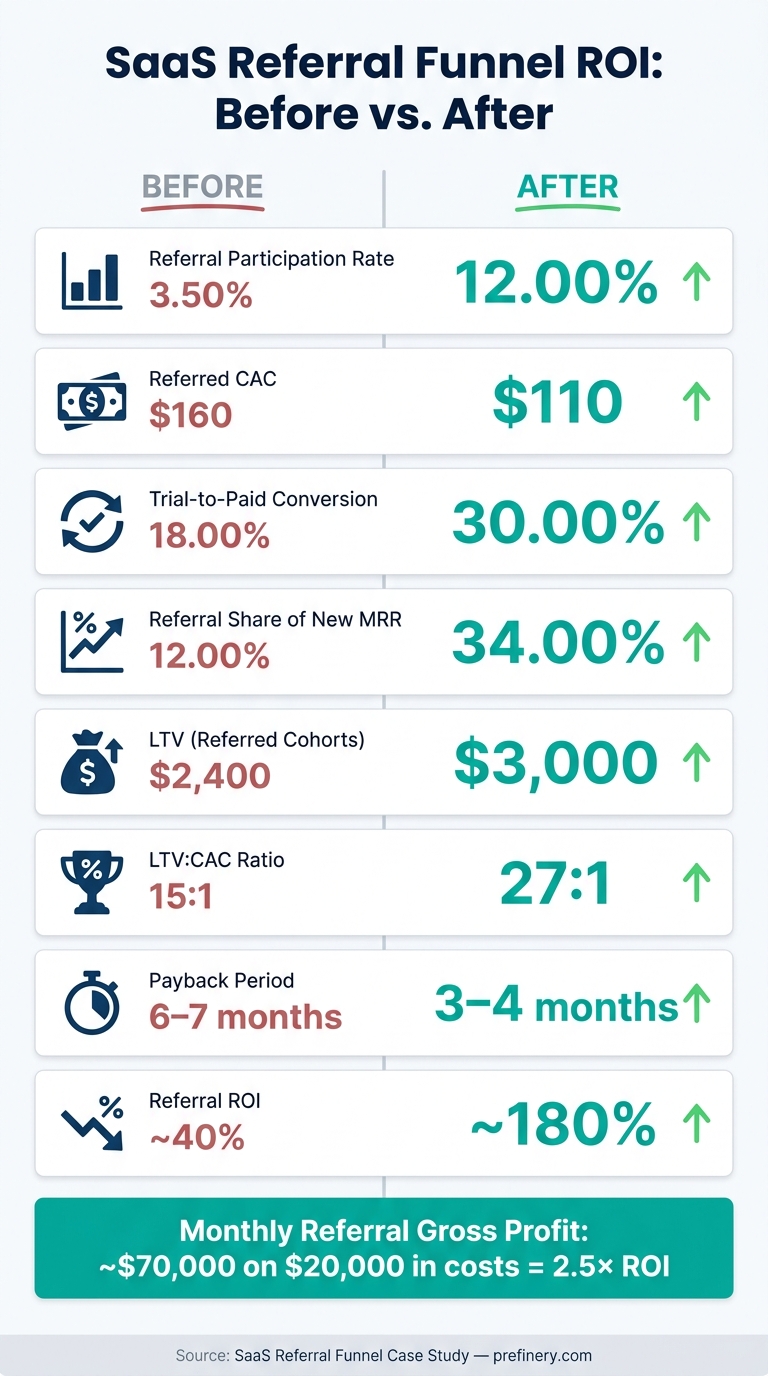
SaaS Referral Funnel ROI: Before vs. After Key Metrics
Before-and-after funnel and financial metrics
Once the winning setup went live, the team looked at what changed in the funnel economics. The three levers from the prior section - participation, conversion, and cost per customer - all improved. Here’s the before-and-after picture.
| Metric | Before | After |
|---|---|---|
| Referral participation rate | 3.50% | 12.00% |
| Referred trial → paid conversion | 18.00% | 30.00% |
| Referred CAC | $160 | $110 |
| Blended CAC (all channels) | $190 | $190 |
| Referral-attributed share of new MRR | 12.00% | 34.00% |
| 12-month retention (referred vs. non-referred) | 5–7% higher | 12–15% higher |
| LTV (referred cohorts) | $2,400 | $3,000 |
| Referral ROI | ~40% | ~180% |
The shift that stands out most is revenue mix. Referral-attributed revenue grew from 12% to 34% of new MRR, which turned referrals into a core acquisition channel instead of a side program. Retention also improved, which pushed LTV up and gave the program more staying power.
Updated ROI calculation and business impact
The team used the same formula the whole time: Referral ROI = (Referral-attributed gross profit − Referral program costs) ÷ Referral program costs.
After the changes, monthly results looked very different. On $90,000 in referral-attributed MRR and 75% to 80% gross margins, referral gross profit landed at about $67,500 to $72,000. Using the midpoint of about $70,000, the math was simple:
$70,000 gross profit − $20,000 costs = $50,000 net; $50,000 ÷ $20,000 = 2.5× ROI.
Referral program costs came to $20,000 total:
- $15,000 in rewards
- $3,000 in platform fees
- $2,000 in operational overhead
Before these changes, the same formula came out to about 40% ROI, based on roughly $30,000 in referral-attributed gross profit and $21,500 in costs.
The unit economics changed in a big way. Referred CAC fell to $110, while referred LTV climbed to $3,000. That put the referred cohort’s LTV:CAC ratio at about 27:1, up from 15:1 before. The payback period also dropped from around 6–7 months to 3–4 months. For a startup, that kind of payback shift matters. It frees up runway instead of tying it up.
There was also a compounding effect. Higher retention led to more secondary referrals, which sent more people back into the top of the funnel without extra spend. This is often achieved by using a viral marketing tool to automate the referral loop.
Takeaways for SaaS teams building a higher-ROI referral funnel
A simple framework for measuring referral ROI
Measure referral ROI by stage, cost, and cohort. If your team treats referrals like a side channel and only watches invites sent, you’ll miss both the true cost and the upside.
Map the whole funnel: invite sent, invite opened, signup, trial activation, paid conversion, and retained customer. Then compare each stage against your own baseline and channel mix. Include every cost that affects ROI, such as rewards, platform fees, developer time, and operating overhead. Track referred LTV and retention apart from your general cohorts. Review results each month by campaign or incentive.
That’s exactly how this startup measured performance: participation, trial activation, paid conversion, retained customer, LTV, and cost. Success wasn’t about stuffing the dashboard with more invites. It meant lower CAC, higher LTV, and stronger retention.
Once those metrics are in place, platform choice stops being a feature-shopping exercise. It becomes a measurement call.
What to look for in a referral platform
The right platform should support the tests that actually change ROI. For this startup, that meant clean handling for unique links, tiered rewards, waitlist mechanics, and attribution. Those capabilities made the startup’s testing possible.
| Capability | Why it matters for ROI |
|---|---|
| Launch and iterate without engineering | Cuts time to launch and speeds testing. |
| Flexible reward rules | Supports tiered, two-sided, and per-segment incentives so you can tune rewards without inflating CAC |
| Granular analytics & attribution | Connects invites to paid conversions across devices and sessions, closing the measurement loop |
| Reliable scale and integrations | Prevents missing attribution data that slows testing and distorts ROI |
Compared with template-based tools, Prefinery supports custom reward tiers, API integrations, and clean attribution, which helps keep ROI measurement accurate.
Key points from the case study
In practice, the gains came from measuring the right funnel stages and cutting friction at the top. Four changes drove the lift.
- Baseline measurement showed exactly where the funnel was losing money.
- Incentives and UX improved participation and conversion.
- Analytics-led A/B testing showed which reward structure and placement mix produced the best LTV:CAC ratio, not just the most signups.
- Tight ROI tracking turned referrals from a secondary channel into a core acquisition channel.
Better measurement + lower friction + smarter rewards = higher ROI. That’s the main thread running through this case.
FAQs
How do I know if referrals are really profitable?
Measure referral ROI, not just lead volume:
((Net Referral Revenue - Program Costs) / Program Costs) * 100
That means looking at the full revenue brought in by referred customers, not just the number of signups or demos. And on the cost side, include everything tied to the program:
- Rewards
- Platform fees
- Marketing spend
- Admin time
It also helps to watch CLV and CAC side by side. Referred customers often have 16% higher CLV, while referral CAC can be 30%–50% lower than what you see from other channels.
If your numbers line up that way, there’s a good chance the program is paying off.
What should I fix first if referral participation is low?
Start by optimizing your reward structure so it does a better job of motivating users. Dual-sided incentives - where both the referrer and the new sign-up get something - can make people much more likely to join in.
You can also use tiered rewards to keep users engaged over time. Instead of sticking with rigid, template-based setups, Prefinery makes it easy to test action-based and milestone rewards so you can see what lands best with your audience.
When should I use tiered or two-sided referral rewards?
Use tiered, two-sided referral rewards when you want to drive more than one referral without letting costs get out of hand.
The idea is simple: give rewards at set milestones, and reward both sides when it makes sense. That keeps people motivated for longer because they can see the next goal getting closer.
This setup works especially well for viral growth and prelaunch buzz. And with Prefinery, it’s much easier to automate these multi-level reward tiers at scale.