
How Referral Marketing Builds SaaS Communities
How structured referral programs reduce acquisition costs, increase retention, and turn users into engaged SaaS communities.

Justin Britten

Referral marketing turns happy users into growth drivers for SaaS companies, helping them acquire, engage, and retain customers while building strong communities. Unlike referral vs affiliate marketing or casual word-of-mouth, referral programs are structured and trackable, ensuring measurable results. Here's why referral marketing works for SaaS:
- Boosts Retention: Referred users churn 18% less and have 16% higher lifetime value (LTV).
- Drives Growth: Product-led companies report 20–30% of signups from referrals.
- Strengthens Communities: Incentives like account credits or feature unlocks encourage users to stay engaged.
To succeed, SaaS companies should:
- Set measurable goals (e.g., 10–15% of net new revenue from referrals).
- Offer rewards tied to product value (e.g., usage credits, premium features).
- Prompt referrals at "success moments" within the product.
- Use referral program examples and platforms for automation and fraud prevention.
Done right, referral marketing not only fuels growth but also creates a loyal, engaged user base that competitors can't replicate.
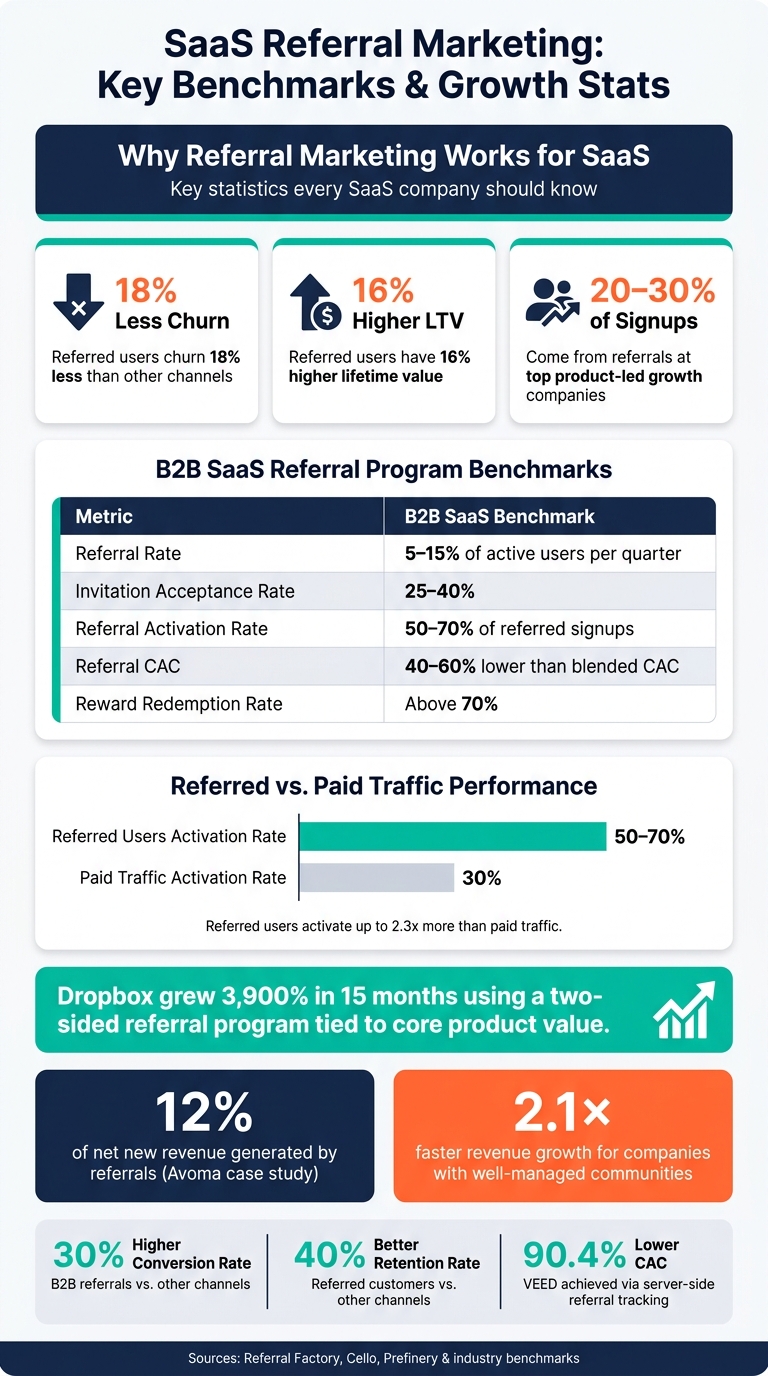
SaaS Referral Marketing: Key Benchmarks & Growth Stats
Designing a Referral Program for Community Growth
Setting Clear Goals for Referrals and Community Building
Before launching a referral program, it’s essential to define specific, measurable goals. Vague objectives won’t cut it - focus on metrics like acquisition, activation, and retention to cultivate a thriving, engaged community.
A solid benchmark? Aim for referrals to contribute 10–15% of your net new revenue. Take Avoma, a conversation intelligence SaaS, as an example. They analyzed their organic word-of-mouth growth and set a similar goal. The result? Their referral program generated 12% of net new revenue, providing clear evidence of its value.
For SaaS businesses that emphasize community, success isn’t just about signups. Instead, track engagement metrics like participation in private Slack or Discord groups or the number of new users joining through viral waitlist invite links. Healthy referral programs in B2B SaaS typically aim for a referral rate of 5–15% of active users and an activation rate of 50–70% for referred signups.
| Metric | B2B SaaS Benchmark |
|---|---|
| Referral Rate | 5–15% of active users per quarter |
| Invitation Acceptance Rate | 25–40% |
| Activation Rate | 50–70% of referred signups |
| Referral CAC | 40–60% lower than blended CAC |
It’s not just about numbers, though. Focus on quality over quantity by prioritizing signups that activate and stick around. Chasing high signup volumes without filtering for intent can lead to fraud and inflated metrics that don’t translate into real community growth.
Once your goals are clear, the next step is crafting incentives that attract the right kind of participants.
Creating Incentives That Strengthen Community
The rewards you offer will define the type of users you attract.
"Product incentives select for people who care about the product. Cash incentives select for people who care about cash." - Atticus Li, Applied Experimentation Lead, NRG Energy
This distinction is critical when building a community. Rewards like feature unlocks, account credits, or extra usage keep users engaged with the product itself. On the other hand, cash incentives often appeal to deal-seekers who may disengage once the reward is gone.
Two-sided rewards - where both the referrer and the new user benefit - are particularly effective. They make the invitation feel like a thoughtful gesture rather than a self-serving request. In professional communities, status-based perks such as early access to features, community badges, or recognition as a “power user” can sometimes be more motivating than monetary rewards.
The key is to align rewards with the way users experience value in your product. For example, a usage-based SaaS could offer usage credits, while a tiered product might unlock premium features. The reward should feel like an integral part of the product, not an afterthought.
Once you’ve nailed down compelling incentives, the next step is embedding referral prompts at the right moments in your product.
Adding Referral Prompts Inside the Product
Where and when you ask for referrals can make or break your program. Prompts placed directly within the product are three times more effective than email-only campaigns.
Timing is everything. The best moments to prompt referrals are during "success moments" - those points in the user journey when someone has just experienced significant value. For example, completing a first project, sending an invoice, or hitting a usage milestone. These are the times when users are most enthusiastic, and a referral request feels natural.
"Referral programs work when the product creates a moment of earned enthusiasm, and the program converts that enthusiasm into a low-friction ask at that exact moment." - Atticus Li, Applied Experimentation Lead, NRG Energy
Dropbox’s referral program is a classic example. By offering extra storage to both the referrer and the new user - a reward directly tied to its core value - Dropbox achieved 3,900% growth in just 15 months starting in 2010.
To make referral prompts effective, embed them in visible but non-intrusive spots like the main dashboard or navigation. Simplify the process with one-tap sharing options for platforms users already frequent, such as Slack, LinkedIn, or email. Pre-filling the message can further reduce friction and encourage users to share.
Using Technology to Scale Referral Marketing
How Referral Platforms Help SaaS Businesses
Once you've added referral prompts to your app, automation is the key to scaling effectively. A single referral program can lead to hundreds of signups, reward claims, and tracking events each month. But when referrals hit around 50 per month, managing everything manually becomes overwhelming.
Referral platforms step in to streamline the entire process. They handle everything from tracking unique referral links and verifying qualifying actions to automating reward distribution and syncing data with tools like Stripe, HubSpot, or Segment. By cutting down on administrative tasks, your team can focus on improving your product instead of juggling spreadsheets.
Another game-changer is in-app referral experiences. Unlike older systems that redirect users to external affiliate portals, modern platforms embed referral widgets directly into your app using lightweight SDKs. This approach isn't just convenient - it performs better. Native in-app referral loops convert 3x better than external portals.
When you're ready to explore referral platforms, it's important to compare features to find the right fit for your business.
Key Features to Compare in Referral Platforms
Referral platforms aren't one-size-fits-all. While feature lists are important, the underlying technology makes a big difference in performance and reliability.
One critical factor is the tracking method. Traditional tools often rely on browser cookies, which are increasingly blocked by ad blockers and privacy-focused browsers like Safari. Server-side attribution, on the other hand, ensures accurate tracking regardless of browser settings. For instance, VEED used server-side tracking to engage 1.3 million users and achieved a 90.4% lower customer acquisition cost (CAC) compared to paid channels.
Fraud prevention is another must-have. Features like self-referral blocking, IP tracking, velocity limits, and pattern detection help protect your program from abuse. This is crucial, as referral fraud contributes to the $1 trillion lost annually to cybercrime worldwide.
Here’s a quick look at essential features to consider:
| Feature | Why It Matters |
|---|---|
| Server-side attribution | Ensures tracking accuracy; unaffected by ad blockers or browser privacy rules |
| Native SDK / no-code embed | Embeds directly into your app for seamless user experience; converts 3x better than external portals |
| Two-sided reward automation | Simplifies payouts for both the referrer and the new user, boosting participation |
| Fraud prevention | Protects against self-referrals, IP abuse, and gaming the system |
| Billing & CRM integrations | Syncs with tools like Stripe, HubSpot, and Salesforce to automate workflows |
Prefinery: A Referral Platform Built for SaaS Startups
For SaaS startups looking to build momentum both before and after launch, Prefinery offers a viral waitlist system that stands out from traditional affiliate tools. Prefinery is designed to turn early signups into enthusiastic advocates who bring in their peers.
On average, 30% of new leads on Prefinery come directly from referrals, allowing startups to lower customer acquisition costs without increasing ad spend. Its no-code setup means you don’t need developer resources, and the platform’s customizable rewards let you tailor incentives to fit your product. Whether it’s moving up a waitlist, unlocking early access, or earning product credits, Prefinery makes it easy to align rewards with your goals.
Unlike rigid, template-based solutions, Prefinery gives startups full control over branding and access to detailed analytics to measure success. Plus, its scalable infrastructure ensures smooth performance even during traffic surges - critical for high-profile launches. For early-stage SaaS teams aiming to build a loyal and engaged community from day one, Prefinery offers the simplicity and reliability needed to grow organically while keeping costs in check.
Running a Referral Program That Grows Your Community
Metrics to Track for Referral Program Success
Tracking the right metrics is key to scaling a successful referral program. Start with your referral rate - the percentage of active users who initiate at least one referral per quarter. For B2B SaaS, this should range between 5% and 15%. If it's lower, your program might lack visibility or offer rewards that users don't find appealing.
Another critical metric is the referral activation rate, which measures how many referred users reach a meaningful milestone in your product. Referred users typically activate at a rate of 50–70%, far outperforming the 30% activation rate seen with paid traffic. This matters because activated users are much more likely to stay engaged and contribute to your community. Additionally, a reward redemption rate above 70% points to a smooth and trustworthy process, while a lower rate suggests that the reward system may be too complex or slow.
| Metric | B2B SaaS Benchmark | What It Tells You |
|---|---|---|
| Referral Rate | 5–15% of active users | Program reach and users' willingness to share |
| Invitation Acceptance Rate | 25–40% | How effective your invite message and channel are |
| Referral Activation Rate | 50–70% | Lead quality and onboarding effectiveness |
| Referral CAC | 40–60% lower than blended | The financial efficiency of the referral channel |
| Reward Redemption Rate | Above 70% | Indicates low friction and high user trust |
Once you’ve nailed down these metrics, focus on designing rewards that encourage meaningful actions.
Tying Rewards to Meaningful User Actions
Be strategic about when and how you reward users. Offering rewards right after signup often leads to low-quality leads or even fraud. Instead, tie rewards to actions that reflect genuine interest and commitment - like completing onboarding, making a first payment, or reaching a specific usage milestone.
This approach ensures that your community grows with users who are genuinely invested in your product. A great example is Typeform’s referral program, led by Senior Product Manager Linus Hallberg. By focusing on meaningful engagement, the program achieved a 27.3% monthly sharing rate and a 12.7% monthly signup rate, making it Typeform’s most cost-effective customer acquisition channel.
"We had a frictionless setup and are seeing promising results. Cello efficiently and quickly helped us set up and experiment upon an important growth loop." - Linus Hallberg, Senior Product Manager, Typeform
Rewards that align with your product - like feature unlocks, extra storage, or additional seats - tend to drive better retention than cash incentives. These rewards attract users who are genuinely interested in your software, fostering long-term engagement and stronger community participation.
Using Community Feedback to Improve Your Product
Once you’ve established metrics and aligned rewards, the next step is to actively gather and act on community feedback. This not only strengthens your referral program but also improves your product, creating a cycle of growth.
Your most active referrers - your "power referrers" - are a goldmine of insights. These are users who are so enthusiastic about your product that they’re bringing others in. They’re also likely to have valuable opinions on what’s working and what could be improved.
Identify these top referrers using cohort analytics, then engage with them directly. Whether through surveys, private Slack channels, or short calls, you can uncover product pain points and feature requests that might not surface from your broader user base. This process not only enhances your product but also makes these advocates feel valued, deepening their connection to your community.
"Advocacy, in the form of referrals, becomes one of the most powerful retention signals a SaaS company can have." - Jessica Paluzzi, CMO, Referral Factory
Keeping Your Community Healthy as It Grows
Setting Clear and Transparent Referral Policies
As your referral program grows, maintaining user trust becomes increasingly delicate. Participants need to clearly understand what they’ll earn, when they’ll receive it, and what might disqualify a referral. Vague or unclear rules can erode confidence in your program.
The best referral programs often limit participation to paid users or those who are highly engaged with your product. Why? These individuals have genuine experience with your offering and are more likely to represent it authentically. Pair these policies with fraud prevention measures like IP tracking, email verification, and reward caps to protect your program without discouraging honest advocates.
Another effective tactic is tying rewards to activation milestones rather than simple signups. For instance, rewards could be triggered only after a referred user completes a meaningful action - such as making their first payment or reaching a specific usage level. This approach discourages fake accounts and ensures referrals are tied to real engagement.
Once your policies are solid, the next step is to leverage the trust inherent in referrals during the onboarding process.
Onboarding Referred Users Into the Community
Referred users have a built-in advantage: they already trust your product because someone they know recommended it. A generic signup process, however, can squander this trust.
"The referred user's onboarding should be different (and usually shorter) than a cold signup. They came with trust. Do not make them fill out the full form." - Atticus Li, Applied Experimentation Lead, NRG Energy
Personalized landing pages can make a big difference. For example, a message like "Your friend Sarah invited you to try [Product]" instantly transfers the trust they have in their friend to your brand. From there, streamline the process to help them quickly reach their first "aha" moment - the point where they experience real value from your product. The faster they get there, the more likely they are to stick around and eventually refer others.
As your user base expands, adapting your referral strategy to scale becomes essential.
Adjusting Your Referral Strategy as Your SaaS Scales
What works for a small community of 500 users often falls apart when you scale to 50,000. A one-size-fits-all referral approach loses its effectiveness as your audience grows. This is where segmentation becomes key. Dividing users into sub-groups based on factors like industry, use case, or experience level allows you to maintain a personal touch, even as your numbers climb.
Your reward structure should also evolve. Early on, a simple two-sided incentive may work well. But as your program matures, consider introducing tiered rewards that acknowledge your most active advocates while avoiding over-rewarding casual participants. For high-value segments, such as enterprise users, invite-only referral tracks can add a sense of exclusivity, building trust and loyalty within those groups.
Non-monetary rewards become increasingly important as well. Things like exclusive badges, early access to new features, or public recognition in a newsletter can often mean more to a loyal advocate than cash rewards. These gestures strengthen the sense of community and shift the focus from purely transactional interactions.
Here’s why this matters: companies with well-managed communities grow revenue 2.1× faster than those without, and community-led onboarding can reduce churn by 29%. These stats highlight why nurturing your community isn’t just a nice-to-have - it’s a powerful driver of growth.
Conclusion: Growing SaaS Communities With Referral Marketing
Referral marketing stands out as one of the most dependable ways to grow SaaS communities. When done right, it not only helps bring in new users but also turns happy customers into passionate advocates who keep the growth momentum alive. As Jessica Paluzzi, CMO of Referral Factory, explains:
"The most resilient SaaS companies do not treat referrals as a side campaign. They embed referral programs into activation milestones, retention strategies, and expansion conversations."
The numbers back this up: B2B referrals boast a 30% higher conversion rate and a 40% better retention rate compared to other channels. On top of that, top-tier product-led growth companies attribute 20–30% of their new signups to referrals. These benefits multiply over time, giving companies a lasting edge over competitors.
The key to success lies in asking for referrals at the right moments, aligning referral incentives with the value of the product, making the referral process straightforward, and consistently using data to improve.
For those ready to implement these strategies, Prefinery offers a no-code platform designed to launch and scale refer-a-friend campaigns seamlessly. With customizable rewards and built-in analytics, it helps you focus on what matters most - creating a product people are excited to share.
FAQs
What’s the fastest way to launch a referral program in my SaaS?
To get a referral program off the ground quickly, make sure your SaaS already has a solid base of 50-100 active users who genuinely benefit from your product. Start by setting clear objectives and crafting incentives that make sharing your product both simple and rewarding. Platforms like Prefinery can help you set up a referral system without coding, offering features like customizable rewards and built-in analytics. Timing is key - launch your program only after gaining some initial traction to ensure higher engagement and better results.
How do I prevent referral fraud without hurting conversion?
To keep referral fraud at bay while still driving conversions, try combining a few smart strategies. Start with email and IP validation, device fingerprinting, CAPTCHA challenges, and identity checks to confirm users are legitimate. Another effective tactic is delaying rewards until users hit certain milestones, like completing a purchase, to ensure they're genuinely engaged.
Stay vigilant by monitoring for suspicious behavior and setting clear, transparent referral rules. These steps help safeguard your program's integrity while keeping things smooth and appealing for honest participants. It's all about finding the right balance between security and a seamless user experience.
When should my product ask users to refer a friend?
When users are actively engaged and have experienced the benefits of your SaaS, that’s the perfect moment to ask them to refer a friend. This often happens once you've hit initial product-market fit - usually around $1M–$3M ARR or when referrals account for 20–30% of new customers. Timing the ask correctly increases the chances they'll recommend your product, helping to drive organic growth and foster a loyal community.