
10 Referral Reward Models for SaaS Partners
Choose referral rewards by sales motion and margins—compare 10 payout models, hold payments through refund windows, and track CAC and fraud.

Justin Britten
I’d choose a referral reward based on your sales process and margin - not just what partners want to earn. Before paying anyone, define the referral event, verify it, and set a cost cap. Count payment fees, product costs, and both recipients’ rewards when calculating customer acquisition cost (CAC).
Here’s how I’d compare the 10 models, similar to successful SaaS referral program examples:
Quick Comparison
| Model | What the partner gets | Best fit | Main cost or risk |
|---|---|---|---|
| Cash rewards | Fixed cash reward | Self-serve SaaS | Fraud and self-referrals |
| Flat-fee conversion payouts | Fixed fee per qualified customer | Sales-led SaaS | Paying for weak deals |
| Account credits | Credit toward future bills | Subscription SaaS | Credits reduce margin |
| Free months and subscription discounts | Free service or lower bills | Self-serve and recurring plans | Lost revenue and service costs |
| Usage credits and feature access | More usage or paid features | Product-led and API SaaS | Usage and support costs |
| Gift cards and non-cash rewards | Gift cards, vouchers, or other perks | Occasional referrers | Fulfillment work and gift-policy limits |
| Recurring revenue share | Percentage of collected revenue | High-lifetime-value customers | Long-term commission costs |
| Tiered and progressive payouts | Higher payouts at set thresholds | Partner programs with steady volume | Overpayment and tracking errors |
| Flat fee plus performance bonus | Base fee plus conversion bonus | Sales-led deals | Spending before a sale closes |
| Dual-sided rewards | Partner reward plus customer incentive | Programs needing both sides to act | Combined reward costs |
My rule: <u>separate earning a reward from receiving payment</u>. Hold conversion-based payouts through the stated refund period, keep an auditable reward record, and check tax, disclosure, and fintech requirements where they apply.
Then test before scaling. Following referral program best practices ensures your incentives drive sustainable growth. Track verified conversions, total CAC, retention, and fraud - not referral counts alone.
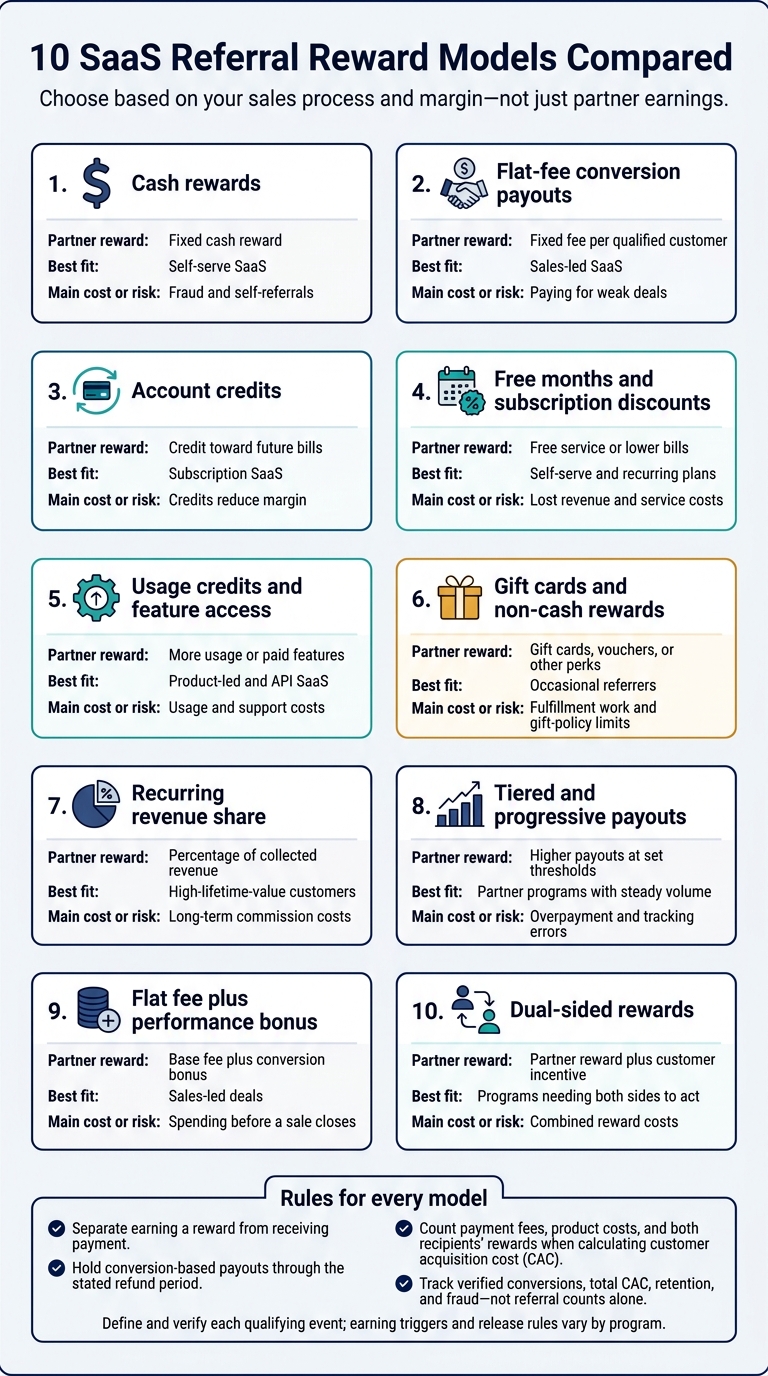
10 SaaS Referral Reward Models Compared
Set Referral Events and Payout Rules
Give each referral event one written definition and one verification step. Use that same definition across all reward models so you can compare cash, credit, revenue share, and dual-sided rewards on equal terms. These models are often central to referral marketing strategies used during product launches.
| Event type | Suggested success criteria | Verification method |
|---|---|---|
| Signup | A new user creates an account | Account record |
| Qualified lead | The prospect meets your written customer-fit criteria | CRM record |
| Sales-accepted opportunity | Sales confirms fit and agrees to pursue the deal | CRM acceptance status |
| Paid subscription | The first eligible subscription payment clears | Billing record |
| Retained customer | The account stays active and paid through your stated retention period | Subscription status and payment history |
Do not pay on sales acceptance unless it is a separate milestone. If you reward both sales acceptance and a paid conversion, track each milestone separately.
Set an attribution window for each program. The guidance suggests 30 days for self-serve SaaS and 60–90 days for sales-led SaaS. For fintech, use a shorter window tied to the transaction.
Publish the payment trigger, refund hold, payout minimum, and self-referral restrictions. Explain what happens to pending or paid rewards after a refund or chargeback. Choose a payout minimum that fits your margin and payment volume. Also state whether partners can refer their own business or accounts they control.
Before paying rewards, have finance and legal confirm U.S. tax forms, disclosure rules, gift-policy limits, and any fintech identity checks. Include these terms in the partner agreement, and make clear that approval does not mean immediate payment.
1. Cash Rewards
Once you’ve defined the trigger, cash rewards are the simplest fixed-value option for self-serve SaaS. Partners know exactly what they’ll earn, and your team can budget a fixed customer acquisition cost (CAC) per customer. Pay the referring partner only after the customer’s first paid invoice clears and the refund hold ends.
Count the reward, payment fees, and administration costs as CAC. Compare that total with gross margin and early churn - not just revenue. Accurate attribution matters, too. Use server-side attribution to block self-referrals and flag spikes from the same IP address or device.
2. Flat-Fee Conversion Payouts
Best-Fit Sales Motion
A flat-fee payout gives partners a fixed acquisition fee for each qualified customer. It fits sales-led SaaS and variable-billing fintech, where payout design matters more than payout size.
Qualifying Event and Recipient
Pay the partner at the first event that confirms the customer is both activated and qualified. Define that milestone around an eligible plan, sales acceptance, and the customer’s first activation or payment.
Reward Cost and Retention
Flat fees can favor volume over retention. Review customer retention and expansion, not just referral counts.
Payout Rules and Risks
Flat-fee payouts are easy to budget, but they can overpay for weak deals. Record reversals in a reward ledger so refunds and chargebacks remain auditable.
For a non-cash option, the next model puts the reward into product value.
3. Account Credits
Best-Fit Sales Motion
Account credits cap CAC by lowering the referrer’s future bill rather than paying cash. They work well for product-led and usage-based SaaS when partners have recurring charges to offset. Apply credits to the referrer’s account, so you don’t need a separate payout rail, helping to optimize your SaaS referral program.
Qualifying Event and Recipient
Release credits only after a verified paid conversion and once the refund or chargeback window has closed. Confirm eligibility through backend payment webhooks, and keep credits pending until they’re ready for release.
Reward Cost and Retention
Measure credits redeemed - not just credits issued to assess reward cost. Track redemption, renewal, and changes in usage to check whether credits encourage repeat spending. Compare referrers who redeem credits with similar customers who don’t.
Payout Rules and Risks
Spell out when credits expire, the balance cap, which charges they cover, and whether they stack with discounts. Explain how refunds, cancellations, and self-referrals affect earned credits. Flag suspected self-referrals and referral spikes for review, but don’t rely on shared IP addresses alone.
If account credits don’t fit your partner mix, the next model offers free months and subscription discounts.
4. Free Months and Subscription Discounts
Best-Fit Sales Motion
Free months work well for self-serve, product-led SaaS. This approach is often powered by a viral marketing tool to automate acquisition. Percentage discounts suit sales-led accounts because the reward grows with the contract value.
Qualifying Event and Recipient
Base eligibility on the paid conversion event in your program rules - not an invite or trial. Apply the free month or discount to the referring partner’s account. Keep it separate from other referral or promo credits so billing can audit it easily.
Reward Cost and Retention
Include both lost subscription revenue and the cost of serving the account during the reward period. For percentage discounts, set the duration upfront so you can forecast the commitment more easily.
Payout Rules and Risks
Define refund and cancellation rules upfront so billing can reverse the reward without confusion.
If cash-equivalent rewards don’t fit your program, the next model uses non-cash incentives.
5. Usage Credits and Feature Access
Best-Fit Sales Motion
Usage credits and feature access work well for self-serve SaaS. They reward referrals with product value and let partners try premium features before paying. Reserve priority support for top-tier partners and early access for beta testers.
Qualifying Event and Recipient
Link the partner’s reward to a verified referral event, then grant access automatically.
For example, unlock the reward after the referred user’s first API call.
Reward Cost and Retention
Budget for usage and support costs, not just the reward itself. Priority support takes staff time, while early access needs oversight. Feature access can also help retain partners by giving them more reasons to stay.
Payout Rules and Risks
Limit support entitlements to what your team can deliver. Give partners a dashboard to check reward status and pending credits. This builds trust and cuts down on support questions. Have your compliance team review non-cash incentives, especially in fintech.
For rewards partners can spend outside the product, the next model uses non-cash incentives.
6. Gift Cards and Non-Cash Rewards
When product credits won’t motivate a partner, offer rewards they can spend elsewhere. Non-cash rewards sit between cash and product credits: cash may feel too direct, while credits may have limited appeal.
Best-Fit Sales Motion
Gift cards work best for occasional referrers who won’t use account credits.
Examples include self-serve users and one-off fintech partners. Training vouchers or event tickets fit agencies and consultants; merchandise fits brand advocates.
Qualifying Event and Recipient
Tie the reward to a verified paid conversion, not just a signup, to protect margins. State clearly whether the individual referrer or their organization receives it.
Reward Cost and Retention
Gift cards can provide strong short-term motivation, but they rarely encourage continued product use. Fulfilling rewards manually also adds reconciliation and admin work.
Payout Rules and Risks
Send gift cards only after the refund or chargeback window closes. Set a $50 minimum to avoid processing costs on small rewards.
For incentives tied to continued revenue, the next model shares value over time.
7. Recurring Revenue Share
Best-Fit Sales Motion
Recurring revenue share pays partners a percentage of collected subscription revenue, either for a fixed term or for life. Fixed terms help keep CAC predictable. Reserve lifetime payouts for high-value partnerships that help retain customers by following principles for designing referral incentives.
Qualifying Event and Recipient
Pay partners only after a paid conversion. Calculate commissions from collected subscription payments - not signups.
Reward Cost and Retention
Base payouts on net subscription revenue, after discounts and taxes.
Payout Rules and Risks
Adjust the commission base when upgrades or downgrades change the plan price. If a customer gets a refund or churns within the clawback window, reverse unpaid commissions. Track attribution and payouts separately so reversals don’t distort payout history.
Tiered payouts give partners who bring in more volume a chance to earn more.
8. Tiered and Progressive Payouts
Best-Fit Sales Motion
Use tiers to increase payouts as partners perform better. Volume tiers reward more signups or paid conversions and fit PLG and SMB SaaS. Value tiers reward ARR or MRR growth and fit enterprise SaaS and agency partners.
Tiered payouts reward milestones. Revenue share pays partners based on collected revenue over time.
Qualifying Event and Recipient
Define exactly what triggers each tier: signups or paid conversions for volume tiers, and ARR or MRR for value tiers. The partner who reaches the next tier earns the higher payout.
Reward Cost and Retention
Set payout caps for each tier to protect your margins. Keep pending and released rewards, churn, and reversals in one reward ledger so you can track and adjust payouts clearly.
Payout Rules and Risks
Specify whether higher rates apply only to future conversions or also to earlier ones. Retroactive rate changes create larger liabilities. Run standard fraud checks before releasing tier upgrades.
To reward both the referrer and the new customer, use the next model.
9. Flat Fee Plus Performance Bonus
Best-Fit Sales Motion
This model pays an upfront fee for verified pre-sale activity, followed by a second payout after conversion. For sales-led SaaS, tie the fee to an accepted lead registration. For self-serve SaaS, a signup for a viral waitlist can qualify. For fintech, check eligibility before paying any fee.
Qualifying Event and Recipient
Pay the base fee for verified activity and the bonus only when the customer reaches the agreed conversion milestone. Make the payment terms clear: Is the upfront fee paid even if the lead never converts? Does the bonus require a paid purchase?
Reward Cost and Retention
Budget for both payments, then cap total CAC based on margin and expected churn. Low-margin products may not support a base fee plus a bonus, especially when churn is high.
Payout Rules and Risks
Set a 30–90-day attribution window and define who gets credit if multiple partners claim the same lead. Apply clawbacks to canceled or refunded deals - not to base fees already earned for valid work. Release bonuses only after verifying payment and waiting through any refund window.
The next model lets you reward both the partner and the customer directly.
10. Dual-Sided Rewards
Best-Fit Sales Motion
Use dual-sided rewards when a one-sided payout isn't enough to drive both referrals and conversions. This is common when executing LinkedIn referral strategies to reach professional decision-makers.
Offer a product-side reward for self-serve SaaS, a partner payout plus customer discount for sales-led SaaS, and cash or credits for fintech with compliance approval.
Qualifying Event and Recipient
Set separate earning triggers and reward release points for each recipient. Partners can earn after a verified conversion. Customers can receive a discount or credit at signup, qualification, or closed-won, depending on the program.
Reward Cost and Retention
Both rewards count toward CAC, including onboarding perks. Compare renewal rates and retained revenue with the full reward cost. Don't assume credits will offset that spending.
Payout Rules and Risks
Block self-referrals and review device/IP spikes. Keep separate invite, attribution, and payout records in a reward ledger so you can trace adjustments and reversals. For fintech, add payout delays and minimums to allow fraud review and compliance approval before release.
Apply the same event, cost, and fraud rules when comparing dual-sided rewards with one-sided models.
Compare Reward Costs, Fit, and Risks
Define one qualifying event for each model so you can compare cost, fit, and risk on the same basis. Then use the table to choose a payout structure that matches how you sell.
| Reward model | Reward type | Primary recipient | Best-fit SaaS motion | Typical payable event* | Cost predictability | Retention alignment | Main risk |
|---|---|---|---|---|---|---|---|
| 1. Cash Rewards | Cash | Referrer/partner | Self-serve / high-volume product launches | Paid conversion | High | Low | Fraud / self-referral |
| 2. Flat-Fee Conversion Payouts | Fixed cash payment | Referrer/partner | SMB / B2B | Qualified lead or sale | High | Low | Low-quality leads |
| 3. Account Credits | Account credit | Referrer/partner account | Subscription SaaS | Paid conversion or renewal | Medium | High | Margin erosion |
| 4. Free Months and Subscription Discounts | Discount | Referrer/partner account | Recurring revenue | Successful payment | High | Very High | Revenue delay |
| 5. Usage Credits and Feature Access | Product benefit | Referrer/partner account | PLG / API SaaS | Signup or milestone | High | High | Technical abuse or low perceived value |
| 6. Gift Cards and Non-Cash Rewards | Gift card or non-cash benefit | Referrer/partner | B2B / Professional | Qualified lead or demo | High | Low | Administrative complexity |
| 7. Recurring Revenue Share | Recurring commission | Referrer/partner | High-LTV B2B | Collected subscription payment | Low | High | Long-term margin loss |
| 8. Tiered and Progressive Payouts | Escalating payouts | Top-volume partner | Mature ecosystem | Volume milestone | Medium | Medium | Tracking complexity or overpayment |
| 9. Flat Fee Plus Performance Bonus | Base payout plus bonus | Referrer/partner | Enterprise | Base qualifying event plus sales milestone | Medium | Medium | High upfront cost |
| 10. Dual-Sided Rewards | Cash, credit, or discount | Referrer/partner and customer | PLG / consumer SaaS | Signup plus paid subscription | Low | High | Budget overruns |
*Events shown are options, not universal requirements.
Budget recurring commissions against collected revenue - not signed contract value. For credits, forecast costs when recipients redeem them, not when you issue them. Dual-sided programs need a budget for both recipients, not just one.
For cash-based programs, set a maximum reward cap per partner and a minimum payout threshold, such as $50, to limit exposure.
Conclusion: Test Your Reward Model Before Scaling
After comparing models, choose the one that fits your sales process and margin. Fixed payouts keep acquisition costs predictable. Recurring revenue shares make sense only when customer lifetime value supports continued commissions. Add tiered payouts to motivate top partners once you’ve tested your base incentives. Offer dual-sided rewards only when both the partner and customer need an incentive.
Before rollout, check the economics. Set your budget based on contribution margin and expected customer lifetime value. Track qualified conversions, total reward costs, retention, and fraud before scaling.
Use server-side attribution, block self-referrals and bursts of activity, and hold payouts until the refund or chargeback window closes. Test attribution, fraud controls, and clawbacks before scaling.
FAQs
How do I calculate an affordable referral reward?
Set your reward amount based on customer lifetime value (CLV) and customer acquisition cost (CAC). As a rule of thumb, keep rewards at or below 10% of CLV. Another approach: many SaaS companies offer 10%–25% of the monthly subscription price.
Choose rewards tied to your product, such as account credits, and consider rewarding both users. To track ROI, compare reward costs with the revenue they generate. Then adjust payouts so the program can keep running without spending more than it earns.
How long should I test a reward model?
Testing a reward model takes repeated work, not a single trial. Start with a small group before rolling it out to more people. Then run quarterly A/B tests to compare cash with credits, or one-sided with two-sided rewards.
Template-based solutions can limit your options. Prefinery lets you adjust reward logic and test incentives to improve ROI. Record your results so you can build on what worked and keep your program competitive.
Can I change rewards without upsetting existing partners?
Yes - keep program rules simple, explain changes clearly, and adjust incentives based on performance. Spell out which actions qualify, the milestones partners must meet, and when payouts happen. Partners should earn rewards under the rules they agreed to - for example, after a purchase.
Tools like Prefinery support custom reward logic and tiered rewards without custom code. That makes it easier to adjust incentives, automate reward distribution, and reduce disputes.