
SaaS Referral Campaigns: Segmentation Best Practices
Targeted segmentation is the key to scaling SaaS referral programs—use lifecycle, behavioral, firmographic, value, and geographic splits to boost conversions and ROI.

Justin Britten
Want to maximize your SaaS referral program's performance? The key lies in targeted segmentation. By focusing on the right customer groups and offering tailored rewards, you can increase referrals, lower acquisition costs, and drive higher conversions.
Here’s a quick breakdown of effective segmentation strategies:
- Lifecycle Stage: Target users at key moments (e.g., after a milestone or a positive experience).
- Behavioral Usage: Focus on actions like product adoption or feature engagement.
- Firmographics (B2B): Segment by company size, industry, or role for more relevant rewards.
- Value-Based: Prioritize high-LTV customers to boost ROI.
- Demographics & Geography: Use age, location, or income to personalize offers.
Pro Tip: Tools like Prefinery make it easier to track user data, automate segmentation, and manage rewards.
Each strategy has its strengths and challenges, but combining methods often yields the best results. Tailor your approach to your business model - B2B SaaS benefits from firmographics and cash rewards, while B2C thrives on behavioral segmentation and discounts—as seen in these SaaS referral program examples.
1. Lifecycle Stage Segmentation
Segmenting users based on their stage in the customer journey can significantly boost the effectiveness of referral programs. This approach groups customers by where they stand - whether they’re trial users, power users, or even churned accounts. Why does this work so well? Timing is everything. A user who just had a positive experience with your product is far more likely to recommend it than someone who hasn’t yet seen its value.
The trick lies in pinpointing those pivotal moments in the customer journey. For instance, in a CRM, a key moment might be when a salesperson closes their first deal. In a budgeting app, it could be when a user successfully stays under their spending limit. Dropbox nailed this concept by defining successful referrals not just as sign-ups but as new users installing the app on their computers. This shift helped them grow from 100,000 to 4 million users.
Data Requirements
To effectively segment by lifecycle stage, you need to track specific conversion events that reflect genuine product use. Key data points include:
- Subscription status (trial, freemium, or paid)
- Milestones like profile completion or a user's first major action
- Tenure combined with satisfaction indicators
For B2B SaaS, tracking actions like linking a credit card for auto-pay or completing three consecutive payments can signal a deeper commitment.
Modern platforms automate referral marketing by creating unified customer profiles. These profiles combine preferences, demographics, and real-time behavior to trigger referral prompts at the perfect moment - when users are most likely to say "yes." The goal? Catch them at their happiest, not at random intervals.
Best Use Cases
Mapping key milestones can further amplify referral success. For example, post-purchase triggers often yield high sharing rates. Order confirmation pages are ideal because users are still excited about their recent purchase. Similarly, milestone achievements - like a user’s third subscription month or hitting a usage goal - are natural moments to request referrals.
For churned or inactive users, lifecycle segmentation allows for personalized win-back campaigns. Tailoring rewards to the user’s relationship with your product is key. For instance, B2B users who don’t pay out of pocket may respond better to gift cards or cash, while B2C subscribers often prefer account credits or discounts.
Impact on Referral Metrics
Lifecycle segmentation can dramatically improve referral program results. SaaSquatch reports that making a referral program visible across multiple touchpoints, rather than burying it in a menu, can more than double its performance. Conversion rates also improve when success criteria are tied to meaningful actions, like upgrading from a trial to a paid plan. This helps weed out low-quality referrals and reduces the risk of fraud. Striking the right balance in reward requirements is essential - too strict, and users may lose interest; too lenient, and you risk gaming the system.
According to Friendbuy, referrals driven by well-timed prompts tend to bring in customers with higher lifetime value. Why? Because these new users often come in with built-in trust.
Advantages and Limitations
One of the biggest strengths of lifecycle segmentation is its ability to align with user emotions. As SaaSquatch explains:
"Identify the places in your application or website where a user would be feeling the most positive... a customer is much more likely to want to refer a friend".
This emotional connection not only boosts participation rates but also ensures higher-quality referrals by tying rewards to meaningful actions rather than superficial ones.
That said, this strategy isn’t without its challenges. Reach can be limited if you focus too narrowly. As Friendbuy cautions:
"If you were to only run a post-purchase widget, you'd be leaving 95 percent or more of your potential on the table".
Most e-commerce sites convert just 3% to 5% of visitors, so relying solely on post-purchase triggers misses a huge opportunity. Additionally, implementing lifecycle segmentation requires a solid tech stack capable of tracking user behavior and mapping the customer journey. Success milestones also need careful calibration - too much friction can discourage users, while too little invites system abuse.
Platforms like Prefinery make this process easier by integrating segmentation strategies with real-time analytics, ensuring referral programs hit the mark.
2. Behavioral and Product Usage Segmentation
Building on lifecycle insights, behavioral segmentation takes things a step further by focusing on users' in-product actions to refine referral triggers. While lifecycle segmentation pinpoints when to ask for referrals, behavioral segmentation zeroes in on what users are doing within your product. By tracking specific actions - like completing a project, reaching a usage milestone, or adopting a key feature - you can identify your most engaged users. And here's the thing: active users are far more likely to recommend your product than those who log in sporadically.
A great example of this approach is Dropbox. Instead of simply tracking sign-ups, they shifted to monitoring desktop installations, which better reflected actual product adoption. Morning Brew took a similar route, measuring successful referrals as a key behavioral metric. By rewarding users based on how many friends they referred who stayed engaged, they grew to 2.5 million subscribers - 30% of that growth came directly from their referral program. The key difference here? Behavioral triggers are action-based, not tied to time intervals.
Data Requirements
To implement behavioral segmentation, you’ll need to capture real-time event data and create a "Golden Profile" for each user. This profile combines preferences, demographics, and behavioral patterns. Key data points might include app installations, feature usage frequency, and milestone completions, like logging a 10th workout or closing a 50th deal.
Customer Data Platforms (CDPs) like Twilio Segment can make this process easier by syncing first-party behavioral data directly to your referral platform. No need for manual exports or custom builds. With API integrations, you can pull referral data straight into your dashboard, creating a seamless experience within your SaaS app. Tools like Amplitude or FullStory further enhance this by analyzing your marketing funnel to identify high-value behavioral segments, such as your most active or highest-spending users.
While behavioral segmentation requires more advanced tracking, the precision it offers is worth it. Instead of guessing when users might be happy, you’re measuring it through their actions.
Best Use Cases
Behavioral segmentation works best when you can pinpoint clear "aha moments" in your product. For instance, a project management tool might identify this moment as when a team completes their third project. For a financial app, it could be when a user links their bank account and completes their first automated transaction. These moments represent real value for users, making them ideal opportunities to ask for referrals.
Visibility is also critical. As SaaSquatch notes:
"The best-performing programs are accessible on every screen of your app. In fact, we've seen program performance more than double simply by making it more visible".
To ensure users see your referral program, integrate it into your app’s main navigation or behind a member login. Avoid burying it in a settings menu where it’s likely to go unnoticed.
Fraud prevention is another key benefit. By setting high-bar conversion events - like requiring a minimum purchase amount or waiting until a trial period ends - you can ensure rewards go only to genuine, high-intent users. This safeguards your budget while maintaining referral quality. In fact, over 70% of successful double-sided referral programs use the same reward structure for both parties (like "Give In fact, over 70% of successful double-sided referral programs use the same reward structure for both parties (like "Give $10, Get $10"), which keeps things fair and simple0, Get In fact, over 70% of successful double-sided referral programs use the same reward structure for both parties (like "Give $10, Get $10"), which keeps things fair and simple0"), which keeps things fair and simple.
By targeting meaningful user actions, you not only engage users but also enhance the performance of your referral program.
Impact on Referral Metrics
Behavioral triggers are highly effective at boosting sharing rates because they target users at moments of peak engagement. When someone has just completed a significant action in your product, they’re emotionally primed to share their success. This well-timed nudge can lead to higher participation rates.
The bigger impact, however, lies in referral conversion rates and ROI. By defining success through high-value actions rather than simple sign-ups, you filter out low-quality leads. Personalized calls-to-action based on behavioral data convert 42% more visitors into leads compared to generic CTAs. Including a behavior-triggered CTA in emails can increase clicks by 371% and sales by an astonishing 1,617%.
Platforms like Prefinery help automate this process, using intelligent behavior tracking and custom event triggers to create dynamic, audience-specific referral experiences. This eliminates the need to build everything from scratch. On average, Prefinery customers see a 40% boost in leads by leveraging referral systems that reward users based on actual engagement patterns.
Advantages and Limitations
The standout advantage of behavioral segmentation is its precision. You’re targeting users based on their demonstrated satisfaction, not assumptions. This allows you to tailor messaging, rewards, and engagement strategies to specific user actions, turning happy customers into enthusiastic advocates.
That said, the technical demands are significant. Unlike lifecycle segmentation, which can rely on basic subscription data, behavioral segmentation requires flexible APIs and robust data integration across multiple sources. Modern tools aim to simplify deployment, often within days.
Another challenge is identifying which behaviors truly correlate with referral likelihood. Not every action signals satisfaction - for example, a user canceling a feature might have high engagement metrics but low advocacy potential. This means ongoing analysis and refinement are crucial, unlike the more straightforward time-based triggers used in lifecycle segmentation.
For SaaS companies with clear product usage patterns and measurable value moments, the investment in data infrastructure pays off. However, businesses still defining their core metrics may find simpler segmentation strategies more practical to start with. These strengths and challenges will be explored further in the comparative analysis ahead.
3. Firmographic Segmentation for B2B SaaS
Firmographic segmentation zeroes in on organizational traits to better understand what drives B2B referrals. This method categorizes customers by company characteristics like size (Small Business, Medium Business, Large Enterprise, Freelancer), industry, and location. For B2B SaaS companies, this is especially important because the person using your product often isn't the one paying for it. That dynamic shifts how you approach referral rewards and messaging.
Data Requirements
To effectively use firmographic segmentation, you need to create unified profiles that combine user and company data. The key data points include organization type, industry, revenue, number of employees, and user roles.
You can gather this information using enrichment tools and first-party integrations, like Twilio Segment, to keep profiles updated in real time. Monitoring in-app events - such as completing a profile or linking a corporate credit card - can also help identify valuable B2B segments.
Automation is a game-changer here. APIs can integrate referral data into your dashboards, ensuring firmographic segments stay current as companies evolve. Tools like Prefinery simplify this process with no-code integrations that sync referral data and update segments automatically. Prefinery’s developer-friendly features and detailed analytics let you fine-tune rewards based on accurate, up-to-date firmographic insights.
Best Use Cases
Firmographic segmentation is particularly useful when rewards need to appeal to the individuals driving referrals. In many B2B settings, employees aren’t footing the bill, so rewards like gift cards or cash are more motivating than subscription discounts. However, for small business owners or freelancers - who often manage their own expenses - discounts or account credits can be more appealing.
Here’s a quick guide to tailoring rewards based on business models:
| Business Model | Recommended Reward | Why It Works |
|---|---|---|
| B2B (Enterprise) | Gift Cards or Cash | Employees don’t pay the bills, so discounts hold less value. |
| B2B (SMB/Freelance) | Discounts or Credits | Users directly benefit from cost savings. |
| B2C | Discounts or Credits | Personal savings resonate with individual users. |
Industry-specific targeting is another strong use case. SaaS products often serve niche markets where trust and word-of-mouth are powerful drivers. Emma Kimmerly from Friendbuy explains:
"SaaS products often serve specific niches or industries... Referral programs can tap into these networks, leveraging the tight-knit relationships and trust within the community to drive referrals."
By using firmographic data, you can craft messages that resonate with specific industries. For instance, exclusive "invite-only" programs for enterprise users could include higher-tier rewards like charitable donations or premium features, appealing to their professional networks.
Impact on Referral Metrics
Firmographic segmentation can significantly boost referral performance. Well-targeted messaging and incentives can drive up to three times more conversions, while also lowering customer acquisition costs. By zeroing in on high-value segments, you attract leads with greater lifetime value. This aligns with the Pareto Principle - where 80% of revenue often comes from 20% of customers.
Multi-tiered referral programs tailored to firmographic tiers, especially for enterprise clients, can encourage consistent sharing. Combining firmographic data with insights like current plan tiers helps identify which segments are most likely to upgrade after a referral.
Vineet Gupta, Founder of 2xSaS, highlights the broader benefits:
"Segmentation enables SaaS companies to identify specific groups with unique preferences, needs, and behaviors... increasing the effectiveness of their marketing efforts."
This matters because personalization works. About 88% of marketers report measurable performance improvements from segmentation-driven personalization, and 70% of customers say a company’s understanding of their needs influences their loyalty. These stats underscore how tailored referral incentives can transform your B2B SaaS strategy.
Advantages and Limitations
The biggest advantage of firmographic segmentation is its ability to target high-value clients with precision. It helps you align referral incentives with industry needs, improving customer satisfaction and supporting broader business goals.
That said, it’s not without challenges. Firmographic segmentation may overlook individual motivations within a company. For example, a VP at a Fortune 500 company might respond differently to incentives than a VP at a startup, even if their roles appear similar. Plus, business data like revenue or headcount can change quickly due to growth, layoffs, or mergers, requiring constant updates to keep segments accurate.
| Advantages | Limitations |
|---|---|
| Targets high-value clients effectively | May miss individual user motivations |
| Allows tailored products and incentives | Business data can change quickly |
| Improves customer satisfaction with relevant rewards | Requires ongoing data updates |
To get the most out of this approach, combine firmographic insights with behavioral data. Use firmographics to determine the right reward and behavioral data to time your referral requests perfectly. This ensures you engage users when they’re most likely to act, using incentives that resonate.
4. Value and Profitability Segmentation
Value segmentation zeroes in on high-spending customers by leveraging Customer Lifetime Value (CLV) to direct referral budgets toward the most profitable users. Unlike strategies that emphasize user behavior or lifecycle stages, this approach focuses on the bottom line - identifying users who contribute significant long-term revenue while avoiding those likely to churn or stick to free trials.
Data Requirements
This method requires precise, integrated data to automate and optimize your referral program by tracking both revenue and user behavior. Tools that build comprehensive customer profiles are key, capturing details like total revenue per user, subscription tier, renewal rates, and critical conversion points - such as upgrading from a free plan or making a first purchase. For accurate revenue tracking, billing data should connect seamlessly with your referral platform. For example, Prefinery offers no-code integrations that automatically sync referral and billing data, keeping profitability segments up-to-date without adding extra work for developers.
Best Use Cases
Armed with robust data, value segmentation helps you pinpoint high-value customers and replicate their traits to improve referrals. These customers not only serve as effective brand advocates but also help create lookalike audiences, which can shorten sales cycles and boost conversion rates. Emma Kimmerly from Friendbuy highlights this advantage:
"Customers acquired through referrals tend to have higher lifetime value because they are more likely to be satisfied with the product and remain loyal over time."
This approach is particularly effective for B2B SaaS companies looking to cut acquisition costs while improving lead quality.
Impact on Referral Metrics
Focusing on high-profitability segments can dramatically improve referral program performance. Some platforms have reported a 312% ROI and 15% ARR growth by using value-based segmentation. Why? Referrals from satisfied, high-value customers are essentially pre-qualified, leading to better conversion rates. Plus, participation rates climb when rewards align with user preferences. For example, B2C users often prefer discounts that reduce their expenses, while B2B users respond better to tangible incentives like gift cards or cash. Morning Brew illustrates this perfectly, attributing over 30% of its subscriber base to its referral program, showing how targeting the right audience with tailored rewards can fuel growth.
Advantages and Limitations
Value segmentation enhances referral programs by linking incentives directly to revenue performance. Its biggest advantage? Maximizing ROI by attracting high-value customers while filtering out those less likely to stick around. You can even introduce tiered rewards, where incentives grow as referred customers spend more.
That said, CLV is a lagging metric, which makes it harder to use for immediate segmentation. High-value segments may also require more expensive rewards and carry risks of fraud if based on projected revenue alone. To safeguard profitability, it's smart to distribute rewards only after confirmed revenue events, such as completing a trial or making a first purchase.
5. Demographic and Geographic Segmentation
Adding to lifecycle and behavioral segmentation, demographic and geographic segmentation provides a simple way to fine-tune referral targeting. By grouping users based on characteristics like age, gender, income, education, and job role, or by location such as city or postal code, this method offers a practical starting point for segmentation . However, while straightforward and cost-efficient, this approach works best when combined with other strategies to avoid oversimplifying customer behaviors.
Data Requirements
This type of segmentation depends on profile data, often collected during user registration. For B2B SaaS, including details like organization type and job role can help craft more tailored incentives. Geographic data plays a key role in customizing rewards to local currencies and meeting regional privacy regulations like GDPR and CCPA . Tools like first-party tracking and data clean rooms ensure privacy compliance. Platforms such as Prefinery simplify this process by syncing demographic and geographic data automatically through no-code integrations, ensuring compliance with strict data protection standards without requiring additional developer resources.
Best Use Cases
When combined with other strategies, demographic and geographic data can create campaigns that resonate on a local or cultural level. This approach is especially effective for B2C SaaS businesses like dating apps, fitness platforms, or services tied to specific locations . It’s also useful for location-based pricing and culturally relevant messaging. For instance, Birchbox ran an A/B test on a Facebook referral post before the holidays in 2023. The version using seasonal messaging ("The Perfect Holiday Gift") outperformed the standard service description, doubling referral visits and sales. Similarly, Dollar Shave Club tested email variations targeting specific demographics, using a humorous tone that matched their brand. This approach doubled referral sales compared to the control version.
Impact on Referral Metrics
Personalized campaigns that consider demographic and geographic factors can significantly improve conversion rates. For example, personalized calls-to-action convert 42% more visitors into leads compared to generic ones. Sending campaigns to well-defined segments can triple conversion rates. Matching rewards to user segments is also crucial: B2B referrers often prefer options like gift cards or cash, while B2C customers tend to favor discounts or credits for their own purchases. Automated tools that adjust messaging dynamically - such as displaying location-specific discounts ("$10 off has been added to your bag") - further enhance relevance and drive results without requiring manual effort. These improvements align with the personalized strategies discussed in other segmentation methods.
Advantages and Limitations
The main strength of demographic and geographic segmentation lies in its simplicity and affordability. It’s easy to implement, ensures messaging aligns with local preferences , and helps quickly identify target audiences. However, it risks oversimplifying customer diversity . For B2B SaaS, firmographics like company size or industry may hold more importance. Additionally, demographic data isn’t static - income levels change, and people relocate - requiring ongoing updates . To maximize its potential, this method should be paired with behavioral insights, such as user activity patterns, to avoid treating all individuals within a segment as identical .
As Vineet Gupta, Founder of 2xSaS, explains:
"Segmentation enables SaaS companies to identify specific groups with unique preferences, needs, and behaviors. With this understanding, enterprises can tailor their marketing messages, channels, and strategies to resonate better with the segment, increasing the effectiveness of their marketing efforts."
Pros and Cons of Each Segmentation Strategy
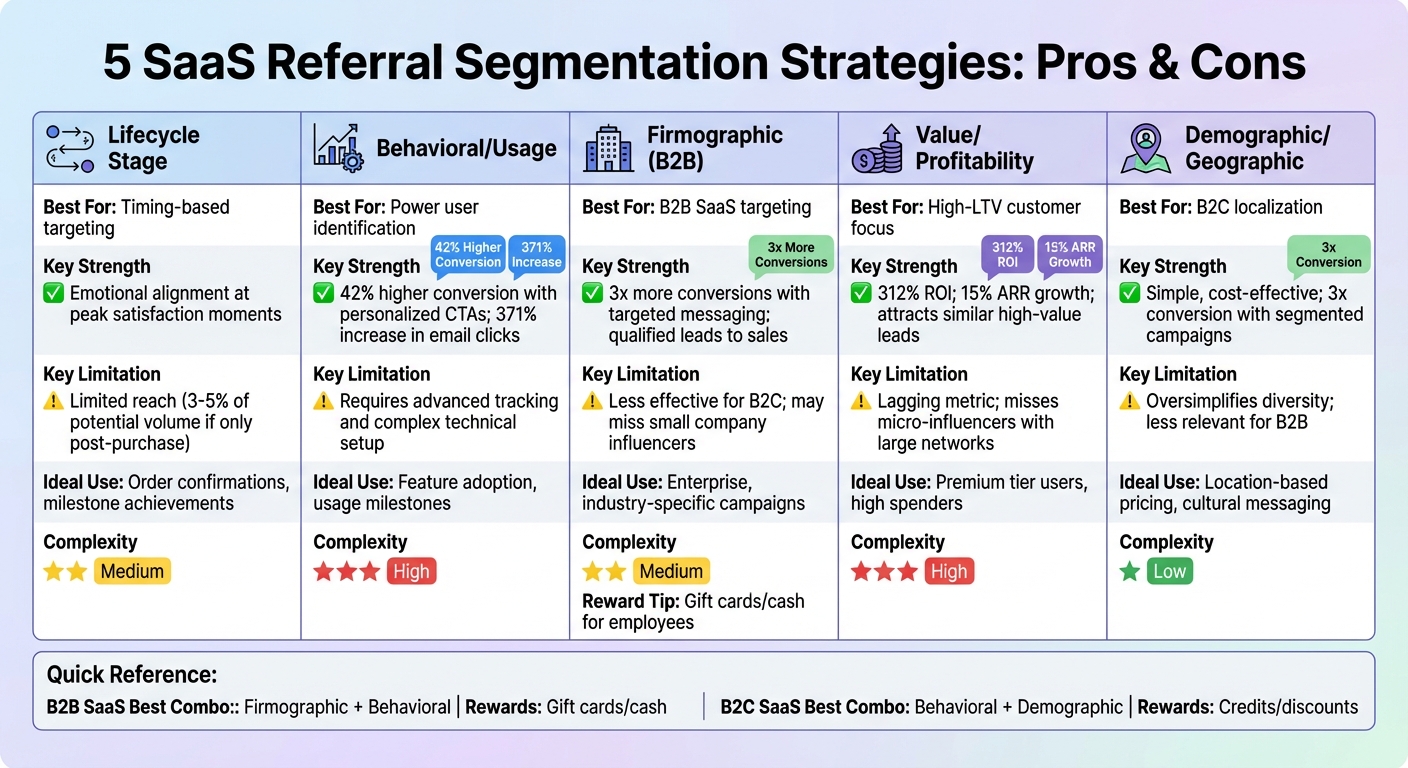
SaaS Referral Segmentation Strategies Comparison Chart
Let’s break down the strengths and weaknesses of the segmentation strategies discussed earlier.
Lifecycle stage segmentation shines when timed perfectly, especially during moments of peak satisfaction. For example, order confirmation pages are highly effective because customers are already in a "conversion mindset". However, focusing solely on post-purchase stages limits your reach, capturing just 3% to 5% of potential volume.
Behavioral and product usage segmentation is excellent at pinpointing power users who are more likely to advocate for your brand. By analyzing user actions, this method outperforms static demographic data in predicting engagement. The downside? It requires advanced tracking tools and a more complex technical setup.
Firmographic segmentation works particularly well for B2B businesses, ensuring referrals align with your Ideal Customer Profile. This approach helps deliver qualified leads directly to your sales team. On the flip side, it’s less effective for B2C products and might miss advocates from smaller companies with significant influence.
Value-based segmentation focuses on high-LTV customers, making it a strong driver of ROI. These customers often refer similarly high-value leads. However, this method can overlook "micro-influencers" - users with smaller spending habits but larger networks who could bring in significant volume through viral marketing.
Demographic and geographic segmentation is straightforward and budget-friendly, making it appealing for many campaigns. But its simplicity can lead to oversights, as it risks generalizing diverse customer groups. Pairing it with behavioral data can help avoid treating all members of a segment as identical.
Each strategy has its own set of benefits and challenges. The best approach depends on how you balance quality, volume, and the complexity of implementation. A thoughtful combination of these methods can lead to a referral campaign that’s both effective and sustainable.
Conclusion
When refining your segmentation strategies, it's crucial to align them with your business model. For B2B SaaS, combining firmographic data with behavioral insights can be highly effective. Incentives like gift cards or cash often resonate well in this space. On the other hand, B2C SaaS thrives on behavioral segmentation, where rewards such as credits or percentage-based discounts can drive engagement. These tailored approaches echo the reward strategies we've explored earlier.
Another key step is defining the conversion event that marks a successful referral. For transaction-based SaaS, this is usually a purchase. For subscription models, it could involve milestones like installing an app, completing a profile setup, or reaching a specific usage goal.
To maximize participation, make the referral program easily accessible. Boost visibility by integrating referral prompts into every screen - whether through in-app widgets placed in navigation menus, dashboards, or footers. These simple additions can significantly improve program performance.
Platforms like Prefinery simplify the entire process. With step-by-step guidance and automated communication, Prefinery handles everything from creating unique referral links to tracking conversions across multiple platforms, including web, iOS, Android, Windows, and Mac. This allows your team to stay focused on product development.
Experiment with A/B testing to find the most effective segmentation combinations and align rewards with customer payment preferences. The best referral campaigns layer multiple strategies to strike a balance between quality, volume, and ease of execution. By combining these methods, you can create a referral program that delivers outstanding results.
FAQs
How does lifecycle stage segmentation improve SaaS referral programs?
Lifecycle stage segmentation lets you fine-tune your referral program to align with where users are in their journey - whether they’re brand-new sign-ups, frequent users, or long-time power users. By tailoring incentives and messages to each stage, you can increase engagement and make referrals feel more relevant. For instance, new users might be enticed by a $10 credit for each referral, while loyal users may appreciate exclusive benefits like feature upgrades or extended trials.
This strategy ensures referral prompts hit at the perfect moment, such as after a user reaches a key milestone or renews their subscription, instead of sending the same generic message to everyone. It also helps control costs by reserving premium rewards for loyal users while offering budget-friendly incentives to newer ones. The payoff? Lower costs per lead, higher participation rates, and referrals that carry more value.
Platforms like Prefinery make implementing lifecycle segmentation straightforward. With its no-code tools, you can set up custom user stages, automate rewards, and adjust your approach as your product evolves. This way, your referral program can grow seamlessly, keeping customer acquisition costs low while maximizing lifetime value.
Why is behavioral segmentation more effective than demographic data in SaaS referral campaigns?
Behavioral segmentation zeroes in on what users do - like how often they interact with a product, which features they use, or their buying habits - rather than relying on static factors like age or job title. This method captures real-time intent, enabling you to send offers or messages that feel personal and hit at the exact moment a user is most likely to act. The payoff? Higher conversion rates and more referrals compared to strategies based solely on demographics.
In SaaS referral campaigns, behavioral insights shine by identifying key moments, such as when a user upgrades, completes a major task, or hits a milestone. Crafting referral prompts around these actions ensures they feel timely and relevant. Tools like Prefinery simplify this process by automating personalized messages and triggers, making it easier to engage users and encourage participation. With a focus on behavior, you can fine-tune your targeting, boost engagement, and drive better outcomes for your referral efforts.
Why is firmographic segmentation important for B2B SaaS companies?
Firmographic segmentation - grouping potential customers based on company-specific traits like industry, size, location, or decision-maker roles - is a game-changer for B2B SaaS companies. Why? Because it pinpoints which organizations are most likely to gain value from their product. This focused strategy helps businesses channel their efforts into high-potential leads, boosting conversion rates while keeping acquisition costs in check.
When marketers customize messaging and referral incentives to match the distinct needs of each segment, campaigns become far more engaging and relevant. This approach is particularly effective in referral programs, where rewarding the right advocates in meaningful ways can drive organic growth and improve ROI.
What sets Prefinery apart is its ability to integrate firmographic filters directly into its no-code platform. SaaS teams can create tailored referral flows and access detailed analytics, ensuring every campaign aligns perfectly with their ideal customer profile while delivering clear, measurable outcomes.