
5 Common Data Privacy Mistakes in Referral Marketing
Avoid five referral-marketing privacy mistakes: collect less, let advocates share links, clarify notices, vet vendors, and set deletion rules.

Justin Britten
Referral programs can create legal risk fast if you collect a friend’s data or send the first message yourself. My takeaway is simple: keep data collection small, let the advocate share the link, explain the referral in plain English, check your referral automation tools, and delete data on a set schedule.
If I had to boil the article down to five points, they’d be these:
- Collect less data. If I don’t need a friend’s email to run the program, I shouldn’t ask for it.
- Don’t treat a referral as consent. A customer’s okay is not the friend’s okay.
- Make notices clear. The first message should say who referred the person, why they got it, and whether a reward is tied to it.
- Review referral program best practices and tools. If a vendor stores referral data, I need to check access, logging, deletion support, and email setup like SPF, DKIM, and DMARC.
- Set deletion rules early. Access, deletion, correction, and opt-out requests still apply after the campaign ends.
A few facts stand out. Under CAN-SPAM, penalties can reach up to $53,088 per email. In places like the UK, EU, Ireland, and Canada, brand-sent referral invites can create more risk than advocate-shared links. And from a campaign angle, unclear invites can lead to spam complaints, which can hurt later email performance too.
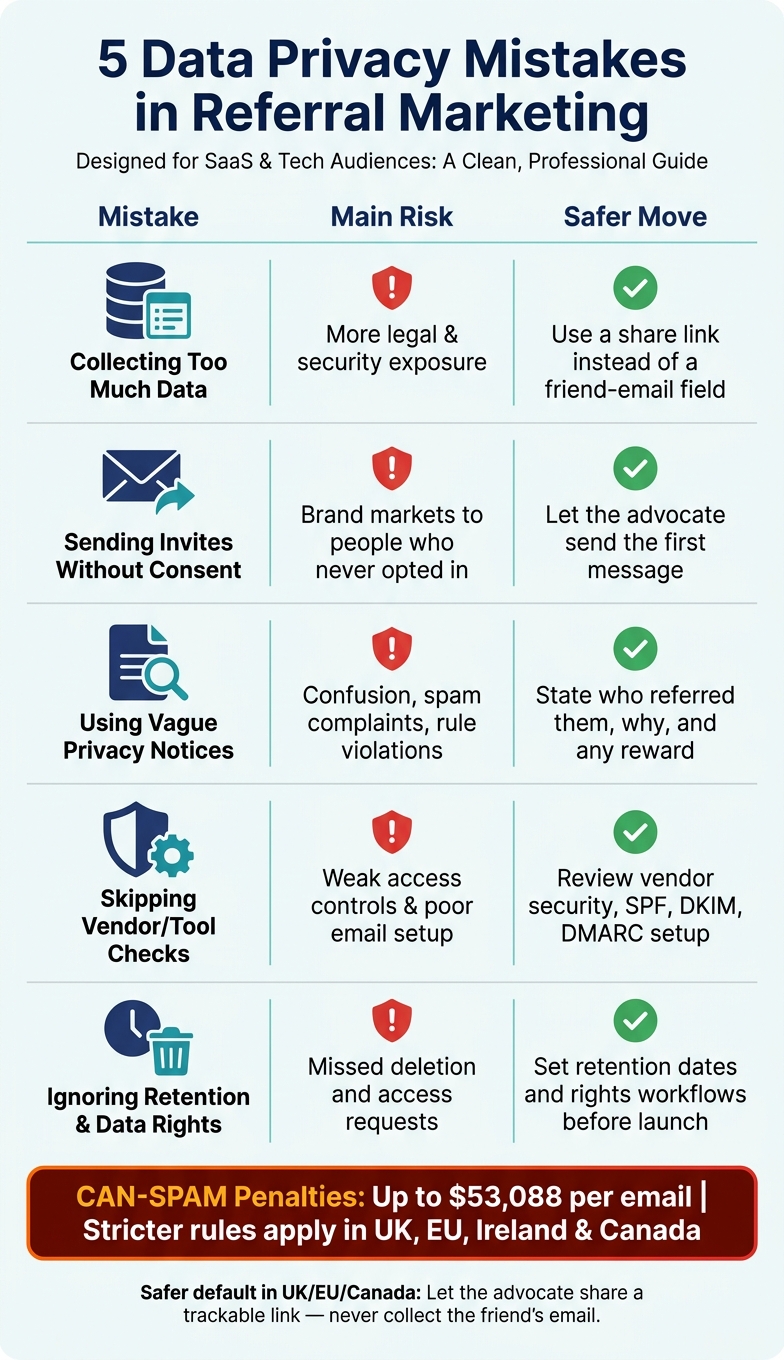
5 Data Privacy Mistakes in Referral Marketing: Risks & Fixes
Quick Comparison
| Mistake | Main Risk | Safer Move |
|---|---|---|
| Collecting too much data | More legal and security exposure | Use a share link instead of a friend-email field |
| Sending invites without consent | Brand sends marketing to people who never opted in | Let the advocate send the first message |
| Using vague notices | Confusion, complaints, and rule violations | State who referred them, why, and any reward |
| Skipping tool checks | Weak access controls and poor email setup | Review vendor security and sending setup |
| Ignoring retention and rights | Missed deletion and access requests | Set retention dates and rights workflows before launch |
If I’m running one of the best SaaS referral programs, that’s the short version: collect less, send less, explain more, and delete on time.
Why Referral Marketing Carries Unique Privacy Risks
Referral marketing changes the privacy equation in a very specific way: the brand may end up with someone else’s contact data.
A customer can submit a friend’s email address or a coworker’s phone number even though that person never agreed to hear from your brand. So with just one referral, you may create a marketing contact who has had zero direct contact with you.
That’s where many teams get tripped up. Consent does not transfer from the referrer to the recipient. Under GDPR and UK ePrivacy rules, a customer giving you a friend’s email is not valid consent to market to that friend. In Ireland, sending emails to non-customers through a “refer a friend” feature is treated as an offense under ePrivacy rules. In Canada, CASL goes even further: an email sent only to ask for consent can still count as a commercial electronic message (CEM). So the very first referral invite can create a compliance problem if it doesn’t fall within a narrow exemption.
Put simply, a referral invite can turn into a marketing message sent to someone who never opted in.
Email and SMS invite flows bring another set of problems. Automated messages to referred contacts can cause sudden jumps in sending volume. That can trip spam filters and draw regulator attention, especially when SPF, DKIM, and DMARC aren’t set up. Referral tools, email platforms, and rewards systems may all handle personal data too, so access control matters.
| Jurisdiction | Key Rule | Safer Default |
|---|---|---|
| US (CAN-SPAM) | Must include a physical address and clear opt-out; violations can lead to penalties of up to $53,088 per email. | Email the referrer with opt-out |
| UK/EU (GDPR/ePrivacy) | Consent is not transferable from the friend to the brand. | Referrer "forward/share" only |
| Ireland (DPC) | Emailing non-customers via referrals is an offense. | Avoid "Email a Friend" features |
| Canada (CASL) | Consent-request emails are themselves regulated CEMs. | Use a narrow one-message exemption or referrer sharing |
In stricter markets, the safer move is to let the referrer send a pre-written message with a trackable link, instead of having the brand collect the friend’s email.
The first fix is simple: collect less data in the referral flow.
1. Collecting More Data Than You Need in Referral Flows
A lot of referral forms ask for more information than they need. It usually happens little by little: a field gets added, then another, and before long nobody's checking whether those fields are still needed to track a referral or send a reward.
Legal Risk
The main risk is simple: collecting contact data you don't need. If you collect a friend's contact details at the start, you take on risk before the referral has even begun.
Impact on Referral Campaigns
Extra fields also drag down completion rates. People see more boxes, hesitate, and drop off. So if you're looking for the first place to cut risk, start with a referral marketing legal compliance checklist to audit your collection step.
Practical Fix for SaaS Teams
Review your referral flow and strip out any field that isn't directly needed for tracking or reward fulfillment. Instead of asking for the friend's email, use a share link.
Give the advocate a trackable link they can send on their own through SMS, WhatsApp, or email. That way, the friend's data stays out of your system until the friend decides to click and sign up.
Referral-Specific Compliance Safeguard
Make copy-link and share-link flows the default, especially for users in the UK, EU, and Canada. Swap the friend-email field for a Copy Link or Share Link button.
Once you collect less, the next risk is how you send the invite.
2. Sending Referral Invites Without Getting Valid Consent
When a customer gives you a friend's email, that doesn't mean you can email that friend. A referral from a customer doesn't turn a marketing email into a lawful one. It creates risk across major markets.
Privacy Law Exposure
The main issue is simple: who sends the first message? That's where things can go sideways. Here's how that risk shows up by jurisdiction:
| Jurisdiction | Key Rule | Recommended Approach |
|---|---|---|
| US (CAN-SPAM) | Requires physical address and opt-out honored within 10 days | Email the advocate; include clear ad disclosure |
| UK/EU (GDPR/ePrivacy) | Consent is not transferable from customer to friend | Use the forward/share model; the advocate sends the invite |
| Canada (CASL) | An email asking for consent is itself a regulated message | Use the forward/share model; the narrow one-message exemption requires the referrer's full name and exactly one send |
| Ireland (DPC) | Marketing to non-customers via referral is an offense | Strictly use the forward/share model |
Impact on Referral Campaigns
The legal side is only half the story. Cold referral emails can also hurt deliverability. They may trigger spam complaints and weaken sender reputation, which can spill over into later campaigns, including emails sent to current customers.
Practical Fix for SaaS Teams
Use a forward/share flow. In plain English, the referrer sends the invite, not your platform. Give the advocate a pre-written message and a trackable link they can share through their own email, SMS, or WhatsApp.
Referral-Specific Compliance Safeguard
If your system sends the first invite to a friend, change that step now. Then, once consent is handled, review what your privacy notice says to recipients.
3. Using Vague or Incomplete Privacy Notices
Even if your referral flow is lawful, the message still needs to spell out the referral in plain English.
A referral notice should explain the referral itself, not just the signup. That means saying who shared the data, why the recipient is getting the message, and what reward, if any, is tied to it. If that context is missing, you're asking for legal trouble and spam complaints.
Privacy Law Exposure
Under CAN-SPAM, referral emails must include:
- a physical postal address
- a clear "From" line
- a conspicuous disclosure that the message is an advertisement
Miss those rules, and penalties can reach up to $53,088 per email.
The notice should also state who shared the data, why the recipient is being contacted, and what reward, if any, applies. A vague message might seem harmless, but in practice, it's the kind of thing that makes people hit Report Spam without thinking twice.
Impact on Referral Campaigns
If a recipient doesn't know who shared their data or why the email showed up, confusion can turn into a spam complaint fast. And once complaint rates climb, the damage doesn't stop with that one campaign. It can hurt your sender reputation and push later emails, including customer emails, into spam.
That's the frustrating part. One unclear referral message can mess with deliverability across your automated referral marketing program.
Practical Fix for SaaS Teams
Use a short disclosure in the first referral message that covers the basics: who referred the recipient, why they're being contacted, and what reward, if any, applies.
Include the referrer's full name. That small detail gives the message context and makes it feel far less random. That clarity helps protect trust; the next risk is how referral tools store and share the data.
4. Skipping Security and Vendor Checks for Referral Tools
Once the invite flow is clean, the next risk is simple: where referral data lives and who can get to it.
Privacy Law Exposure
Referral tools handle personal data. That includes invite templates, reward records, referral links, and recipient contact data. So they need the same guardrails you’d expect from your core product systems: access controls, logging, and support for deletion requests.
Impact on Referral Campaigns
While technical security is paramount, your choice of platform also dictates your reach, such as when implementing LinkedIn referral strategies for SaaS.
Check that the tool supports SPF, DKIM, and DMARC. If it doesn’t, referral emails can hurt inbox placement.
Practical Fix for SaaS Teams
Before you commit to any referral tool, do a basic vendor review. Look at the vendor’s security controls, breach history, and data-processing terms. Then confirm the tool supports SSO, 2FA, role-based access, encryption, and audit logs.
If you can, give extra weight to vendors with recognized standards like ISO 27001 certification. Also make sure the tool can handle DSAR exports and deletions. If the tool uses AI, check that it does not train on customer data and that you can see how AI systems access personal data.
Referral-Specific Compliance Safeguard
Use advocate-driven sharing as your default. That way, the platform never sends the first invite. Platforms like Prefinery make advocate-driven sharing easier without custom development.
After vendor access is under control, the next privacy risk is how long referral data stays in the system.
5. Ignoring Data Subject Rights and Retention Limits
Privacy Law Exposure
The last risk shows up after the invite is sent. At that point, the job isn't over. You still need to know who can access referral data and when that data gets deleted. Referral data still triggers access, deletion, and opt-out duties even after the campaign ends.
Impact on Referral Campaigns
Poor handling of deletion and opt-out requests doesn't just create legal risk. It can also hurt deliverability. When teams miss those requests, spam complaints go up and future sends are more likely to get suppressed.
Practical Fix for SaaS Teams
Referred contacts have the right to access, correction, deletion, and objection - and those rights don't disappear when the campaign does. Keep only the referral data you need to run the program, resolve disputes, and meet legal duties. Delete the rest on a fixed schedule.
Then look at the full data path. Your referral tool should be able to handle rights requests across your CRM, email platform, analytics, and referral records. If it can't export or purge data when needed, fix that before the next campaign.
Referral-Specific Compliance Safeguard
Use a tool that can export, correct, and delete referral data across every connected system.
Use this checklist to confirm each referral system can export, delete, and retain data on schedule:
- Export referral data when a person asks for access
- Correct referral data when a record is wrong
- Delete referral data across connected tools when required
- Apply retention rules on a set schedule
- Cover CRM, email platform, analytics, and referral records in the same process
Quick Compliance Checklist for SaaS Referral Programs
Use this checklist to turn the five risks above into launch-day checks. The goal is simple: collect less, explain more, and set clear rules before the campaign goes live.
| Compliance Area | What to Do | Retention |
|---|---|---|
| Data Collection | Collect only the advocate and reward data you need. Avoid collecting recipient contact details. | - |
| Consent | Use a forward/share flow. Send a confirmation only after the recipient opts in. | - |
| Privacy Notice | Update your privacy policy to explain how referral data is collected, used, shared, and deleted. | - |
| Vendor Security | Verify encryption at rest and in transit, access controls, API authentication and rate limits, and regular security audits. | - |
| User Rights | Build a documented workflow to handle access, correction, deletion, and opt-out requests. | - |
| Retention Schedule | For records that must be kept, define the deletion date now, not after the campaign starts. Document retention by record type and automate deletion on schedule. | - |
A checklist like this can save a lot of cleanup later. If your team handles these items before launch, you're far less likely to run into preventable privacy or security issues.
Comparison Tables
These tables show the tradeoffs behind each compliance choice.
Data Collection: Minimal vs. Over-Collection
A lean signup flow usually creates fewer problems. If you only ask for the data you need, you cut friction for users and reduce what you have to protect.
| Feature | Minimal-Data Model | Over-Collection Model |
|---|---|---|
| Data Fields | Name, email, referral code | Phone, address, social profiles, demographics |
| Compliance | Lower risk - follows data minimization rules | Low - violates data minimization principles |
| User Friction | Low (quick signup) | High (lengthy forms) |
| Security Risk | Lower (less sensitive data stored) | Higher (more attractive target for breaches) |
Consent Patterns in Referral Outreach
Collection limits one risk; delivery method creates another.
This is where many teams get tripped up. A referral program can look fine on the surface, then run into trouble because the outreach method assumes consent can be passed from one person to another. It usually can't.
| Pattern | Mechanism | Privacy Risk |
|---|---|---|
| Share Link | Advocate posts a unique URL to social media or private chat | Low - the brand never handles the friend's data before opt-in |
| Advocate Forward | Advocate sends a pre-written message via their own email or SMS | Low - brand never handles friend data until opt-in |
| Direct Friend Email | Brand emails the friend using the advocate's data | High - often violates GDPR/CASL; consent is not transferable |
| Automated blasts to scraped lists | Automated blasts to scraped lists | Illegal - violates CAN-SPAM and GDPR |
Privacy Notices: Generic vs. Referral-Specific
Once the invite method is set, the message itself has to explain the referral clearly.
A generic privacy notice often leaves too much unsaid. In referral flows, people need plain answers: who shared their data, why they got the message, and whether any reward is tied to the referral.
| Feature | Generic Privacy Notice | Referral-Specific Privacy Notice |
|---|---|---|
| Scope | General website usage | Specific referral data processing |
| Source Disclosure | Vague on third-party sharing | Explicit about who shared the recipient's data |
| Reward Disclosure | Not addressed | Clear about what reward, if any, applies |
| Recipient Instructions | Standard opt-out | Clear instructions for both referrers and friends |
Spreadsheet Tracking vs. a Dedicated Referral Platform
The last decision is operational: how you track, secure, and delete referral data.
Spreadsheets may seem fine at first. Then the program grows, edge cases pile up, and simple tracking turns messy fast. That’s the gap a tool like Prefinery is built to fill.
Unlike spreadsheets, a dedicated platform like Prefinery automates tracking, consent logs, and deletion workflows.
| Feature | Spreadsheet Tracking | Dedicated Platform (Prefinery) |
|---|---|---|
| Accuracy | Prone to human error | Automated, real-time tracking |
| Scalability | Hard to manage as user base grows | Scales with automated workflows |
| Fraud Prevention | Manual and error-prone | Built-in (IP tracking, device fingerprinting) |
| Compliance | Hard to manage subject rights and deletion | Structured data controls and consent logs |
| Integration | Manual data entry | Native API, webhooks, and CRM sync |
Conclusion
Most referral privacy issues come down to simple mistakes that are easy to avoid. Teams often collect more data than they need, email friends without consent, rely on vague privacy notices, skip vendor reviews, or ignore deletion requests. None of that has to happen.
The fastest fix is a short pre-launch audit. Before you go live, check your data collection, consent flow, privacy notices, vendors, and retention settings. If your referral program only works by emailing the friend, the setup is too aggressive. In the UK, EU, and Canada, a forward/share model should be the default. It puts the advocate in control and cuts down privacy risk. It also helps with deliverability.
Privacy-aware referral marketing builds trust and supports long-term growth.
FAQs
Can I email a referred friend directly?
Yes, but it’s the highest-risk option.
If a customer shares a friend’s email, that does not automatically mean you have permission to send that friend marketing emails. That matters even more in the UK, EU, Ireland, and Canada, where consent rules are stricter.
The safer default is simple: email your current customer instead. Give them a prewritten message they can forward or share, along with a trackable link.
If you do that, make sure your email still follows CAN-SPAM rules, including:
- Real header information
- Clear ad labeling
- An easy way to opt out
What data should a referral form collect?
Collect only the information you need to run the program and respect user privacy. At a minimum, identify the referrer and the referred person so you can attribute rewards accurately.
Use a unique referral link or code for each participant, and pass the referrer’s identifier into a hidden signup field. Be clear about how data is used and stored. And don’t ask for extra information upfront if you don’t need it.
How long should I keep referral data?
Keep referral data only as long as needed for operations and legal compliance. A common guideline is:
- Referral data: 3 years
- Permission forms: 5 years
- Program messages: 2 years
- Check reports: 7 years
Prefinery’s infrastructure can help you manage retention in a secure, efficient way while you stay focused on growth.