
Optimizing ROI Through Referral Partnerships
Reduce CAC and boost ARR by fixing referral tracking, aligning payouts to paid conversions, and simplifying partner sharing.

Justin Britten
Referral partnerships can cut CAC by 40%–60% and help referred customers convert 3–5x faster - but only if I track revenue, pay for paid conversions, and make referrals easy to act on.
If I want more ROI from referrals, I focus on three things first:
- Clean attribution: track links, source data, and billing so referral revenue is not lost inside “direct” or “organic”
- Payout control: reward paid customers, not raw signups, and match payouts to plan value, churn, and margin
- Partner activity: give customers, affiliates, agencies, and SaaS partners simple assets and low-friction flows so they actually refer
The core math is simple: ROI = (referred revenue − program cost) ÷ program cost × 100. From there, I watch referral CAC, LTV, payback period, and influenced ARR. If those numbers beat paid search or outbound, referrals deserve more budget. If not, the leak is usually in tracking, incentives, or partner follow-through.
A few benchmarks help frame the channel:
- Referrals can drive 15%–40% of new customers
- B2B referral CAC can land near $112 per lead versus $395 for paid search
- Some data sets show $150 CAC for referred customers versus $1,980 for outbound
- Referred customers often bring 16%–25% higher LTV
Here’s the short version: referral ROI stalls when the program is loose, not when the channel is weak. I need a clear referral model, one way to measure sourced vs. influenced revenue, and a reward setup that protects margin.
If I’m prelaunch, I can test this early with a viral waitlist. A referral waitlist with share links, queue rewards, and cohort tracking gives me a low-cost way to compare referred users against paid users before I spend more on acquisition.
That’s the playbook this article covers: what counts as a referral partnership, how to measure ROI, where programs break, and what to fix first to get more ARR for less spend.
Define referral ROI before you try to improve it
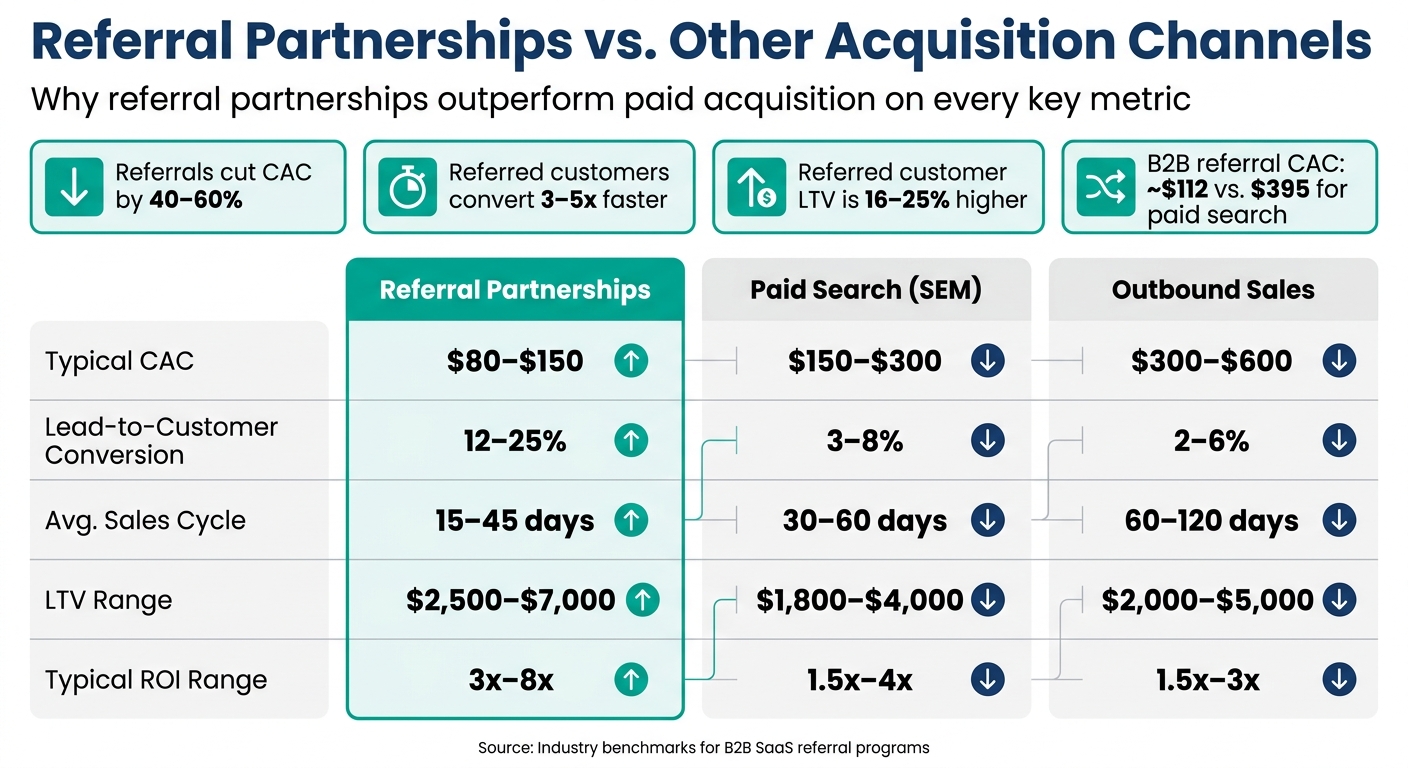
Referral Partnerships vs. Other Acquisition Channels: CAC, Conversion & ROI
Before you try to improve referral ROI, set the math first. A lot of teams skip this part. Then marketing, partnerships, and finance all end up using different numbers, which makes referral performance hard to judge.
The standard formula is simple:
Referral Program ROI (%) = (Revenue from referred customers − Total program costs) ÷ Total program costs × 100
Program costs include referral rewards, partner commissions, software fees, and internal labor. Measure new ARR from referred accounts over a set monthly or quarterly window. Once everyone uses the same formula, you have one number you can track, compare, and improve.
Use a simple measurement model tied to revenue
The top-line ROI formula matters, but it doesn't tell the whole story by itself. Four supporting metrics help you see what's happening month after month:
| Metric | Formula | Typical Target |
|---|---|---|
| Referral CAC | Total referral program costs ÷ new customers from referrals | 20–50% lower than paid channels |
| Referred-customer LTV | (ARPA × gross margin) ÷ churn rate | 10–25% higher than non-referred cohorts |
| CAC payback period | Referral CAC ÷ monthly gross profit per referred customer | Under 120 days for B2B SaaS |
| Influenced ARR | Sum of ARR where a partner had documented involvement | Use your internal target |
To calculate sourced revenue and partner influence the right way, tag every referral with a standard lead source and a referrer ID. Then, at the opportunity level, track whether the partner sourced or influenced the deal. That detail matters because it changes both CAC math and commission rules.
Use one rule and stick to it: deals logged before qualification are sourced; deals logged after are influenced.
Compare referral economics against other acquisition channels
Once the formula is locked in, compare referral economics against the channels fighting for the same budget.
| Channel | Typical CAC (USD) | Lead-to-Customer Conversion | Avg. Sales Cycle | LTV Range (USD) | Typical ROI Range |
|---|---|---|---|---|---|
| Referral partnerships | $80–$150 | 12–25% | 15–45 days | $2,500–$7,000 | 3x–8x |
| Paid search (SEM) | $150–$300 | 3–8% | 30–60 days | $1,800–$4,000 | 1.5x–4x |
| Outbound sales | $300–$600 | 2–6% | 60–120 days | $2,000–$5,000 | 1.5x–3x |
Use your own numbers. Referrals only earn more budget if they outperform other channels on CAC, conversion, and payback. If they don't, the problem usually isn't hard to spot - you've got leaks somewhere in the funnel.
The biggest problems that reduce referral partnership ROI
Once you’ve measured referral ROI, the next move is simple: find the leaks.
Referral ROI usually slows down for three main reasons: weak tracking, poor incentives, and low partner activation. And these problems don’t stay in their lane. They stack up and make each other worse.
Incomplete tracking and weak attribution
Tracking falls apart when UTMs aren’t used the same way, links get lost, and CRM records never connect back to the referrer. When that happens, referred customers often get lumped into organic or direct traffic. That means referral revenue gets undercounted, and your ROI math can look worse than it is.
The bigger issue is missing invoice-level attribution. A signup doesn’t prove revenue. If you can’t connect subscription plans and invoices back to the referring partner, you’re tracking activity, not actual income. That gap also leads to payout disputes, and those disputes can damage partner trust fast.
Incentives that do not fit your CAC and margin targets
Paying on signups instead of paid conversions can make a referral program lose money once you factor in CAC, churn, and refunds.
Flat commissions make the problem worse. If every referral gets the same payout no matter the plan value, you’ll end up overpaying for some accounts while shortchanging partners who bring in your best customers. A better setup ties payouts to paid conversions, plan value, and fraud checks rather than simple form fills.
There’s also the abuse problem. Self-referrals and duplicate accounts can quietly push up your effective CAC if you don’t have automated controls in place.
Low partner activation and weak enablement
Even a well-built program can fall flat if partners don’t promote it. A big share of enrolled partners never share their referral link at all, or they share it once and then go silent. Usually, it comes down to a bad trade-off: too much work for too little reward. Clunky portals and multi-step flows make sharing stall out fast.
Partners also lose momentum when they don’t have ready-to-use messaging, co-branded assets, or a clear picture of which customers to go after. If they have to guess, many will stop. Weak enablement holds referral ROI down. Strong enablement can improve partner output fast.
Those leaks are usually easiest to fix when you tighten up measurement, rewards, and partner enablement.
How to improve ROI with better measurement, incentives, and enablement
If you want to plug referral ROI leaks, focus on three things: measurement, rewards, and friction.
Build a minimal referral measurement stack
Start with the basics. Use unique referral links or codes, UTM tags, and a 30–60 day cookie window. Capture the referrer in a hidden signup field and store that data in your CRM.
The part that matters most is tying your CRM to billing data. That’s how you track MRR, LTV, and churn by referral cohort. If billing isn’t connected, you’re not measuring ARR. You’re just counting activity.
You don’t need a huge reporting setup, either. A monthly dashboard with four numbers is enough to run the program well:
- Invite-to-signup rate
- Signup-to-paid conversion
- Reward cost per customer acquired
- 6- and 12-month retention for referred cohorts
Then compare referred cohorts against non-referred ones. If referred customers stick around longer or spend more, that gives you a solid case for paying higher rewards. If they don’t, higher payouts are hard to defend.
Once your tracking is clean, you can set rewards based on margin instead of gut feel.
Design rewards around unit economics and partner behavior
The best reward setup depends on two things: who is referring and what action you want from them. There’s no one-size-fits-all model, so it helps to look at the trade-offs side by side.
| Incentive Structure | Best Use Case | ROI Risk | Fraud Exposure | Operational Complexity |
|---|---|---|---|---|
| Single-Sided | B2B SaaS with agency or consultant partners | Low | Low | Low |
| Double-Sided | Product-led growth and consumer SaaS | Medium (higher CAC) | Medium | Medium |
| Tiered Rewards | Activating power referrers | Low (pay-for-performance) | Medium | High |
| Fixed Bounty | Predictable CAC targets | Low | Low | Low |
| Recurring % | High-LTV B2B SaaS partnerships | High (margin erosion) | High | High |
| Milestone-Based | Quality-focused programs | Low | Low | High |
Recurring commissions, often 20–30% of net subscription revenue, fit programs where partners keep helping the customer after the sale and referred LTV can carry the long payout tail. Fixed bounties are much easier to forecast, which makes them a good fit for early-stage programs that are still testing whether the channel works.
One simple rule helps here: stick to one or two reward instruments - for example, product credits, fixed dollar credits, or recurring commissions. Once you pile on more than that, attribution gets messy fast.
After the payout model matches your unit economics, the next step is making referrals easy enough that people will actually do them.
Make it easier for partners and customers to refer
A partner kit can do a lot of the heavy lifting. Give partners ready-to-use email templates, social posts, and a short product overview. That cuts out the “what should I say?” problem. And when the message is already there, partners tend to share more. Automated monthly emails with partner stats also help keep them active without adding manual follow-up.
On the customer side, place referral prompts at moments when people already feel good about the product: after a smooth onboarding step, on the payment confirmation page, or inside the app dashboard. Pre-filled messages and one-click sharing trim the gap between interest and action.
The landing page matters too. Referred users are more likely to convert when the offer is easy to grasp, pricing is plain, and the signup form is short. In most referral programs, less friction beats bigger rewards.
Using viral waitlists and prelaunch referrals to lower CAC
Where viral waitlists fit in a referral ROI strategy
After launch, you can measure referral ROI directly. But a prelaunch waitlist lets you test those same economics before you pour money into paid acquisition.
That’s the point of a viral waitlist: it shows you how people refer others when interest is still early, and it turns that interest into data you can measure.
The setup is simple. Give each signup a unique referral link and a clear reason to share it, like:
- Priority access
- Credits
- Higher placement in the queue
Then track every new signup back to the original referrer. From there, carry that source data into launch-stage activation and paid-conversion reporting.
This is what makes a waitlist more than a top-of-funnel signup tool. It becomes a way to study ROI at the cohort level. The main metrics to watch are signup source, referrals generated per user, and activation and paid conversion by cohort.
If waitlist-referred users convert at a higher rate than users from paid channels, that gives you a direct argument for moving more budget toward referrals.
Of course, that only works if attribution stays clean when the product goes live.
Why purpose-built tools matter for tracking and customization
Building waitlist referral tracking in-house sounds simple at first. Then the work starts piling up: link generation, attribution, rewards, email flows, and analytics.
For most early-stage teams, that’s time better spent on the product itself.
Prefinery covers the core pieces without custom code. It handles unique links, referral tiers, leaderboards, and per-referrer analytics. At the same time, teams can still set custom reward rules, signup flows, and messaging.
That’s a big step up from template-based options. You get more control without pulling engineers away from the main build.
And there’s another piece that matters just as much as ease of use: attribution accuracy. If attribution breaks, the ROI math gets shaky fast. A tool built for this job cuts that risk from the start, which makes the reporting after launch much easier to trust.
For teams looking for the fastest path to lower CAC, prelaunch referrals are the place to begin.
Conclusion: The fastest path to stronger referral ROI
Referral partnerships drive more ROI when they’re measurable, aligned with the right incentives, and easy for users to act on.
For SaaS and fintech startups, prelaunch referral systems add another lever: a qualified pipeline built at a small share of the cost of paid acquisition. That makes them one of the clearest proof points in the case for referral ROI.
FAQs
How do I track referral revenue accurately?
Use an attribution system instead of manual spreadsheets. Spreadsheets can miss errors, and they usually fall apart when people switch devices. A good setup lets you track referred customers from their first purchase all the way through upsells, renewals, and recurring revenue.
The basics matter here:
- Use unique referral links or codes
- Keep attribution windows consistent
- Set up server-side tracking
If it fits your setup, Prefinery can automate attribution with unique IDs, CRM and payment processor integrations, and fraud detection. That gives you more dependable ROI data.
What referral rewards protect profit margins?
To protect profit margins, put non-cash rewards first. Things like service credits, feature access, or extra storage often work 24% better than cash.
Why does that matter? Because you can give people something they want without cutting too deeply into revenue.
It also helps to use tiered and dual-sided incentives. That gives you a better grip on costs while still making the offer feel worth it for both sides.
A good rule of thumb: keep total reward costs between 10% and 25% of customer lifetime value.
Prefinery also lets you set custom reward logic, so payouts only happen after someone hits a milestone, like a completed purchase.
When should I use a prelaunch referral waitlist?
Use a prelaunch referral waitlist when you're getting ready to launch a new product or service and want to build early momentum, check demand, and bring in engaged early adopters.
Prefinery fits well at this stage because it creates a viral loop: users move up the waitlist by referring friends. That can help cut customer acquisition costs while keeping the experience in line with your brand and launch plan.