
How to Promote Referral Programs for Lead Generation
Promote referral programs to generate high-quality leads using timing, double-sided rewards, tracking, and automation.

Justin Britten
Referral programs can drive high-quality leads, but they often fail due to poor visibility. To succeed, you need to actively promote them using the right strategies and tools. Key takeaways:
- Referral programs work: Referred customers convert 3–5x more than paid traffic and have a higher lifetime value.
- Promotion is essential: Use channels like websites, emails, and social media for visibility.
- Timing matters: Prompt users to share during peak engagement moments.
- Double-sided rewards: Incentivize both referrers and new users for better participation.
- Track performance: Focus on metrics like referral conversion rates and lead quality. You can also optimize your SaaS referral program by automating tracking and email workflows.
Tools like Prefinery simplify referral management with no-code setups, fraud protection, and analytics. Start by setting clear goals, offering relevant rewards, and promoting where your audience is most active.
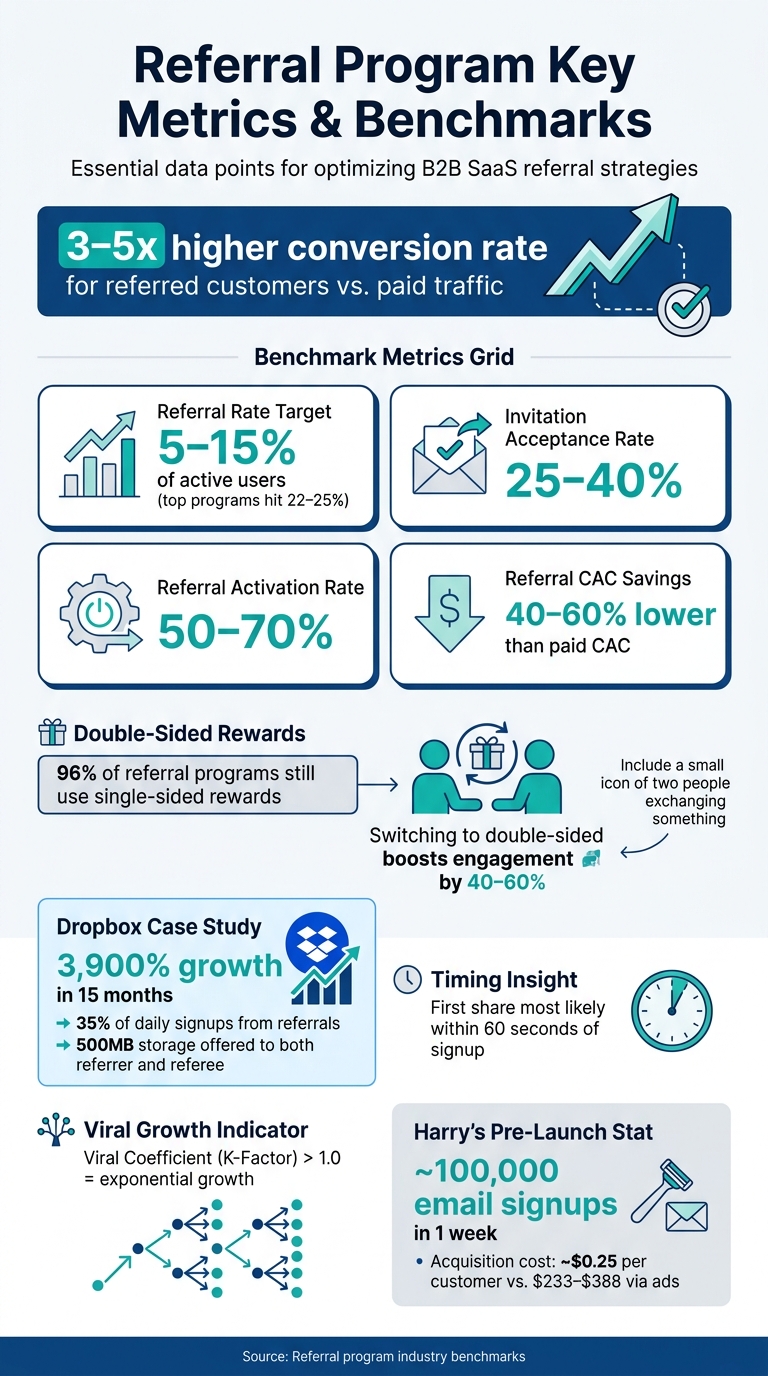
Referral Program Key Metrics & Benchmarks at a Glance
Align Referral Promotion With Your Lead Generation Goals
The key to a successful referral program lies in aligning every strategy to turn signups into high-quality leads. Before expanding your promotion efforts, it's critical to establish clear lead generation goals. Without these, you might end up chasing unqualified signups instead of valuable leads.
Set Clear Lead Generation Goals
One of the biggest pitfalls is focusing solely on the number of signups. More signups don't necessarily mean better results. Instead, prioritize metrics like activated or qualified leads - users who, for example, complete onboarding, request a demo, or reach a significant milestone with your product.
As a general guideline, aim for a referral rate of 5–15% of active users, with an invitation acceptance rate of 25–40%. Top-performing programs can even hit referral rates of 22–25%. These benchmarks are far more meaningful than vanity metrics like total shares.
| Goal Type | Recommended Metric | Target Benchmark |
|---|---|---|
| Lead Quality | Referral Activation Rate | 50–70% |
| Cost Efficiency | Referral CAC | 40–60% lower than paid CAC |
| User Engagement | Referral Rate | 5–15% of active users |
| Growth Velocity | Viral Coefficient (K-Factor) | >1.0 for exponential growth |
Once you've defined these performance metrics, you can focus on choosing rewards that attract the right kind of leads.
Choose Incentives That Attract High-Quality Leads
The type of reward you offer can significantly influence the quality of leads your referral program generates. For example, cash and gift cards often attract "reward-hunters" - people who sign up just for the incentive and never engage with your product. To avoid this, opt for product-relevant rewards like extra credits, feature unlocks, or extended trials. These appeal to users who genuinely value your product.
Double-sided rewards, which benefit both the referrer and the referred user, are especially effective. They remove the awkwardness of asking for a favor while increasing participation. Despite their effectiveness, 96% of referral programs still rely on single-sided rewards. Switching to a double-sided model can boost engagement by 40–60%. A well-known example is Dropbox's referral program, which offered 500 MB of storage to both parties. This strategy drove a staggering 3,900% growth in 15 months, with referrals accounting for 35% of daily signups.
For B2B or professional audiences, consider offering status-based rewards rather than monetary ones. Perks like early access, "founding member" badges, or exclusive community invites often resonate more with professionals, leveraging their desire for recognition and exclusivity.
The next step is identifying the perfect moments to promote your referral program for maximum impact.
Find the Right Moments to Promote Referrals
Timing can make or break your referral program. The best time to ask for referrals is when users are most engaged - neither too early nor too late.
"Referral programs work when the product creates a moment of earned enthusiasm, and the program converts that enthusiasm into a low-friction ask at that exact moment." - Atticus Li, Applied Experimentation Lead, NRG Energy
These "earned enthusiasm" moments often align with natural success peaks, such as completing onboarding, generating a first report, hitting a usage milestone, or achieving a positive outcome with your product. For pre-launch waitlists, timing is even more crucial. The highest likelihood for a first share occurs within the first 60 seconds after signup. That's why your post-signup confirmation page should always prominently display the referral link, making it easy for users to share immediately.
Get Your Referral Program Ready to Promote
Having a reliable and easy-to-use referral program is the backbone of any successful promotional effort. Even the most creative promotion strategies can fail if the referral process is clunky or unclear. A poorly designed program wastes your budget and frustrates users, often stopping them from sharing links altogether.
Build a Simple, Friction-Free Referral Experience
The easier it is for users to share referral links, the more likely they are to participate. Aim for a process that feels effortless. This means giving each user a unique referral link, providing mobile-friendly share buttons, and including a confirmation step that explains what happens next. Tools like Prefinery can simplify the entire process, from generating links to tracking rewards and managing confirmation pages.
Matt Tarczyński, CEO of a company using Prefinery, highlighted its impact:
"Prefinery saved us hundreds of hours we would have to spend on web development, allowing us to optimize onboarding."
This kind of time savings is especially valuable during pre-launch periods, where resources are often stretched thin.
Once the referral flow is smooth, focus on making the program rules clear and easy to understand.
Write Clear Rules and Eligibility Criteria
Clarity in your referral program rules eliminates confusion and builds trust. Define exactly what counts as a successful referral - whether it’s a confirmed signup, a completed demo request, or a verified email. Also, outline who can participate and when rewards will be distributed.
To prevent abuse, include fraud prevention measures in your rules. For example, ban self-referrals, disposable email addresses, and multiple accounts tied to the same household or IP address. Harry's razor brand offers a great example. During their pre-launch campaign, they set up specific reward tiers - like free shaving cream for 5 referrals and a year of free blades for 50 referrals. This clear structure helped them collect around 100,000 email signups in just one week.
Josh Ledgard, Founder of KickoffLabs, emphasizes the importance of detailed rules:
"If you're running a manual or DIY setup, you need explicit rules in your terms (one referral per household, valid email required, etc.) and some system to audit entries before delivering rewards."
Once your rules are in place, the next step is ensuring you can measure the program’s performance effectively.
Set Up Tracking and Analytics
Before you launch any promotions, confirm that every referral action - whether it’s a link click, a signup, or a reward being claimed - is tracked and attributed correctly. Some key metrics to monitor include:
- Referral conversion rate: How many people take action after clicking a referral link.
- Cost per referred lead: The expense tied to acquiring each referred user.
- Referral activation rate: The percentage of referred users who actively engage with your product or service.
- Top referrer performance: Insights into who your most effective referrers are.
Prefinery’s built-in analytics dashboard makes it easy to track all these metrics in one place, sparing you from juggling multiple tools. You can also sync referral data with platforms like Zapier or Make to keep lead records accurate. Setting up this infrastructure before launching ensures clean, reliable data from day one, saving you from headaches later on.
The Main Channels for Promoting Your Referral Program
Once your referral program is set up and ready to track, it's time to focus on how to get the word out. The channels you use will play a big role in how visible your program is and how many people actually participate.
Website and In-App Placements
Your website and product interface are prime real estate for promoting referrals. For example, right after a user signs up, you can display their unique referral link, their position in the queue, and one-click sharing options. These features can also be added to dashboards or empty states. A simple banner encouraging users to refer friends to move up in line can be effective without feeling pushy.
Take Pronti.AI as an example: they included a referral-based waitlist in their pre-launch signup process. This strategy helped them grow their user base from 3,000 to 80,000 users. Referral waitlist pages can convert signups at rates of 20–40% or more, meaning even a small amount of traffic can lead to a big boost in leads - provided your referral prompts are visible and enticing.
With tools like Prefinery, integrating referral links and tracking into your website or app becomes straightforward. This ensures your analytics stay connected to the infrastructure you’ve already set up.
Lifecycle and Transactional Emails
Email is a powerful tool for driving momentum in your referral program, and timing is everything. Sending a welcome email within 60 seconds of signup can significantly increase referral activity. Place the referral link prominently at the top of the email to grab attention - don’t let it get lost at the bottom.
A well-planned email sequence can keep users engaged and motivated to share:
| Email Type | Timing | Primary Goal |
|---|---|---|
| Welcome/Confirmation | Immediate (within 60s) | Share the referral link and encourage initial sharing |
| Reminder | Day 3 | Show progress toward rewards and encourage more sharing |
| Milestone/Reward | Triggered by action | Celebrate achievements and prompt further referrals |
| Re-engagement | Day 7–10 (if inactive) | Remind users of their referral link and queue position |
Milestone emails, in particular, can be highly effective. For instance, letting users know they’re only a few referrals away from earning a reward creates a sense of urgency and motivates action.
To maximize your email strategy, pair it with efforts on social media and within online communities.
Social Media and Community Engagement
Social platforms and niche communities are great ways to amplify your referral program. Features like gamification elements like leaderboards or real-time social proof can encourage friendly competition and increase sharing. The platform you choose should match your audience: LinkedIn is ideal for B2B programs, while Instagram and Facebook tend to work better for B2C products.
Don’t overlook smaller, focused communities. Platforms like Slack, Reddit, Discord, or industry-specific forums can help you tap into highly engaged audiences, especially during your program’s early stages. These spaces often foster organic participation, giving your program a strong foundation to grow.
Advanced Tactics for Generating High-Quality Leads Through Referrals
Take your referral program to the next level with strategies designed to attract leads that convert and maintain long-term growth.
Partner With Influencers and Industry Experts
Collaborating with micro-influencers and niche experts can yield impressive results. These individuals often have a stronger connection with their audience, leading to higher engagement and trust. Instead of focusing solely on large followings, prioritize influencers whose audiences align closely with your brand.
One way to maximize this partnership is by offering exclusivity. For instance, give influencers early access to your product or create an invite-only waitlist they can share. This sense of exclusivity encourages action. A great example is Harry's razor brand, which slashed acquisition costs to roughly $0.25 per customer compared to the $233–$388 they would have spent on ads. Remember, a smaller but more engaged audience can drive better conversions than a large, less-targeted one.
Additionally, you can tap into the enthusiasm of your most loyal users by creating a structured advocate program.
Build a Customer Advocate Program
A tiered advocate program is an excellent way to turn excited users into consistent referrers. By rewarding users as they reach certain milestones, you keep them motivated to continue referring others.
Here’s an example of how a SaaS company might structure its rewards:
| Tier | Milestone | Reward |
|---|---|---|
| Tier 1 | 3 referrals | Bonus week of early access |
| Tier 2 | 10 referrals | Free Pro plan for 6 months |
| Tier 3 | 25 referrals | Lifetime 50% discount |
| Tier 4 | 50 referrals | Lifetime free access + founder call |
The first milestone should be easy to reach, encouraging users to get involved right away. For example, Robinhood used a queue-jump mechanic in its pre-launch waitlist. Users could move up the list by referring friends, which helped them secure 1 million signups before the product even launched.
To keep momentum going, automated progress emails can be incredibly effective. A simple update like "You're 2 referrals away from unlocking your next reward" creates urgency while staying engaging.
Test and Refine With A/B Experiments
Even with solid partnerships and advocacy programs, continuous refinement is key. Referral programs often plateau not because the concept doesn’t work, but because small details need adjustment. That’s where A/B testing comes in.
Focus on testing one variable at a time to ensure clear results. High-impact areas to experiment with include the type of incentive offered, the wording of your referral call-to-action, or even where your referral link is placed. Run each test for at least 90 days to gather meaningful data. Shorter tests might lead to misleading conclusions.
It’s also essential to track the right metrics. While click-through rates on referral links may look good on the surface, they don’t tell the full story. What truly matters is whether referred users activate, stay engaged, and eventually convert into paying customers. Tools like Prefinery can help you track these downstream outcomes, allowing you to focus on lead quality rather than just quantity.
Measure, Improve, and Scale Your Referral Promotion
Running a referral program without tracking it is like driving blind - you can’t guide or improve what you don’t measure. Josh Ledgard, Founder of KickoffLabs, sums it up perfectly:
"A referral program you can't measure is a referral program you can't improve."
Track and Attribute Referral Performance
The key to effective tracking lies in using unique personal share URLs (e.g., yoursite.com/r/jane). These links ensure you can trace every referral back to its source, giving each participant their own digital footprint.
But don’t stop at tracking clicks. Focus on lead quality instead of sheer volume. After all, 1,000 clicks mean nothing if they don’t convert into engaged users. Tools like Prefinery allow you to dig deeper, offering over 55 data points to analyze user behavior. This helps you separate high-quality leads from casual sign-ups.
Pay attention to two critical metrics: share rates and conversion rates. A share rate below 20% might indicate your incentives aren’t compelling enough, while low conversions despite high shares could mean your landing page needs work. By combining clear tracking with these insights, you can identify the channels and referrers that consistently bring in the best leads.
Spot Top-Performing Campaigns and Referrers
Once your tracking system is in place, it’s time to figure out what’s actually working. Look for trends: Which channels deliver the most referred sign-ups? Which referrers consistently attract users who stick around?
Often, a small group of highly active referrers will drive a large chunk of your results. Recognizing and rewarding these top performers is crucial. Depending on your audience, you can use different tactics. For example, a public leaderboard can ignite friendly competition in developer or gaming communities. On the other hand, B2B SaaS audiences might respond better to private updates, like a "your current rank" view, which avoids exposing your top advocates to competitors.
Automate and Systematize Your Promotion Efforts
Manually managing referrals isn’t scalable. That’s where automating your referral marketing comes in. Once you’ve identified what works, let technology handle the heavy lifting to keep your program running smoothly.
Start by automating the first 60 seconds after someone joins your program. This is when enthusiasm is at its peak. Use the confirmation page and follow-up emails to immediately provide pre-filled share copy for platforms like WhatsApp, LinkedIn, and X. Follow this with behavior-triggered emails to keep participants engaged. For example, notify referrers when they’re close to earning a reward with messages like, "You're 2 referrals away from your next reward".
To maintain lead quality, only reward participants when their referrals take meaningful actions - like requesting a demo or completing a purchase. This approach discourages abuse and ensures your program drives genuine value. Additionally, send bi-weekly rank update emails to show users their progress and motivate them to climb higher. Platforms like Prefinery can handle these workflows seamlessly, freeing your team to focus on strategy rather than day-to-day operations.
Conclusion: Put Your Referral Program to Work for Lead Generation
This guide has walked you through every essential step - from defining your goals to implementing tactics and tracking results - to help your referral program become a dependable source of high-quality leads.
The key to success? Consistent and active promotion. Many businesses stumble by treating their referral programs as a "set it and forget it" initiative. The truth is, consistency is what transforms a program from a fleeting experiment into a long-term growth engine.
Every step in this guide plays a vital role: setting clear objectives, streamlining the referral process, engaging participants on the right platforms, and focusing on metrics that matter. Regularly reviewing performance data allows you to fine-tune rewards and sharing options for better results. Even small tweaks - like adopting double-sided rewards or using branded referral links - can make a noticeable difference. For instance, branded share URLs featuring your domain can boost growth by an average of 40%.
Referrals outshine paid channels by delivering better conversion rates at a fraction of the cost. They’re a win-win for businesses aiming for efficiency and effectiveness.
To ensure your program stays effective, automated fraud detection is crucial. Blocking disposable emails, self-referrals, and suspicious activities like questionable IP addresses helps maintain lead quality and ensures your budget is spent on genuine leads.
If you're looking to streamline all these strategies, Prefinery offers a comprehensive solution. It combines customizable rewards, branded referral links, behavior-triggered emails, fraud protection, and in-depth analytics - all in one platform. Whether you’re building a pre-launch waitlist or scaling an existing user base, these practices can help turn engaged users into loyal customers. And with the right tools in place, your referral program can run smoothly without requiring constant hands-on management.
FAQs
What reward should I offer to attract serious leads?
To bring in genuine leads, steer clear of generic rewards like cash or gift cards. These tend to attract people chasing freebies rather than those genuinely interested in your product or service. Instead, go for incentives tied directly to your offerings - think early access, premium upgrades, or account credits. These kinds of rewards connect better with your target audience and align with their interests. Prefinery makes this process easier by offering automated, scalable tiered rewards. This system ensures both referrers and new users gain something valuable, all while minimizing the effort involved in sharing recommendations.
When is the best time to ask users to share a referral link?
The best moment to ask for referrals is when users are at their happiest - usually 48–72 hours after hitting their first meaningful milestone. Why? Because this is when their enthusiasm for your product or service is at its peak. Asking too soon, like right after signup, often doesn’t deliver the same results.
Here’s where Prefinery stands out. Unlike template-based tools that rely on generic triggers, Prefinery’s no-code integrations allow you to time your referral prompts with precision. This means you can nudge users to share their referral links exactly when they’re most likely to advocate for your brand.
Which metrics matter most for referral lead quality?
When evaluating the success of your referral program, it's crucial to look beyond surface-level metrics like vanity clicks. Instead, prioritize metrics that reveal genuine intent and drive meaningful growth. Here are the key ones to track:
- Referral rate: This measures the percentage of participants who actively refer others to your product or service.
- Conversion rate: Tracks how many of those referrals turn into paying customers.
- Activation rate of referred signups: For healthy B2B SaaS communities, this typically falls within the 50–70% range, serving as a benchmark for engagement.
What sets Prefinery apart is its ability to go deeper than basic tools. With advanced analytics, it helps identify which channels are bringing in the most engaged leads. This insight allows you to focus on sustainable growth while ensuring the quality of your new users remains high.