
User Onboarding Through Referrals: Guide
Set eligibility and rewards, keep referral attribution through signup and billing, track activation to revenue, and test before scaling.

Justin Britten

I measure referral success by what users do after signup - not how many accounts they create. Start with one audience, one qualifying action, and one reward tied to verified product use.
Dropbox offers a clear example: both users received 500 MB of extra storage after the invitee signed up and installed the app - not just submitted an email.
In this guide, I cover how to:
- Set eligibility rules, reward limits, and clear terms.
- Choose tools that keep referral credit linked through signup, product use, and billing.
- Connect invite pages, emails, and in-product steps to first value.
- Track activation, 30-day retention, paid conversion, and reward costs.
- Check privacy, fraud, and payouts, with named owners for each task.
My rule: <u>test before you scale</u>. Use a holdout group to check whether referrals add paying customers, then expand only when retained revenue covers the costs.
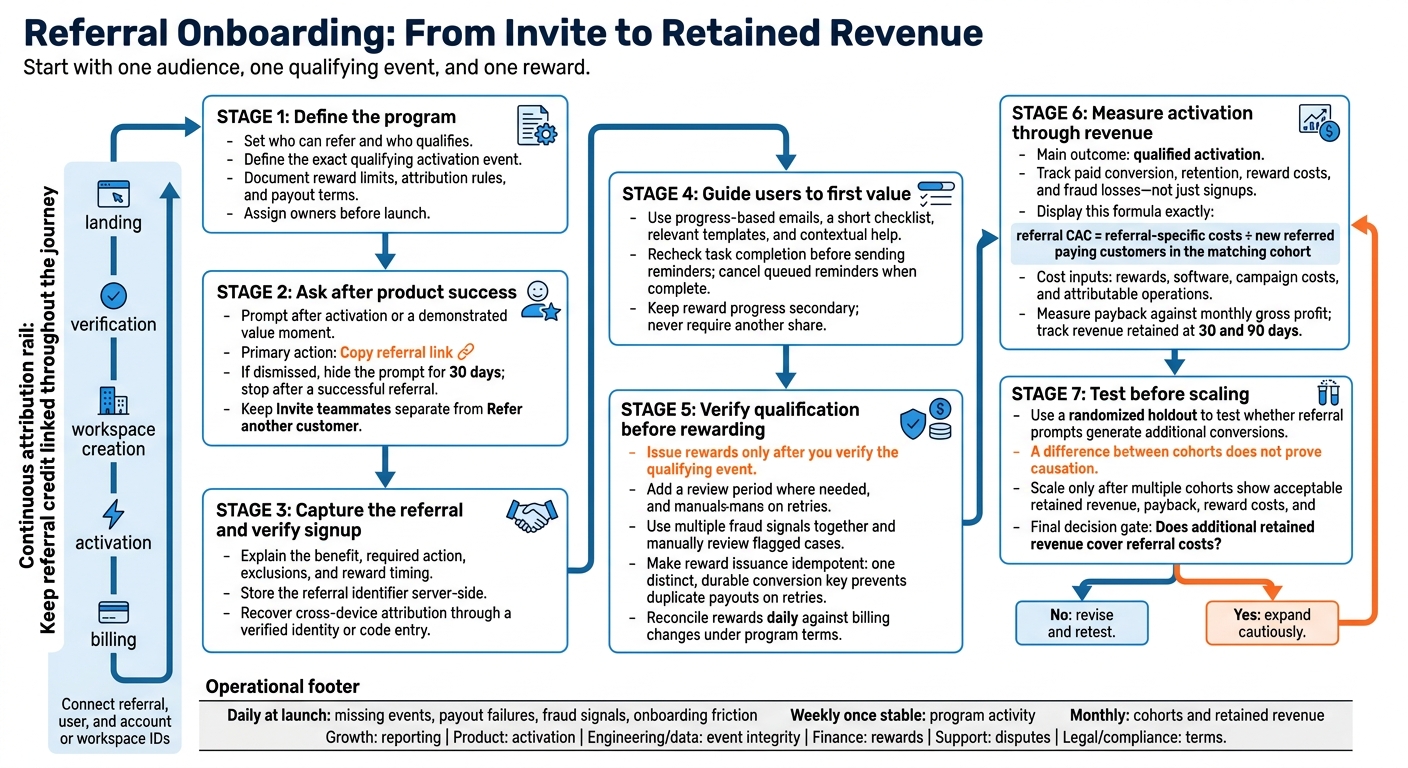
Referral Onboarding: From Invite to Retained Revenue
Plan Your Referral Program
Define who can participate, what counts as a qualified referral, and how rewards connect to activation. Track the full path from referral to activation so attribution doesn’t get lost along the way.
Set Activation Goals and Launch Requirements
Define who can refer and who qualifies. Let active customers refer others after they’ve completed activation or used a core feature repeatedly - not right after signup. Specify the invitee’s use case, plan fit, company size, role, and geography. Pick one primary metric, such as activated referred accounts, and document the exact event that counts. Use paid conversion and retention as supporting measures. For B2B products, link attribution to the company account when the invitee isn’t the buyer.
Before launch, check that referral IDs stay attached through signup, product use, and billing. Test email verification, delayed signups, cross-device handling, and server-side payment confirmation. Map each event to its source: your product, CRM, or billing system. Assign owners for implementation, reward approval, reporting, and support. Then test the full sequence in a sandbox.
Once you’ve set eligibility rules, choose a reward that encourages the adoption behavior you want.
Choose Rewards and Eligibility Rules
Match the reward to the adoption barrier and unit economics. Offer a double-sided incentive when invitees need a reason to try the product. Choose a single-sided reward when simplicity or cost control matters more. Base your budget on gross profit, LTV, and payback - not a fixed percentage of revenue.
| Reward | Best use case | Delivery | Cost profile | Build effort | Main abuse risk |
|---|---|---|---|---|---|
| Account credit | Subscription SaaS with predictable recurring revenue | Referrer only or both parties | Cap against future bills | Low to medium; billing integration | Self-referrals and credit stacking |
| Cash or gift cards | Consumer products, marketplaces, or high-value B2B referrals | One or both parties | Cap payouts; verify qualification | Medium to high; payout and identity workflows | Fake accounts and chargebacks |
| Feature access | Products with useful premium features | Referrer only or both parties | Low marginal cost; limit duration | Medium; entitlement management | Account farming |
| Tiered rewards | Repeated sharing and launch campaigns | Usually referrer only | Cap milestones and total liability | Medium to high; threshold tracking | Spam and milestone gaming |
Write the eligibility and payout rules before launch. Cover the attribution window, precedence, existing-account exclusions, account limits, reward expiration, and refund handling. Explain how device changes and referrals involving multiple employees at one company affect credit.
Issue rewards only after you verify the qualifying event, adding a review period where needed. Use several fraud signals together and send flagged referrals to a manual-review queue. Don’t reject legitimate referrals based on a single signal.
Next, choose tools that keep attribution intact through signup and activation.
Choose Your Referral Tools
| Approach | Engineering effort | Brand control | Attribution and reporting | Best fit |
|---|---|---|---|---|
| Hosted referral pages | Low | Moderate; depends on customization | Provider tracking and dashboards | Early launches and small teams |
| Embedded widgets | Low to medium | High inside the product | Authenticated-user context | SaaS teams with logged-in referral flows |
| Custom API flows | High | Highest | Control over product, CRM, billing, and warehouse events | Complex account logic or enterprise reporting |
Choose a tool that passes referral data into onboarding emails, in-product prompts, and billing events. Prefinery supports no-code referral setup with rewards, emails, analytics, and webhooks. Its applied, invited, and active statuses can trigger automated engagement emails.
But waitlist status isn’t proof of activation. Connect status updates to verified product events in your app. Before choosing a plan, confirm support for your activation and billing events, webhooks, reward fulfillment, and a test environment.
Build the Referral Onboarding Journey
Once the program rules are set, build the user journey around verified progress, not raw signups.
Ask for Referrals After Product Success
Show an optional referral prompt after a completed project, successful collaboration, or positive support interaction that shows the product’s value. Explain what both parties get and which action qualifies. Make Copy referral link the main option, with email or native sharing as secondary choices.
Show the prompt once after activation. If dismissed, hide it for 30 days; stop showing it after a successful referral. Suppress it during setup, payment failures, unresolved support cases, or other critical onboarding tasks. Users should never have to share to access the product or finish onboarding.
Keep Invite teammates separate from Refer another customer so collaboration doesn’t feel like a sales pitch.
Create Invite Pages That Keep Referral Attribution
Before signup, explain who the product is for, what each party gets, the required action, reward timing, exclusions, and any expiration date. Display the inviter’s name only with permission.
Keep the form short and mobile-friendly, with clear labels, inline errors, keyboard access, accessible contrast, and identity checks. Store the referral identifier server-side so credit carries through signup, activation, and billing. Validate it at landing, verification, workspace creation, activation, and billing - not just through a browser cookie.
Recover cross-device attribution through a verified identity or code entry. Give users clear paths for expired links, existing accounts, missing codes, and duplicate referrals instead of forcing duplicate signups. Format amounts as $25.00, dates as MM/DD/YYYY, and deadlines with a labeled time zone, such as Eastern Time.
Once the referral link is live, use onboarding emails to help referred users reach activation without losing attribution.
Trigger Emails by Onboarding Progress
Use email to help users through each onboarding step, not add noise. Treat the timing below as a starting point rather than a fixed schedule. Before sending, recheck whether the task is complete and cancel queued reminders when it is.
Separate transactional notices from promotions and follow applicable consent rules. US commercial emails need accurate sender details, a valid postal address, and a clear unsubscribe method. Honor opt-outs within 10 business days.
| Trigger and audience | Primary action | Suppression rule | |
|---|---|---|---|
| Welcome | New referred signup | Begin the first setup step | Prevent duplicate sends |
| Setup | Required setup incomplete after 24 hours | Open guided setup | Stop when setup is complete |
| Activation reminder | Not activated after 3 days | Complete the next product-specific action | Stop at activation |
| Collaboration | Active workspace, but no teammate invited where collaboration matters | Invite a teammate where collaboration matters | Stop after a teammate invite |
| Reward status | Verified milestone or reward-status change | View reward status: pending, approved, delivered, or unavailable | Send once per verified change |
| Retention | Early value reached, followed by 7 days without use | Return to the next activation-relevant step | Stop after renewed activity |
Emails should support the same steps users can take inside the product.
Hypothetical welcome email
Subject: Welcome to [Product] - start with your first [core outcome]
Hi [First name],
[Inviter name] invited you to try [Product]. Your referral benefit is tracked automatically, and you’ll receive it if you complete [qualifying action] by [MM/DD/YYYY].
Start here: Create your first [project/workflow] - it takes about 5 minutes.
Need help? Use the guided setup inside your workspace.
- The [Product] team
Guide Users to First Value in the Product
Base guidance on use case and completed actions, not referral source. Provide a short checklist, relevant templates, and help where users need it. Wait until the workspace is useful before showing collaboration prompts.
Record each completed step against the activation event so emails and in-product guidance stay in sync. Keep reward progress secondary, and never require another share. Notify referrers only about verified milestones - not private project names, usage, or billing details.
Track and Improve Referral Results
Once your referral journey is live, track whether it brings in activated users and revenue - not just signups.
Track the Referral-to-Revenue Funnel
Follow users from invite to activation, then to revenue. Track every step: eligibility, prompt views, shares, clicks, signups, verification, activation, paid conversion, retention, expansion, cancellations, refunds, and rewards issued.
Define each metric’s denominator, attribution window, and unit. Keep users separate from paying accounts. And don’t count a copied link as a delivered invite.
Break down results by campaign, channel, plan, device, geography, and signup cohort. Connect Prefinery referral analytics with product and billing records through stable referral, user, and account or workspace IDs.
Calculate referral CAC = referral-specific costs ÷ new referred paying customers in the matching cohort. Include rewards, software, campaign costs, and attributable operations, but keep this metric separate from blended CAC. Measure payback against monthly gross profit, and track revenue retained at 30 and 90 days. Use k-factor only to assess viral growth.
Use this funnel data to choose which cohorts and changes to test next.
Compare Cohorts and Test Changes
Match referred and non-referred cohorts by signup date, plan, company size, geography, acquisition period, and observation window. Report sample sizes, too: a difference between cohorts does not prove causation.
Test prompt timing, reward framing, signup friction, invite-page copy, and onboarding messages separately. Make qualified activation your primary outcome. Use fraud rate, reward cost per activation, paid conversion, unsubscribe rate, support burden, and user complaints as guardrails.
Set sample-size requirements and stopping rules before launch. Then give delayed conversions time to come through.
| Metric | Referred cohort | Non-referred cohort |
|---|---|---|
| Qualified activation within 14 days | Qualified activations ÷ verified referred signups | Qualified activations ÷ verified non-referred signups |
| Time to first value | Median elapsed time for referred users reaching value | Median elapsed time for non-referred users reaching value |
| Paid conversion within 60 days | New paying accounts ÷ referred signup accounts | New paying accounts ÷ non-referred signup accounts |
| Day-90 retention | Retained ÷ initially paying referred accounts | Retained ÷ initially paying non-referred accounts |
| Expansion by month 6 | Expansion revenue ÷ starting referred recurring revenue | Expansion revenue ÷ starting non-referred recurring revenue |
| Support burden over 90 days | Tickets ÷ referred accounts | Tickets ÷ non-referred accounts |
Check Attribution and Reward Processing
Bad attribution disrupts both onboarding follow-up and reward fulfillment. Test journeys that include delayed signups, interrupted onboarding, repeated clicks, multiple inviters, cross-device use, private browsing, and signups before the click. Document tracking limits and send unresolved cases to a dispute queue.
Make event processing and reward issuance idempotent. In plain terms, give each qualifying conversion a distinct, durable key so retries can’t trigger duplicate payouts.
Reconcile rewards daily against upgrades, refunds, cancellations, failed payments, chargebacks, and downgrades, following program terms.
Investigate self-referrals, duplicate accounts, disposable emails, impossible signup velocity, suspicious payment instruments, and suspicious IP or geography patterns together. No single signal should serve as isolated proof of fraud. Shared IPs or office networks alone are not grounds for a fraud flag.
Review Privacy, Disclosures, and Terms
Audit eligibility, qualifying actions, expiration, and dispute terms across pages, emails, product screens, and billing. Collect only the data you need, restrict access by role, and document retention and deletion periods.
Have qualified counsel review applicable U.S. privacy, commercial-email, tax-reporting, and payment requirements. Give fintech programs added scrutiny. Explain when compensated recommendations need a clear incentive disclosure. Check whether rewards create tax-reporting obligations rather than assuming every reward gets the same treatment.
Assign Owners and Set a Review Schedule
Maintain a metric dictionary that records formulas, sources, windows, access, and owners. Assign campaign reporting to growth, activation to product, event integrity to engineering or data, reward reconciliation to finance, disputes to support, and terms to legal or compliance.
During launch, check daily for missing events, payout failures, fraud signals, and onboarding friction. Once the program is stable, review program activity weekly and cohorts and retained revenue monthly. Record test decisions and unresolved data limits.
Expand eligibility, rewards, or channels only after multiple cohorts show acceptable retained revenue, payback, reward costs, and fraud losses.
Conclusion: Test Before You Scale
Once the journey is built, optimize your SaaS referral program and test it before scaling. Start with one audience, one qualifying event, and one reward. Ask for referrals after users succeed with the product, then help invitees reach their first moment of value. Keep referral attribution intact through billing, and pay rewards from retained margin - not signup volume.
Before launch, confirm that you have named owners, event tracking, tested invite pages, approved onboarding messages, reconciliation, fraud review, dispute handling, consistent terms, and role-based reporting access.
Then test whether the program adds growth. Scale only with evidence. Use a randomized holdout to check that referral prompts generate additional conversions rather than take credit for organic ones. Scale only when activated referrals generate additional, retained revenue at reward costs that retained margin can cover.
FAQs
How do I choose an activation milestone for my SaaS?
Choose an action that shows a user has experienced your product’s value. That could be a first purchase, a paid subscription, or reaching a specific usage threshold.
Unlike tools with rigid templates, Prefinery lets you set custom events as milestones and trigger rewards for actions like purchases or meeting referral goals. Tie each milestone to genuine engagement so your referral program attracts high-quality, long-term customers - not just signups.
How can I test referrals with a small user base?
Start with your most engaged users, and test one variable at a time, such as the reward type. Run each test for two to four weeks. Track referral, share, and conversion rates, and use short surveys to learn which rewards users prefer.
Prefinery’s no-code integration and user-level tracking help you launch your test and see how each user responds.
What should I change if referrals activate but don't convert?
Check for friction after someone clicks. Shorten your signup form, make the landing page easy to use on mobile, and use clearly labeled fields with real-time validation. Show the value of signing up right away, and send automated email reminders to referred friends who haven’t finished registering.
Use Prefinery’s analytics to see where people drop off. Check whether your messaging, the reward’s value, or technical issues are keeping them from signing up.