
How Referral Marketing Helps Define Target Audience
Referral behavior reveals true audience fit—track who shares, which channels convert, and which incentives uncover high-fit users prelaunch

Justin Britten
If I only track sign-ups, I can mistake curiosity for demand. Referral data gives me a better read because it shows who shares, which channels bring in the right people, how those referrals convert, and which rewards push people to act.
Here’s the short version:
- A waitlist alone shows interest, not fit
- Referral actions show who will back the product in public
- Channel data helps me link audience segments to where they spend time
- Reward tests show what different groups care about
- A short form with 1–2 extra fields can make referral data far more useful
A few numbers make the point fast. A waitlist page often converts at 10% to 30%. And Typeform saw a 27.3% monthly sharing rate and a 12.7% monthly signup rate from its referral program. That kind of behavior says more than a raw email count.
If I want to define my target audience before launch, I need more than names on a list. I need a second action. Referral marketing gives me that.
What stands out to me is simple: the best early audience signal is not who signs up, but who shares. A person who refers others is doing more than showing interest. They are showing fit, intent, and network pull.
I’d boil the article down to four takeaways:
- Track people, not just totals. Look at role, company type, and referral activity together.
- Separate channels. LinkedIn, X, and niche groups can bring in very different kinds of users.
- Test rewards. Early access, credits, and status perks can point to different audience motives.
- Use a viral waitlist as a research tool. It should help me sort high-fit users from low-fit sign-ups.
This matters because weak targeting can waste time and ad budget after launch. But a referral-based waitlist can help me spot which segment is most likely to join, share, and stick.
In other words: referrals help me find my audience before I build too much for the wrong one.
How referral marketing solves the audience-definition problem
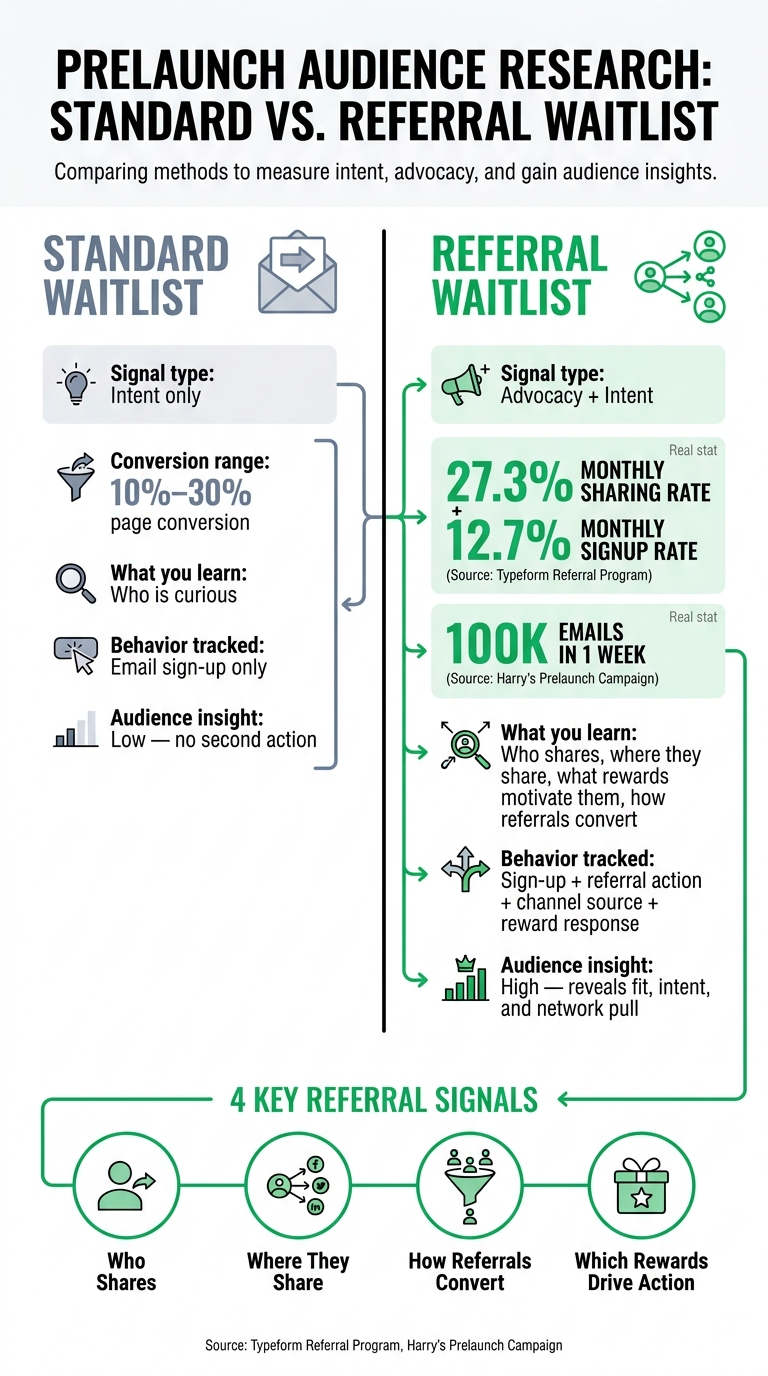
Referral Waitlist vs. Standard Waitlist: Audience Signals Compared
Referral waitlists make each signup more useful. You’re not just getting an email address - you’re seeing whether someone will take a second step and share your link. That extra action helps separate mild interest from actual demand. And that gives founders a much clearer picture of who their audience is.
Referral data points that sharpen your target audience
The most helpful signals are simple:
- who shares
- where they share
- how referrals convert
- which rewards drive action
Put together, those four signals give you a behavior-based profile of your strongest segments. They also make it easier to spot which audiences are the best fit.
Why viral waitlists work well before launch
Queue-based mechanics create urgency in a way a static form just can’t. If people know they can move up the list by referring friends, they tend to care more. That added investment matters because it gives you a cleaner signal about intent.
Harry's prelaunch campaign reached 100,000 emails in one week and showed which reward tiers different audiences found compelling. Those incentives also help show which segments care most about speed, rewards, or status.
Where Prefinery fits in
Prefinery combines a viral waitlist with customizable rewards and analytics. That helps startups see who refers the most and what those referrals say about audience fit.
Those patterns get more useful when you segment brand advocates by role, company type, and referral activity.
Practical ways to use referral data to refine your audience
Segment advocates by role, company type, and referral activity
Use referral data to tighten your ICP. A good first step is to break down your top referrers by job title, industry, and company size, then compare that with your current idea of an ideal customer profile.
For B2B SaaS, this usually means looking for patterns across SMB and enterprise accounts, technical and non-technical roles, and certain verticals. When the same role or company type keeps appearing among your most active referrers, that tells you a lot more than a long list of sign-ups. Referral activity helps you spot actual fit, not just casual interest.
After that, connect those referrers to the channels they use.
Map referral channels to audience segments
Where a referral comes from can tell you which audience segment is most engaged. Track LinkedIn, X, and niche communities separately so you can see which channels bring in high-intent advocates and which ones drive low-fit signups using a viral waiting list.
If one channel keeps attracting a certain role, industry, or company size, you get a much sharper view of which messaging and acquisition tactics are landing with that segment.
Once you see those channel patterns, the next step is to test what each segment responds to.
Test incentives to learn what different segments value
Incentives can tell you what people care about. Early access, status rewards, and credits can show whether a segment is driven by speed, recognition, or savings.
Typeform's referral program - led by Senior Product Manager Linus Hallberg - achieved a 27.3% monthly sharing rate and a 12.7% monthly signup rate, making it their most cost-effective acquisition channel. That result shows how much reward design can shape who joins in.
Run A/B tests to optimize your referral funnel with two reward types across your waitlist segments. One group may react strongly to early access, while another only moves for credits. That gap tells you those segments want different things. You can then use that insight to shape segment-specific messaging.
How to set up a referral system that produces useful audience insight
A referral system should do more than collect names. It should help you spot fit, not just interest: who signs up, who shares, and who comes back to act again. That gives you a much clearer read on which people look like strong future customers and which ones are just mildly curious.
The key is to collect only the details that help you tell high-fit groups apart from casual sign-ups.
Collect the right fields at sign-up
Keep the sign-up form short: email plus one or two high-signal fields, like role, company type, or primary goal.
On their own, those fields are useful. But they become much more telling when you pair them with referral behavior. Someone who says they're an ideal buyer is one thing. Someone who says that and shares your waitlist with others is saying a lot more with their actions.
Design referral mechanics around trackable behaviors
Treat the referral system like a fit test. It shows whether people care enough to put their reputation on the line by sharing, instead of just handing over an email. Queue-jump referrals are a strong signal because they show who is motivated enough to take that extra step.
Prefinery's no-code setup, customizable rewards, and analytics make it easier to track referral behavior and segment people fast. That gets even more useful when the system also records who each advocate is and where they came from. This is particularly effective when applying LinkedIn referral strategies to reach professional audiences.
Referral-based targeting vs. other prelaunch methods
Referral waitlists show advocacy and network value. Standard landing pages show intent only.
Conclusion: Use Referral Marketing to Define a Clearer Target Audience Before Launch
Put these signals together, and referral marketing becomes a practical way to boost product launches and figure out audience fit before launch. It gives you something stronger than instinct or survey responses because it shows advocacy, not just interest. In plain English, it shows who is willing to put their own credibility behind the product, not just join a list.
Compared with founder instinct or survey-only research, referral-driven waitlists show actual behavior instead of stated interest.
Referral data also helps teams see which advocates are most engaged and which audience segments are most likely to spread the word. For SaaS startups, that means a waitlist can do more than collect emails. It can become a source of audience insight.
If you want to get that signal without extra engineering work, it helps to use a viral marketing tool built for waitlists. Prefinery makes this practical with no-code setup, customizable rewards, and built-in analytics that help teams track referrals, segment advocates, and refine audience fit.
FAQs
Why are referrals a better signal than sign-ups?
Referrals tell you more than sign-ups because they show active validation, not just curiosity. A sign-up says your promise caught someone’s attention. A referral says that person is willing to put their name behind your product and share it with someone else. That points to higher intent and a stronger match between your product and what people want.
Referral behavior also gives you more useful insight into engagement. It helps you spot your most important advocates instead of leaning on static metrics or vanity numbers.
What signup fields should I collect?
Keep your initial signup form short if you want more people to finish it. In most cases, just asking for an email address works best. After that, add one or two qualifying questions, like:
- job role
- company size
- current tools used
- how often they deal with the problem
That gives you a bit more context without turning signup into a chore.
Prefinery lets you collect custom fields and sync them on its own. You can also gather extra details later through follow-up emails, which keeps the signup flow simple while still helping you learn more about each lead.
How do I know which channels bring the best audience?
Track signup sources and look at lead quality side by side. Use UTM parameters like utm_source=referral to tie signups back to specific channels. That way, you can see which platforms bring in the most engaged users, not just the biggest pile of signups.
Unlike other tools, Prefinery does more than show basic signup totals. It combines firmographic and behavioral data so you can spot which channels keep sending your highest-value leads.